Interesting times getting from Tanzania to Uganda. Our flight was cancelled, we found a new one via Rwanda, on the way to the airport our driver was the victim of a shakedown by dodgy police who pocketed cash in exchange for not issuing a speeding fine. But we made it. First stop, Ziwa Rhino Sanctuary.
Idi Amin’s murderous reign as President of Uganda from 1971 to 1979 not only resulted in the deaths of around 300,000 Ugandans, it decimated the country’s fragile economy. Except for a small Amin-aligned elite, the entire population was impoverished. Rural communities reverted to an effectively subsistence agricultural life.
With rhinoceros horn fetching up to $US60,000 per kilogram on the black market, and the average male’s horn weighing about 10kg, it’s not surprising that poaching exploded.
Both black and Northern white rhinos are indigenous to Uganda. As at 1970, the population numbered around 700. The last surviving one was shot by poachers in 1982, and the Ugandan rhinos were gone.
By far the major market was Asia, mainly China. There, some believe rhino horn enhances male sexual potency, and being able to afford it is a sign of wealth. What a shame those tiny minded men don’t realise that boasting of owning rhino horn doesn’t send the message “I’m rich”, so much as “I have an undersized/under performing pecker”.
In 1998, Rhino Fund Uganda was established with the goal of re-introducing white rhinos to the country. A few years later, in an area of prime suitable habitat, Captain Joseph Roy, a former pilot agreed to convert his 70 sq km ranch into a rhino haven. Ziwa Rhino Sanctuary was born.
In 2005, two male and two female white rhinos were acquired from Kenya. Another male and female were donated by, of all places, Disney Animal Kingdom in Florida, USA.
The six rhinos acclimatised well. The American female took a shine to one of the Kenyan males, and in 2006 the sanctuary’s first baby was born. They named him Obama. American mother, Kenyan father. Get it?
The long term goal is to build a sustainable population and relocate rhinos back to their original habitats in other protected parts of Uganda. But for now, Ziwa is the only place in the country where you can see them.
Protecting the rhinos against poaching is a constant challenge. A team of 78 rangers and security guards watch them in shifts, 24 hours a day.
Seeing them at all is a privilege. We were warned by the ranger who took us tracking, “the rhinos are wild, they roam free, we may only see one or two”.
The fact that they are constantly under watch by the guards means the rangers know where the various rhino groups are moving at any given time. It’s more a question of whether they are in areas accessible to trekking.
The sanctuary has a mix of swamp, grassland and woodland. “We should be able to see them in the swamp”. Great.
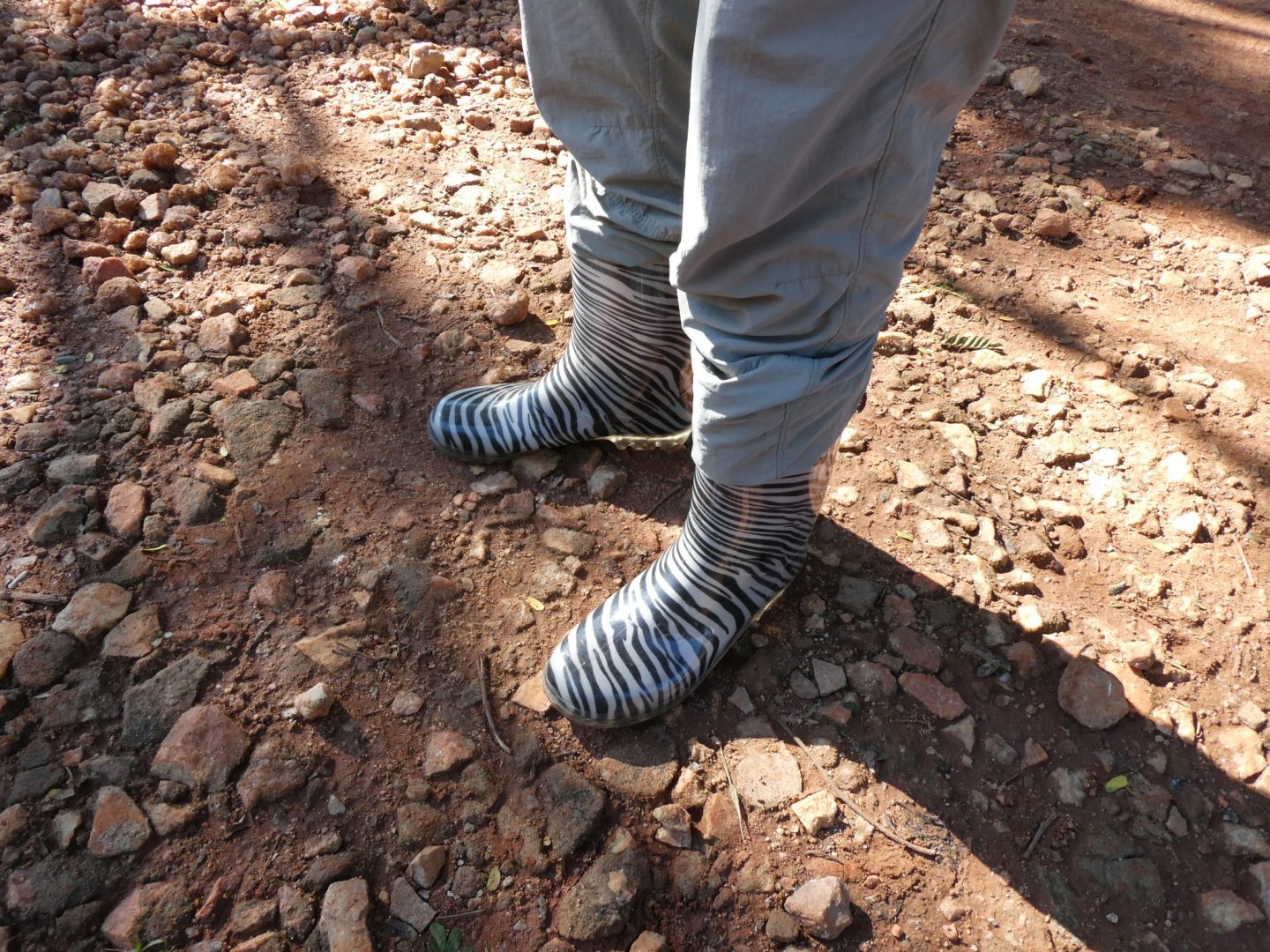
We were fitted with gum boots. John received a particularly fetching pair of zebra striped ones. The ranger joked that if you want to sneak up on a rhino, it’s good to be disguised as a zebra.
 We sloshed through the swamp for a while and then the ranger stopped abruptly. There, in the grass on the swamp edge were two adult females.
 To be honest, Julie was disappointed. They were quite well hidden. Is this all we will see?
But in retrospect, the ranger was having a lend of us. “Come”, he said, “they are moving this way”. We continued our sloshing and then across a patch of open grass we could see a couple of the security guards. That’s a sign the rhinos are close.
We waited and sure enough a rhino ambled out of the foliage.
 Followed by another and another and another.

A mother and baby appeared. Reproduction at the sanctuary has exceeded all expectations. From the original six, the population has grown to 51. They will soon need to acquire a few more outsiders to prevent an in-breeding problem.
 White rhinos are huge. Of land based animals, only the elephant has a greater body mass. The head is enormous.

And would it be unkind to comment on its behind?
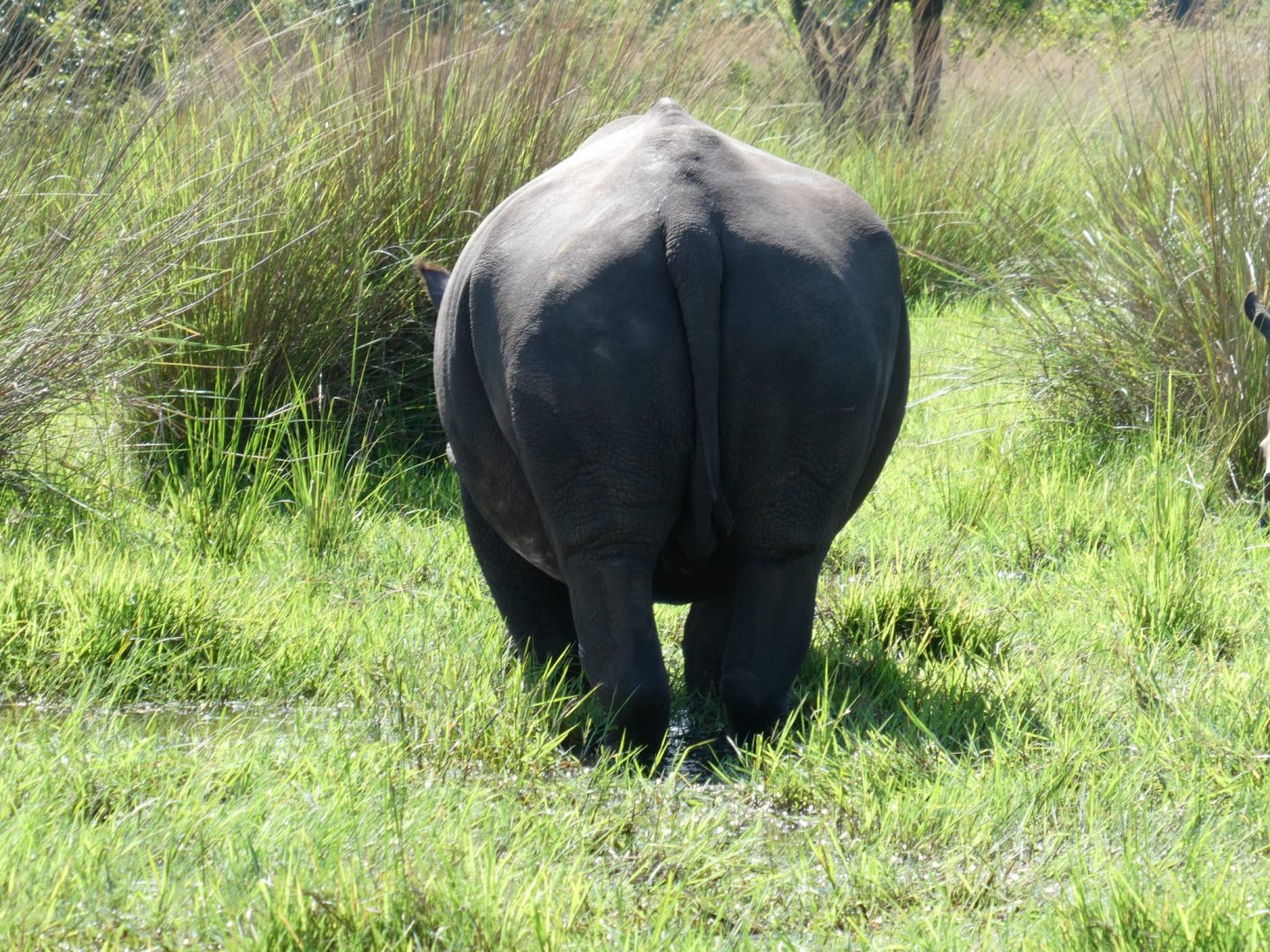
You might notice that the white rhino isn’t white. There’s a widely told story as to how the name came to be. Dutch settlers in what is now South Africa identified two species of rhinos, one with a broad square lip and one with a narrow lip.
They referred to the first as ‘wijd’, a Dutch-derived Afrikaans word meaning ‘wide’, referring to the shape of the lip. But the English misunderstood, translating the word as ‘white’ and the first scientific reports sent back to the motherland referred to a ‘white rhino’ species. Unwilling to admit their mistake, the English then called the other species the black rhino, despite the fact that the two are almost identical in colour.
The story is almost certainly untrue, but no better explanation has been nailed down, so the story has stuck.
Back in Ziwa, the group of females and the baby grazed for a while and lumbered on.

Rhinos live in groups with a single alpha male, several females and the young fathered by him. The male is never far from his harem, so the ranger was confident the male wouldn’t be far behind.
We waited only a few minutes and then he came marching out of the foliage, spraying to mark his territory like a male cat. Except, as you might imagine from an animal weighing over two tonnes, the volume was seriously impressive.

Seeing these enormous, powerful animals up so close was awesome.
We stayed at the sanctuary’s on-site lodge. You need an escort to go between your cottage and the main area after dark because the rhinos like to sleep near people and can wander through at night.
We didn’t see them, but staying here came with free entertainment from the vervets who also hang around.

 A special experience.

Love the pecker line! Great work.