It seems somehow fitting that our last post from Africa – for now – is another one dominated by cats. Spotted cats!
In prehistoric times, cheetahs roamed Europe, parts of Asia and much of Africa.
They became extinct in Europe long ago, went extinct in Asia in the 1940s save for a tiny population in central Iran, and are gone from all but 9% of their previous range in Africa.
They are listed as Vulnerable to Extinction on the IUCN Red List. And the largest remaining cheetah population in the world is here, in Namibia.
In 1991, conservation biologist Laurie Marker established the Cheetah Conservation Fund (CCF), a not-for-profit organisation aimed at protecting cheetahs who could not survive in the wild, working with local farmers to promote ‘peaceful co-existence’ and studying the genetics of cheetahs with a view to ensuring survival of the species. We visited the Fund’s reserve to see these spotted beauties.
We were taken on a drive through the reserve for a close up view of the adults who live here permanently for different reasons. In the heat of the day, they were mostly lounging under the trees.
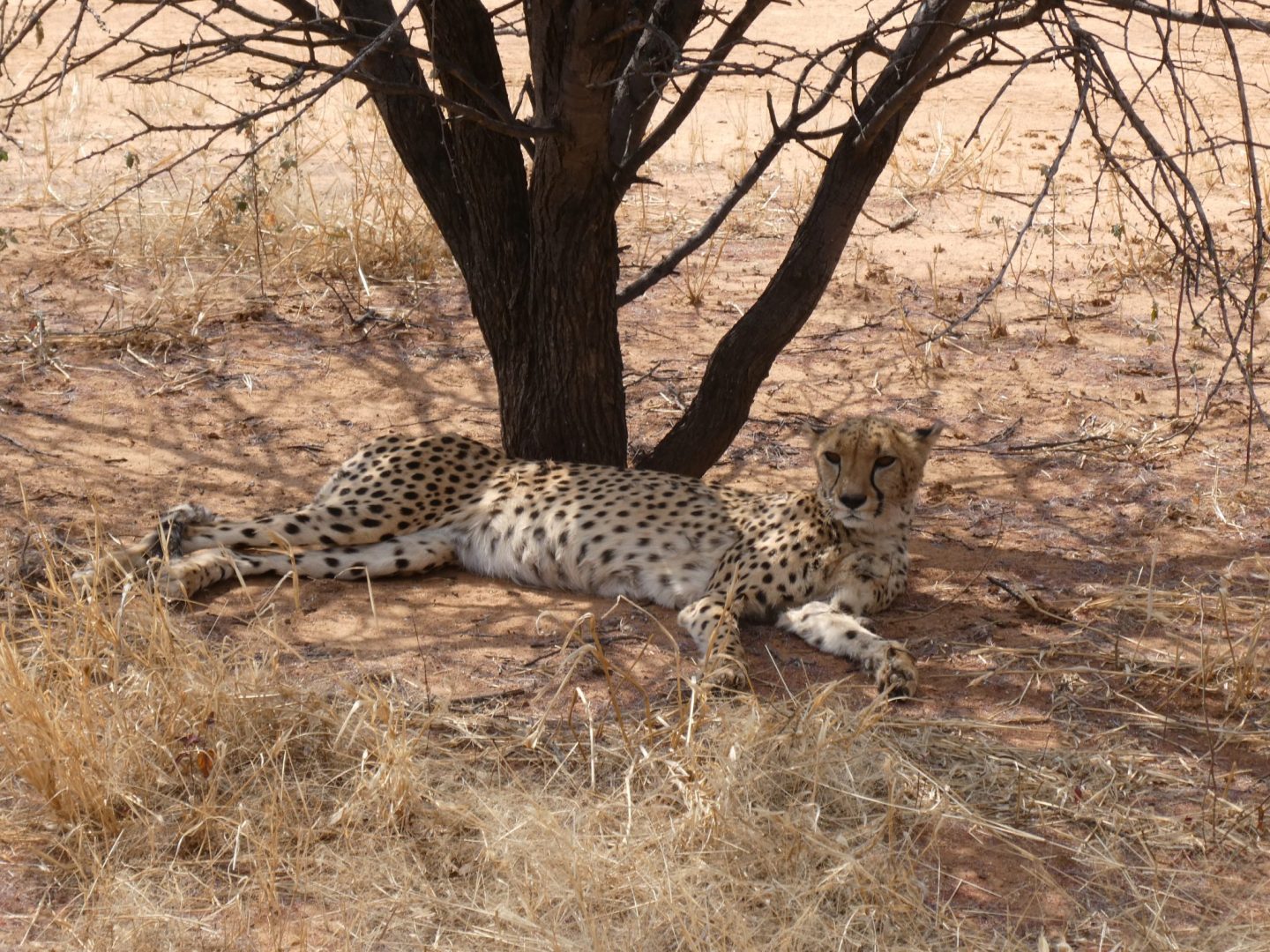

The greatest threat to cheetahs is what is euphemistically referred to as ‘human-wildlife conflict’. Basically, cheetahs are killing machines. They see something worth killing, they kill it, even if they aren’t hungry. To a cheetah, a herd of cattle isn’t a menu from which to select a choice cut, it’s that buffet you keep going back to even when you’re stuffed, because you just have to try everything. And that makes them the farmers’ greatest enemy.
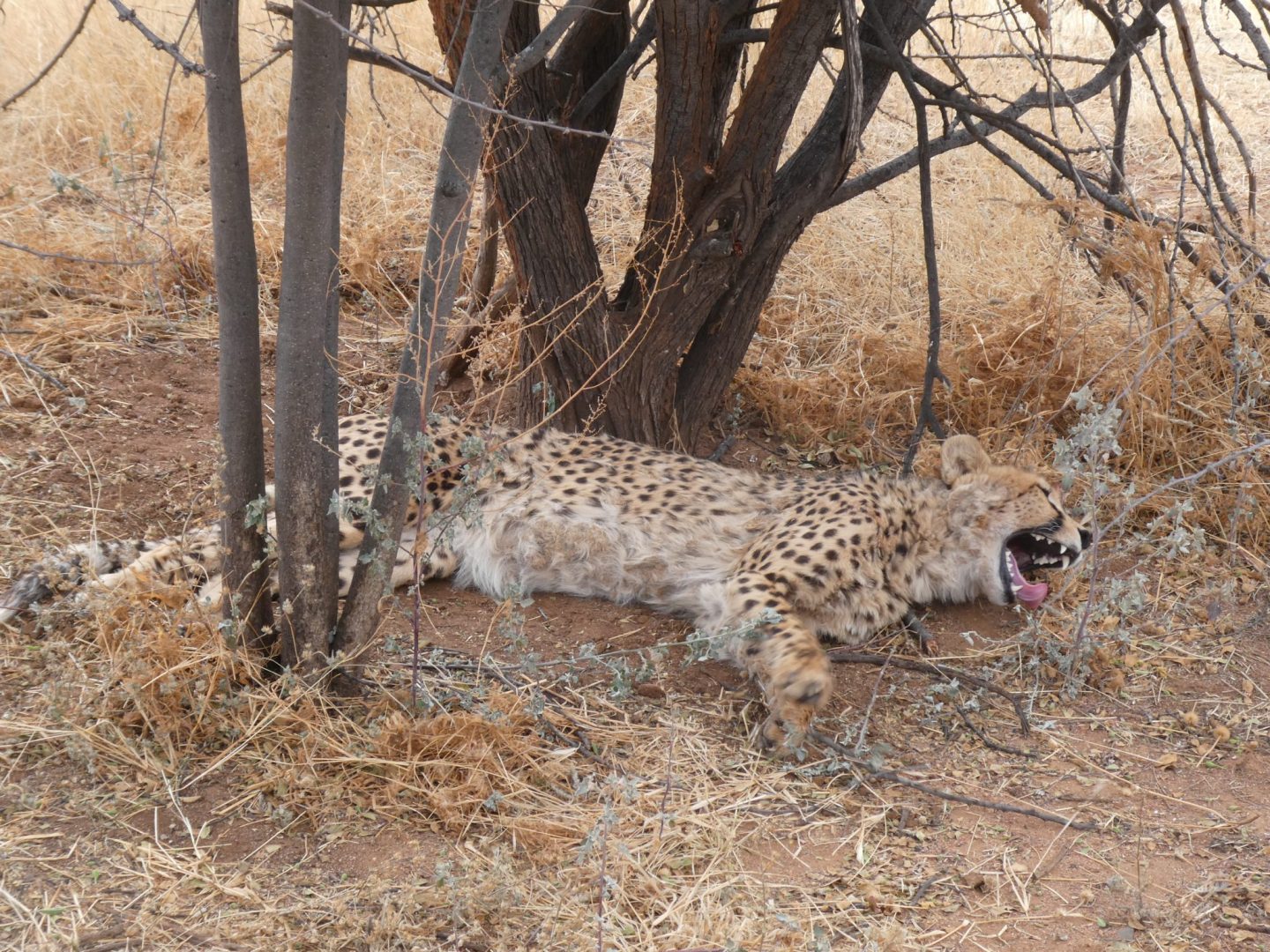
CCF will collect and manage cheetahs encroaching on human activities but one of its biggest challenges has been convincing farmers to request removal rather than just shooting a troublesome cheetah on the spot. In part that’s because it was once thought that translocation away from farming areas was the solution. It isn’t, because even if you move a cheetah hundreds of kilometres, it will find its way back. Within a short period, the livestock killing will begin again.
So instead of attempting translocation, CCF now provides a permanent home for several cheetahs who would otherwise be likely to return to their former farmland hunting grounds.

Cheetahs are the fastest land animal, capable of sprinting at up to 100kph. They have evolved for speed, with a lighter build and longer, thinner legs than other cats and a long tail which they use like a rudder to change direction while moving at high speed.

Check out the paws and claws. Fun fact: cheetahs don’t have retractable claws. This increases grip on the ground, which assists with agility at speed but means that unlike lions and leopards, they cannot climb trees.

Cheetahs hunt in the daytime and it’s thought that the distinctive black tear-shaped facial streaks running from the eyes to the mouth are to help protect their eyes from the sun’s glare.


Despite being killing machines, cheetahs are highly trainable as pets. As incredible as it sounds, a cheetah cub removed from its mother within days of birth, ie before it observes its mother’s habits and has its own killing instinct activated, can be raised like any domesticated cat. Except, of course, they eat a lot more.
It remains a status symbol with some wealthy Namibians who live on the land to have a cheetah as a pet. We don’t approve at all. It is so contrary to the natural instinct of the animal. But Julie did think it would be sooooo cool to stroll along the River Walk in Brisbane with a cheetah on a lead. Imagine the reaction from all those dogs and dog walkers!
That’s how this shy beautiful girl ended up at CCF. She was hand raised as a pet by a fellow who claimed to have found her. More likely the cub was snatched or the mother was killed to get access to the cub. All went well until as an adult she started shredding things in the house. Just like a bored domestic cat, and then when his attempts to ‘discipline’ her failed, he decided to get rid of her. Thankfully, she ended up here.
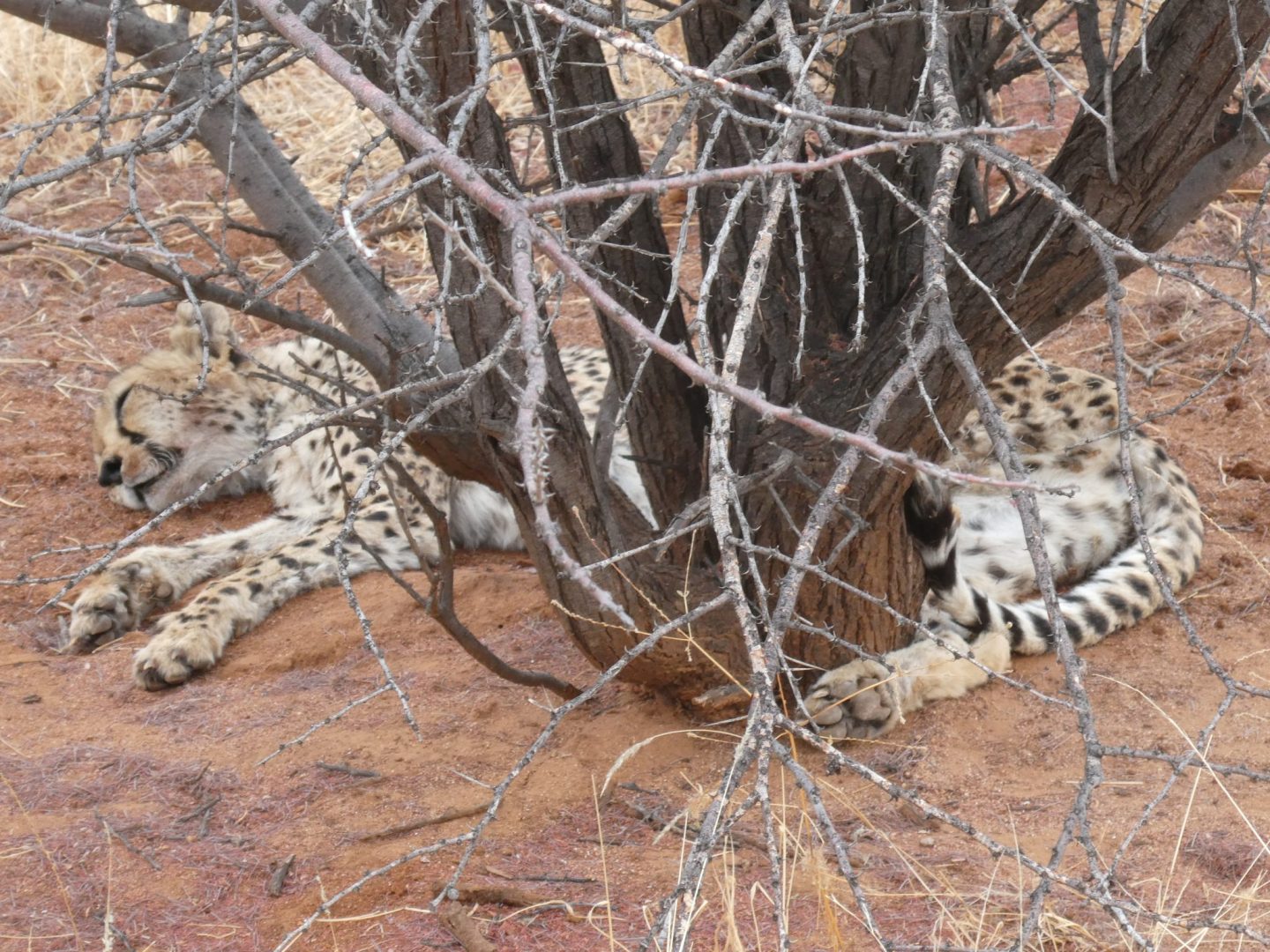
We visited CCF on our way to Okonjima, a private reserve famous for its population of leopards and the home of the Africat Foundation.
Africat was established around the same time as CCF and initially focussed on caring for injured, rescued and abandoned cheetahs with a view to releasing them to roam within the Okonjima reserve. But lions and leopards kill cheetahs, either to steal an animal the cheetah has felled or to reduce competition for prey. There are no lions at Okonjima but plenty of leopards. This led to an unforeseen but unfortunate situation.
Cheetahs and leopards can co-exist in the wild if there is enough food and a large enough area for overlapping home ranges, but the leopards didn’t think that was the case at Okonjima. Some years after the program began, studies confirmed that all of the cheetahs Africat ‘rehabilitated’ into the reserve were dead within two years, a few from disease but most from predation by leopards.
Africat pivoted to the study of leopards, leaving CCF to tend to the cheetahs. Aside from a remaining three who won’t be released from the Africat facility for obvious reasons, there are no cheetahs at Okonjima now, but it’s the place in Namibia with the highest likelihood of seeing leopards in the wild.
Africat is conducting long term studies at Okonjima with a view to developing ‘best practice’ guidelines for sustainable management of leopards in reserves and national parks. And guests have the opportunity to go game driving to spot them.
It’s tricky. They roam far and wide, and most are shy. But a select few are tracked and guides can identify at least the general area where these are. Our guide did a stellar job finding this young female which we then had the opportunity to watch as she prowled.
We first spotted her coming out of the scrublands.

 We followed her at a distance for a while. She climbed onto a termite mound and scanned the area.

She spied some giraffes. And they saw her.
 She slunk closer to have a better look.
 A leopard can kill a baby giraffe, but with its mother on alert, it’s a big ask. This mother was well and truly on alert, placing herself between the baby and the leopard.
 And just out of shot, other giraffes were circling the wagons. It was way too hard. The leopard stole away, continuing her hunt further afield.
A brilliant sighting. And on our way back, we found her brother basking on another termite mound.
 It was our last day at Okonjima, and our last day in Africa. There was time for one more, extra special and totally unique experience. Okonjima is one of a very few places where you have some chance of seeing pangolins.
This elusive creature has been the subject of surprisingly little formal study. Little is known about things as basic as how widely it forages, how it establishes a home range, food preferences and its capacity to adapt to environmental change. Africat is engaged in a long term research study on the pangolins at Okonjima, and if you stay two or more nights here, you can join a researcher on a night time observation exercise.
When Julie signed us up for this, she thought it was a dusk activity. But on the day, we were told that it depends on the pangolins. They emerge from their burrows any time between dusk and midnight. Or maybe not at all. We were told to be on standby for any time up to 11pm. If they don’t emerge by then, or the researcher can’t find them in the dark, the activity doesn’t proceed.
We had dinner. We read books for a while. Time passed. Around 9pm John said, “If you wanted to see pangolins, why didn’t we just go to the Wuhan wet market?”
At 10.45pm, there was a knock on our door. The researcher had radio-ed in. A pangolin had emerged. We and four others were driven into the same area where we’d observed the leopards. We were led into the bush and instructed ‘not to allow any distance between each person because leopards hunt at night’. Yes, of course they do.
Anyway, no leopards but one pangolin. They are so shy, they will instantly curl into a ball at the slightest disturbance. We stood frozen while the researcher shone a red light on the pangolin, making it visible but not alarming it. It shuffled around nosing out insects. What an extraordinary creature.

 The pictures aren’t much, but it was one of the most unique and utterly absorbing experiences we’ve ever had. Worth waiting up till midnight for. And an amazing end to our African adventure.

Loved the cheetah post – such a conflict keeping them in a reserve to avoid their desire to dine on a buffet of farmer’s stock. Pangolins are as you say unique – thanks you introducing me to their existence x
Brilliant – fun fact – Cheetahs have evolved to climb trees in the Serengeti – we have the photos! But have absolutely love the series on Africa. Hope you are coming back at Christmas. Take care out there. Cheers, Alison
Author
I didn’t know that! Thanks and yes, we will catch up at Christmas.
Brilliant end to your African Adventure. Leopards are so athletic. Watching them hunting really highlights this. And then cheetahs are so delicate and refined looking. A true contrast. Ah, but I must remember the kill for the sake of killing bit 🤣
What a privilege to watch the pangolin. Definitely worth waiting up for, and safer than Wuhan 😳