Etosha is a Europeanisation of a local word, ‘etotha’ meaning ‘place without plants’. It’s sometimes translated as ‘place of emptiness’ but Etosha is anything but empty. It has some of the highest wildlife densities of any semi-arid area on the planet.
At almost 23,000 sq km, it’s one of the largest national parks in Africa.
The Park is named after its centrepiece, the Etosha Pan, a 4,700 sq km saline pan so distinctive in the bare landscape, it is visible from space. It is the parched remnant of an enormous prehistoric lake. In times of heavy rainfall in southern Angola, water makes its way there but evaporates within months, so most of the time it’s a bare expanse of white chalky dust.
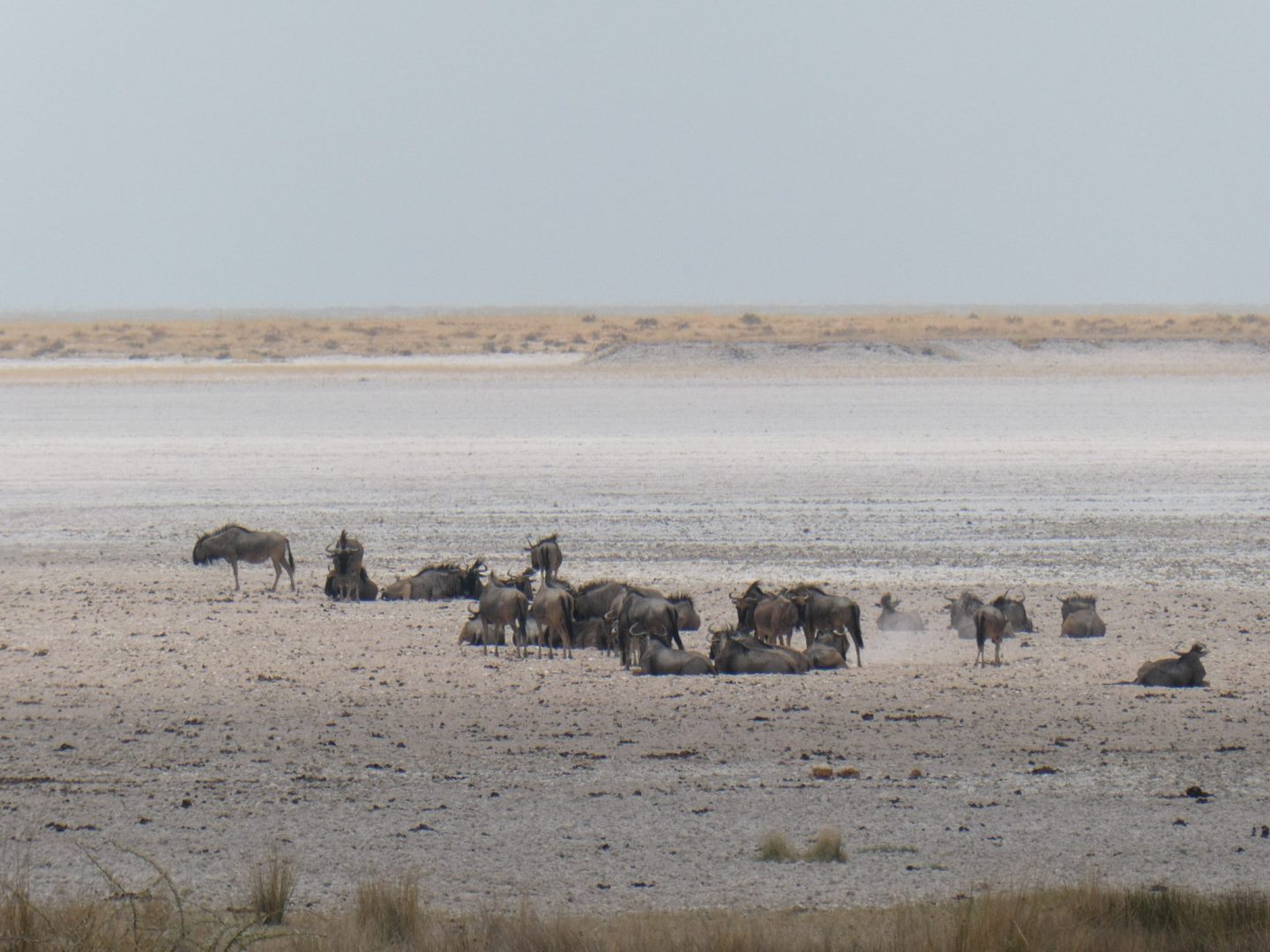
Along the southern edge, water seeping through subterranean porous rock feeds waterholes, some permanent, some seasonal and some created by the National Park Authority. It’s rather cool watching the processions of animals heading toward them.


The waterholes are essential to the survival of the Park’s wildlife and it’s here you see animals congregating in large numbers.


And the waterholes are where the action is. Check this one out. Springboks, zebras, ostriches and oryx are here for the water, with hyenas and jackals scavenging from a recently dead beast.

As we watched, they all started getting twitchy. The zebras and ostriches fled. Most of the springboks bolted. Even the hyenas grabbed chunks of booty and started skulking away.

Why? Out of the grass, a lion emerged.

That cleared the area, but she was only after a drink.

When she finished, she walked toward where we were parked and it became obvious why she wasn’t interested in the other animals. The blood on her face and chest, and her distended belly were clear signs she’d recently had a massive feed. Now we knew who was responsible for that carcass the hyenas and jackals were chomping on.
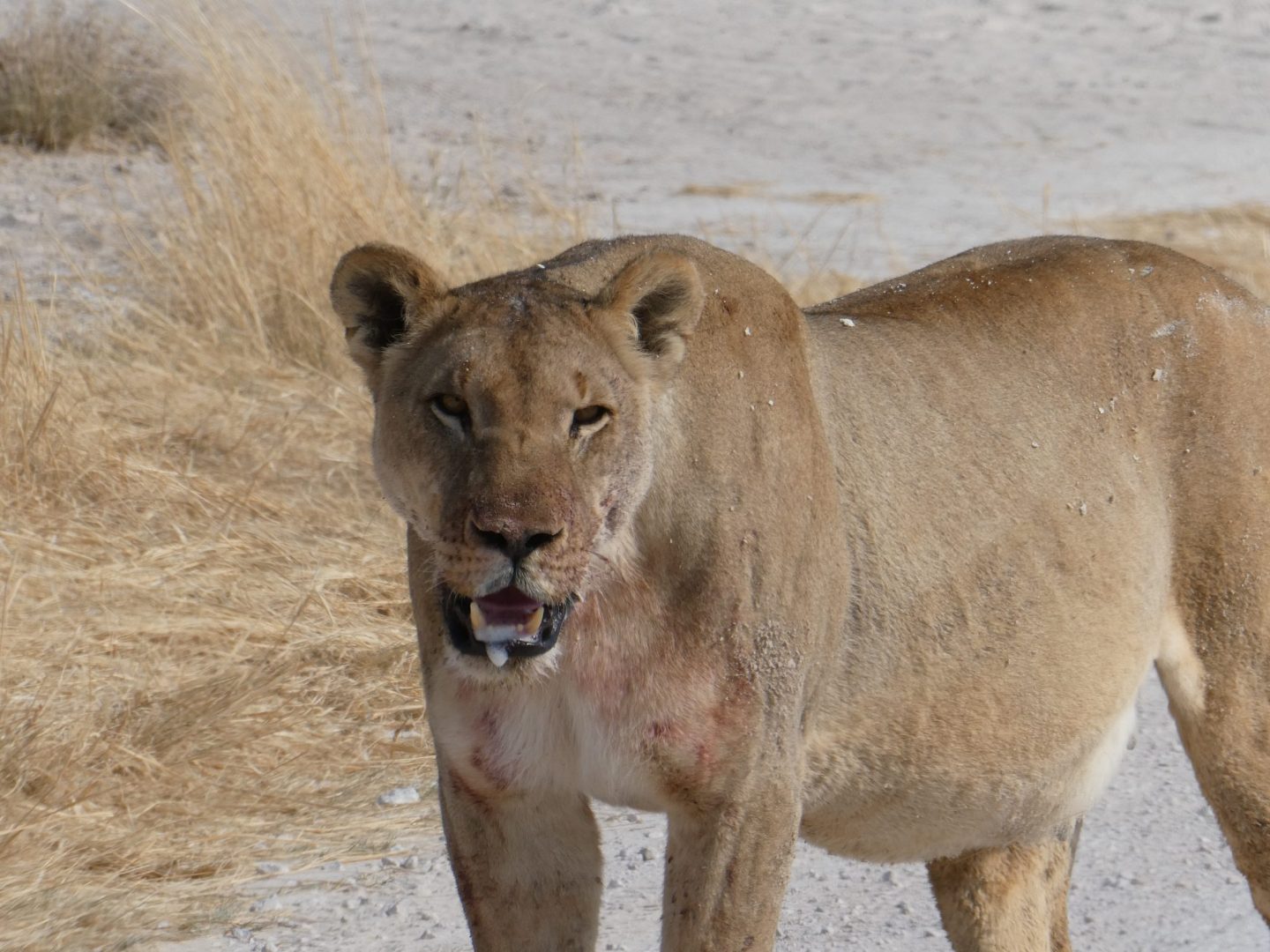
She loped away to find a shady place to sleep through the heat of the day.

The antelopes and zebras were still keeping their distance. After a few minutes, the reason became clear. There were two more lions in the grass, the brother and sister of the one who’d already left. Like their sibling, they were preparing to leave for their daytime sleeping place.


A few of the bolder hyenas and jackals had returned, unwilling to give up on a prime carcass, but they were keeping a watchful eye as the female lion strode toward the water.


The blood on the lions showed that like the first one, they’d eaten their fill. They weren’t after the carcass but as a matter of instinct the sister seemed to feel obliged to chase the hyenas.

She went for a drink while the brother waited. Then it looked like he was laughing at her doing a tiny poop.

She responded, jumping on him to annoy him.


Until he got sick of it and growled at her, signalling ‘enough!’.

And they took off together.

Brilliant!
There’s lots of small creatures to see, too. As the name suggests, the Etosha agama is native to and found only in Etosha.

Not as striking as the Namib rock agamas we saw sunning themselves around Twyfelfontein in Damaraland.

The southern yellow billed hornbill is found throughout southern Africa, nicknamed the ‘African flying banana’ for its bright yellow beak.

They look comical but their mating behaviour is shocking. The male seals the female inside the hollow cavity of a tree using a blend of mud, droppings, and natural debris, leaving only a narrow slit. She lays her eggs, sheds all her flying feathers to create a soft environment for the chicks, and remains sealed inside in the dark for about 50 days. The male pokes food through the slit each day and only once the chicks are fledglings is she able to break free. Ornithologists call it a ‘cooperative breeding strategy’. The Taliban call it ‘model family life’. We’d call the police.
And when she’s not locked away, like all monogamous species, they can have the occasional domestic!

Crowned lapwings, on the other hand, lay their eggs in the clay, and the males share egg minding duty when it’s hot.

Back to the big guys. At another waterhole, the animals were watching the horizon but not showing fear.

Slowly, two of the famed ghost elephants of Etosha appeared. Far away, but striding majestically toward the waterhole.

Elephants bathe themselves in dust or mud to cool down and to remove parasites. The elephants of Etosha are no different, but the pale clay and calcite dust of the pan makes them appear almost white. Such is their celebrity, some people come here solely to see and photograph them.
Eventually they passed within metres of where we were watching.


We spent a day in Etosha with Tuly, our guide from Ongava, then a second day self-driving through the Park en route to a lodge just outside the opposite end. On our second day, we were lucky enough to see more of these awesome giants. This one was standing absolutely still on the edge of the pan after coating himself. From a distance, it looked like some grotesque art installation, but when we got close, yes he was real.

And then we saw several others nearby.


Tuly had given us some pointers on how to find lions. Basically, park near a waterhole and watch. If the animals don’t want to go near the water, there’s a lion. If they are near the water but all looking off in the same direction, most likely one is on its way. We were quietly chuffed with ourselves when that strategy resulted in success. These giraffes and zebras just didn’t seem to want to come close to the water.

We scanned and scanned but couldn’t be sure. Is that a rock near the grass?

We re-positioned slightly and waited. Then the rock rolled over. Not a rock, after all.

At the very last waterhole we saw what may have been the cutest thing we caught on film in Etosha. A giraffe’s neck isn’t long enough to reach the ground from a standing position, so they splay their front legs to drink.

They are quite vulnerable in that position because it’s ungainly to move, so they tend to be quite picky about where and when. Most only drink once every few days – not surprising when it’s this difficult! So the last thing they need is for spectators to arrive, especially ones that show off how effortlessly they can drink.

And then at Onguma, the private reserve where we stayed that night, a final lion treat. Eleven – let me say that again, eleven – lions relaxing. Four adult females and seven cubs of various ages.
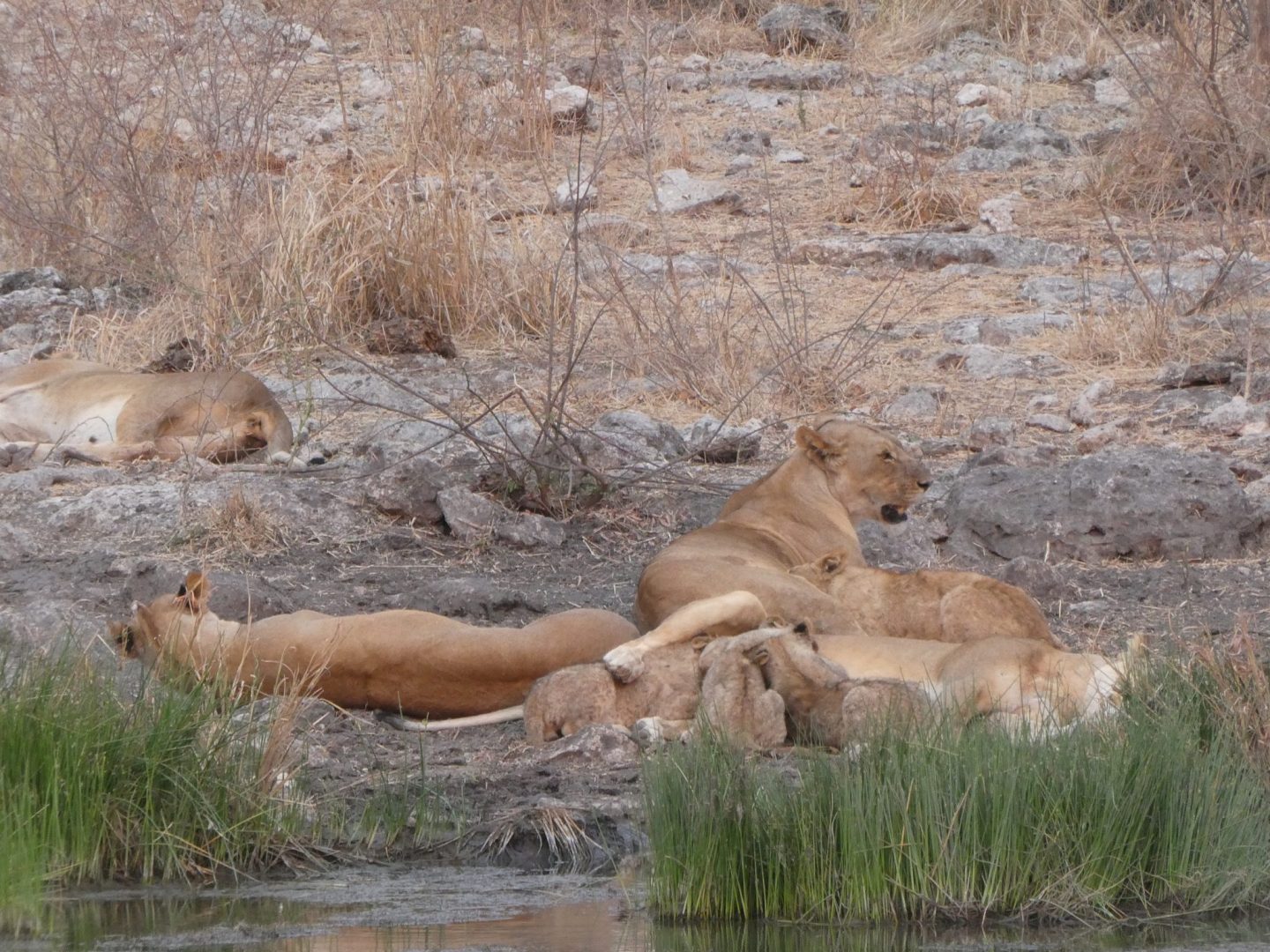


Fabulous!

Seriously amazing
oh I so want a giraffe ! Please bring one home…we can keep them out the back of BP !!! The drinking pic is gorgeous. Hope all is well X