From Gdansk we needed to start heading south. Looking for a suitable next stop, we found Torun. A medieval city undamaged by war and famous for gingerbread. Sounded good.
Torun is one of the oldest cities in Poland, first settled in the 8th century. The Teutonic Knights ruled the area for 200 years until the mid 1400s when the local populace grew indignant at the Knights’ taxes and exploitation. They stormed the castle, routed the Knights and dismantled the fortifications brick by brick.
The remnants were neglected and eventually covered over until being excavated, cleaned up and opened as a museum in the mid 1960s.

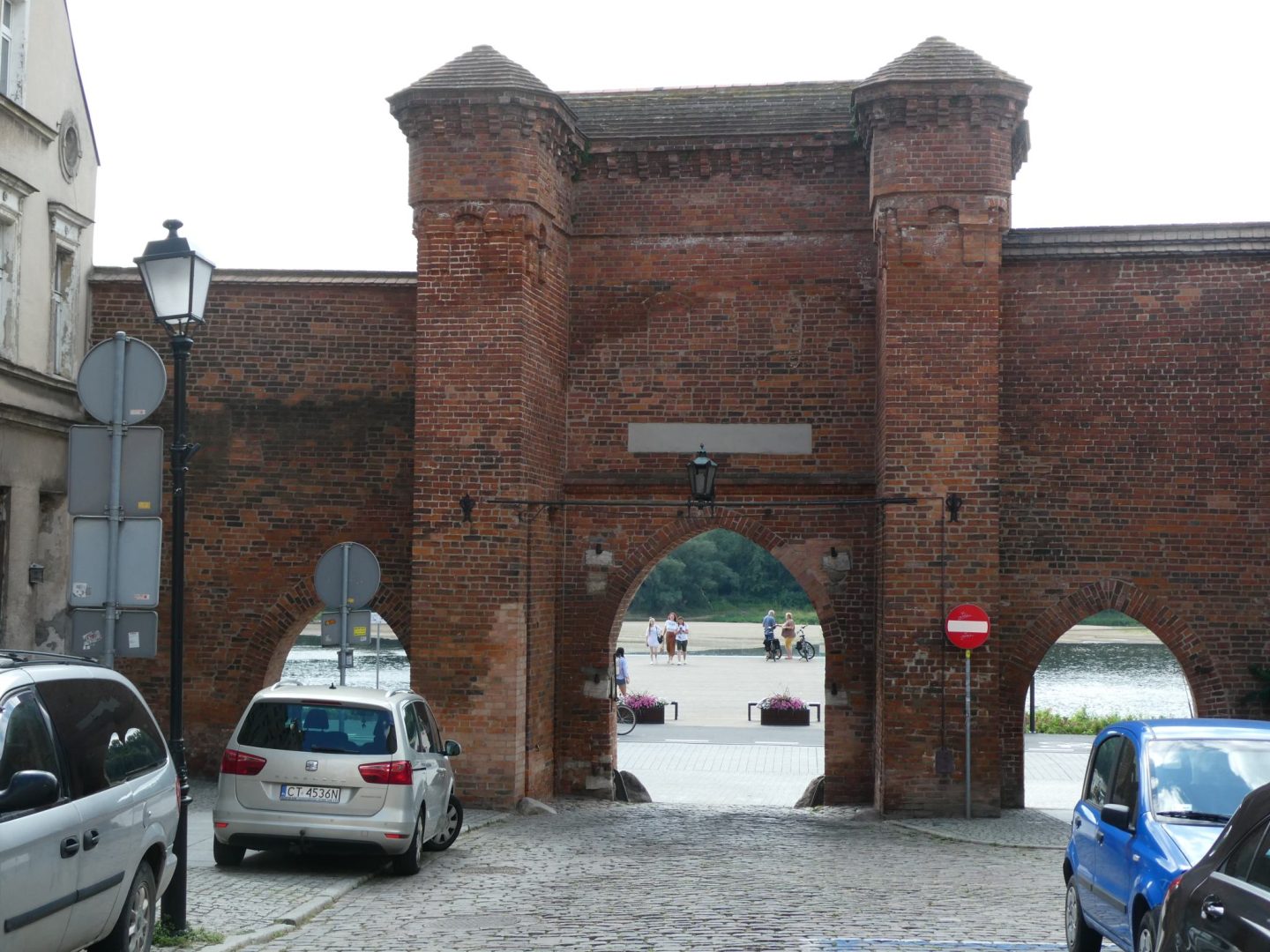
In the Knights’ era, the city was surrounded by a double set of brick walls punctuated by defensive towers. Most are gone but the three gates and nine towers which remain have been restored.

The top of the Leaning Tower is displaced 1.5 metres from where it would be if properly vertical. A local proudly told us it has a greater angle of lean than that famous one in Pisa.
The scientific explanation is that it was built on unstable, sandy soil which gradually subsided. The romantic explanation concerns a Teutonic Knight caught engaging in an illicit relationship with a local merchant’s daughter. His penance was to build a tilted tower, a metaphor for his breach of the Knights’ vow of chastity. Legend has it that those who have sinned are not able to maintain their balance under the tower. That’s all of us, isn’t it?

Although occupied by the Germans during WWII, Torun suffered no bombing or street battles. It emerged from the war intact.
In 1997 the old part of the town achieved UNESCO World Heritage listing for its concentration of intact Middle Ages Gothic architecture. All are intact originals, not post-war reconstructions.


Napoleon Bonaparte stayed in what is now the Postal Building for four nights in June 1812 on his way to getting his butt kicked by the Russians in the campaign that shattered the myth of his invincibility. And by decimating his army, ultimately ended his power when he was defeated at Waterloo three years later.

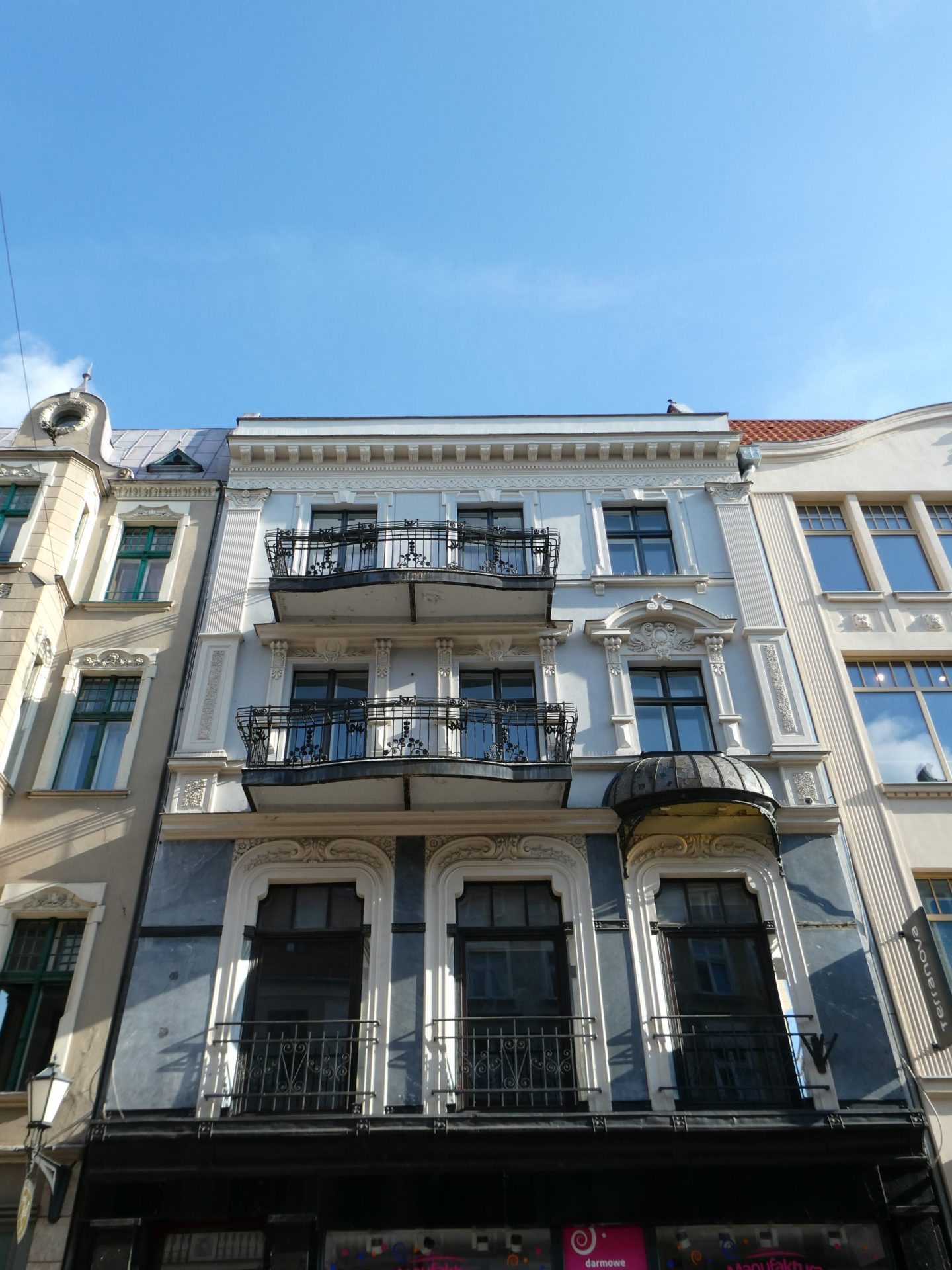
And the architecture isn’t just Gothic. There’s some lovely later era buildings as well.


The bronze donkey on the edge of the central square gets lots of attention. Irreverently he’s been dubbed ‘brass ass’. He’s a copy of a wooden donkey which stood on this corner in medieval times as an instrument of punishment. A sharp metal strip was attached to the donkey’s back. Convicted criminals were required to sit astride the donkey. According to the seriousness of the crime, extra weights were attached to the criminal’s legs. Yikes!

Nicolaus Copernicus was born in Torun in 1473. You can visit his birth house, now a museum.

The university and one of the local gingerbread companies are also named after him. And of course there’s a statue of him in the square. Erected in 1766 it is the oldest Copernicus monument in the world. The inscription translates to “He moved the Earth, and stopped the Sun and the Sky”.

Nearby is the Rafter’s Monument, also known as the Frog Fountain. According to legend, a witch who had been expelled from Torun cursed the city with a plague of frogs. People tried everything to get rid of them but still they kept multiplying. Then a rafter happened along, playing an out of tune violin. The frogs seemed to like the tinny music and started to gather around him. He led them Pied Piper style out of town to the wetlands beyond. He received a rich reward and, like all fairytale heroes, the hand of the local princess in marriage.


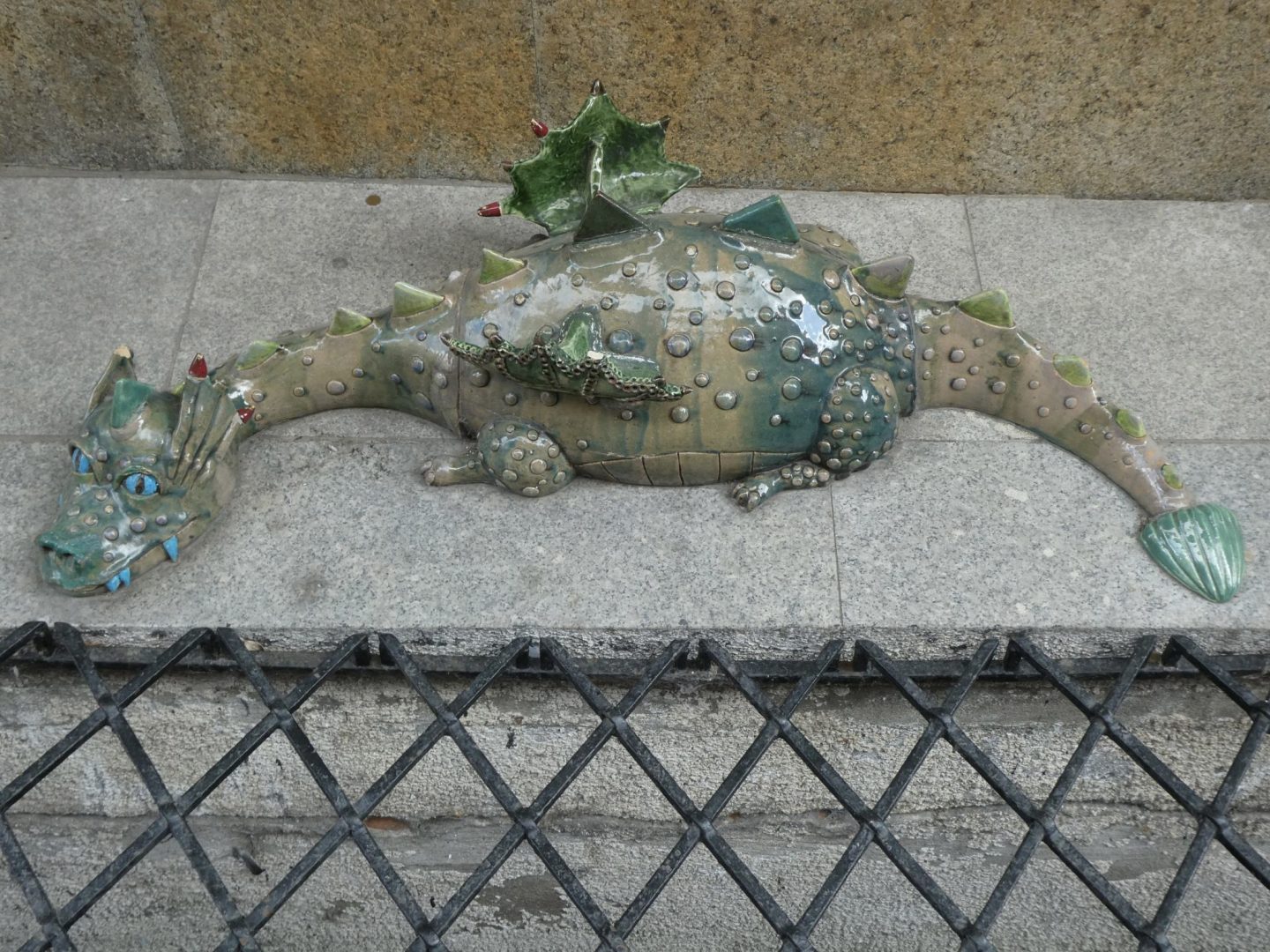
On 13 August 1746, a master carpenter and the wife of a local soldier reported seeing a two metre long dragon flying toward the castle. Sounds to us like a story to deflect questions about why they might have been in each other’s company. If so, it worked. The dragon became part of the town’s history. What happened to the eye witnesses did not.
The ceramic of Smok Torunski which hides down one of the side lanes in the old town isn’t exactly ferocious.
Another cutie is Filus. Renowned Polish cartoonist Zbigniew Lengren attended university in Torun. He was best known for a strip featuring Professor Filutek and his dog Filus which appeared in a Krakow weekly for over 50 years. The cartoon was much loved, bringing humour and levity during the dark years of Communism.
Lengren died in 2003 and the statue was erected in his memory in 2005. Filus waits faithfully, holding the Professor’s hat and minding his umbrella. There’s a superstition that stroking his ears brings good luck in life, stroking his tail brings good luck in love.

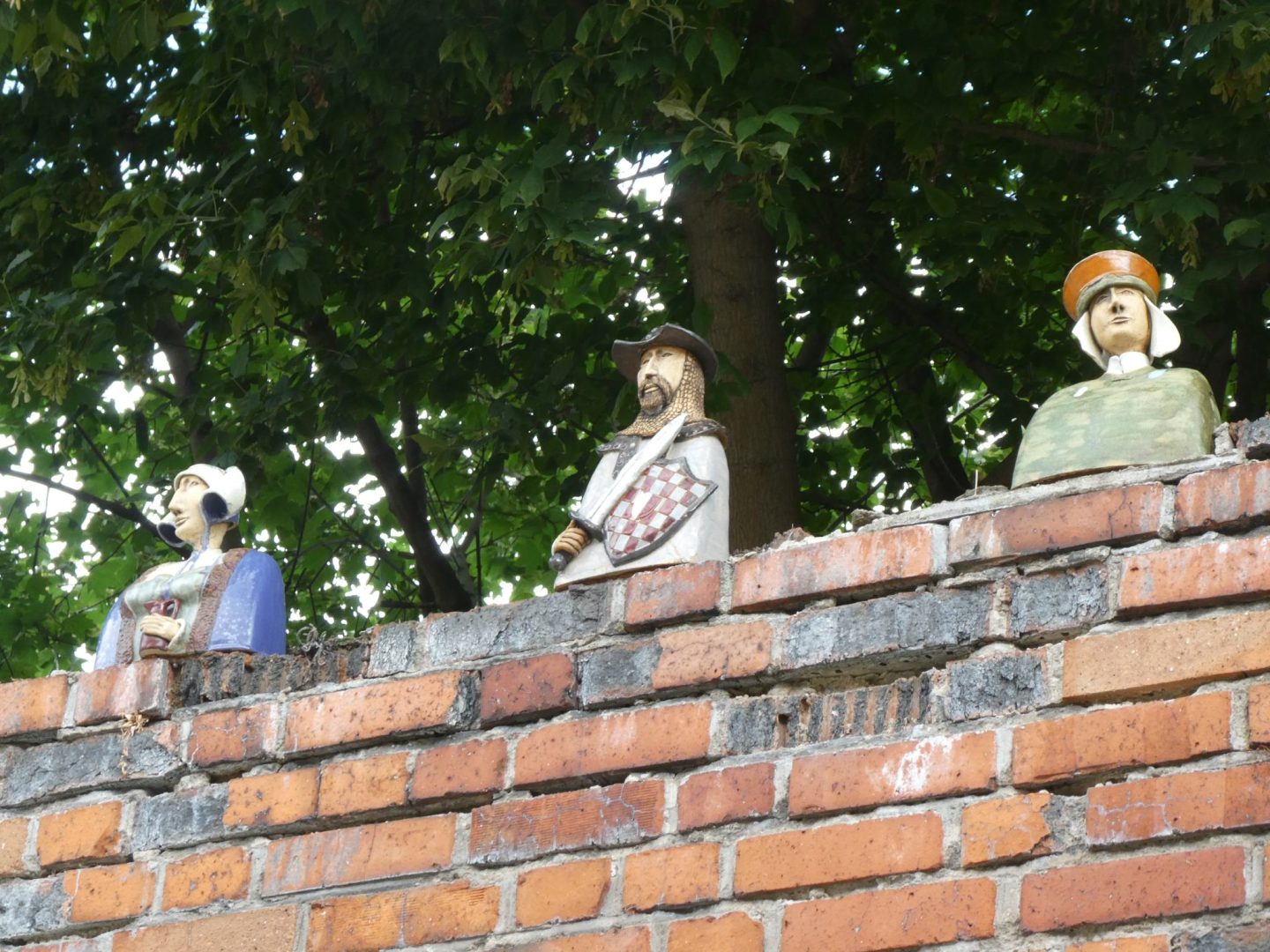
Tucked into and on top of the walls along Podmuna Street are these cute ceramic figurines. They are styled on townspeople depicted in a medieval painting known as the Torun Passion in one of the city’s many churches.


It’s always good to look up in towns like this. We saw this cat stalking a bird on a roof.
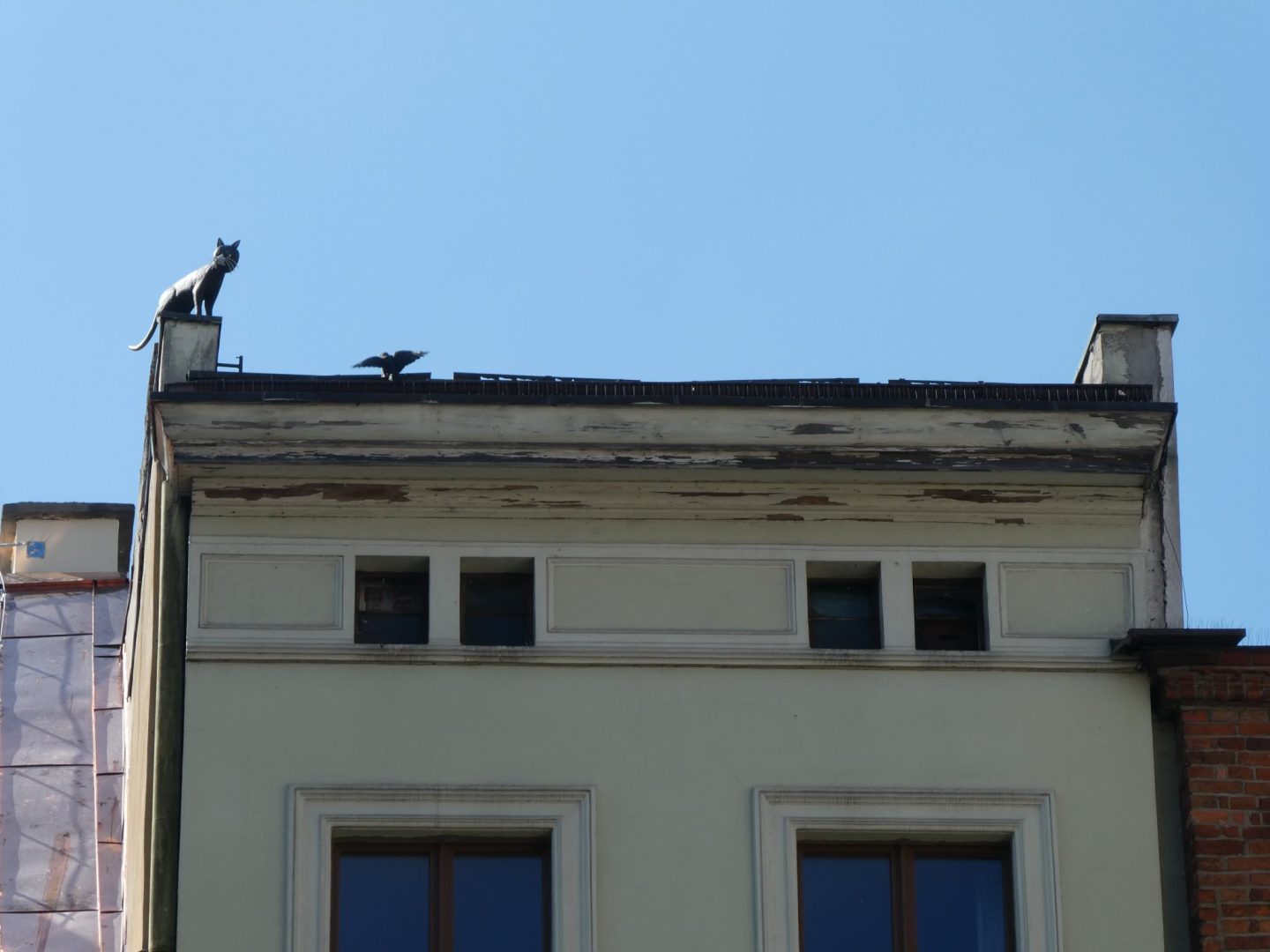
But look closer. Real bird, bronze cat.

Prior to WWII the Polish Navy had a training academy in Torun. One officer who believed his training here was the reason he survived the war was so grateful he gave the city a gift. A bursary for poor but worthy students? No. A contribution to a building fund? No.
His gift? A defused sea mine.

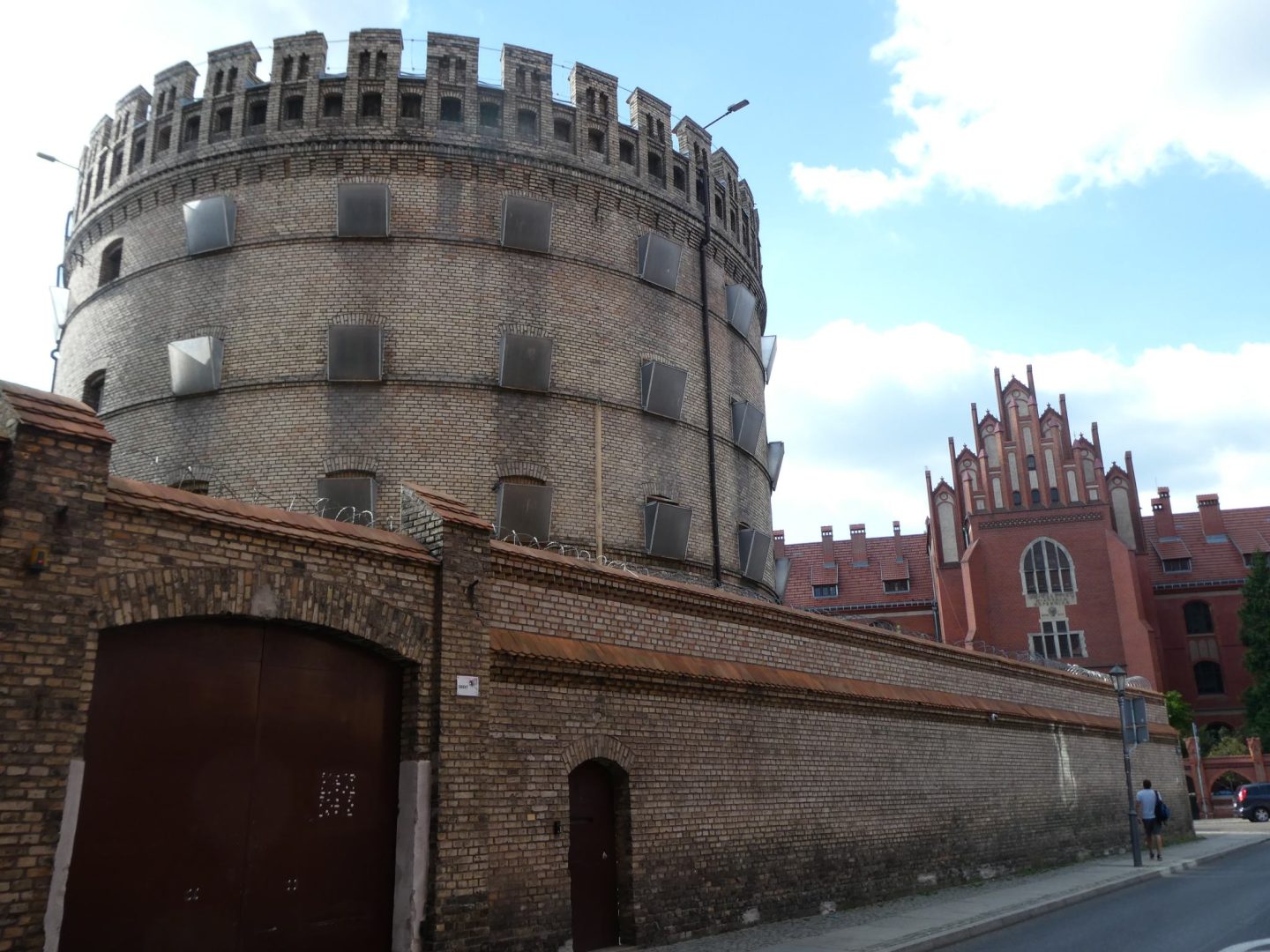
Torun has been, at various times, Catholic, Lutheran and Protestant as well as having a Jesuit order and several monasteries. This might explain the number of monumental churches, far more than you would think necessary for a town of its size back then.
Most of them aren’t particularly spectacular. Plain was the order of the day in Gothic times. But they are all really …. big.

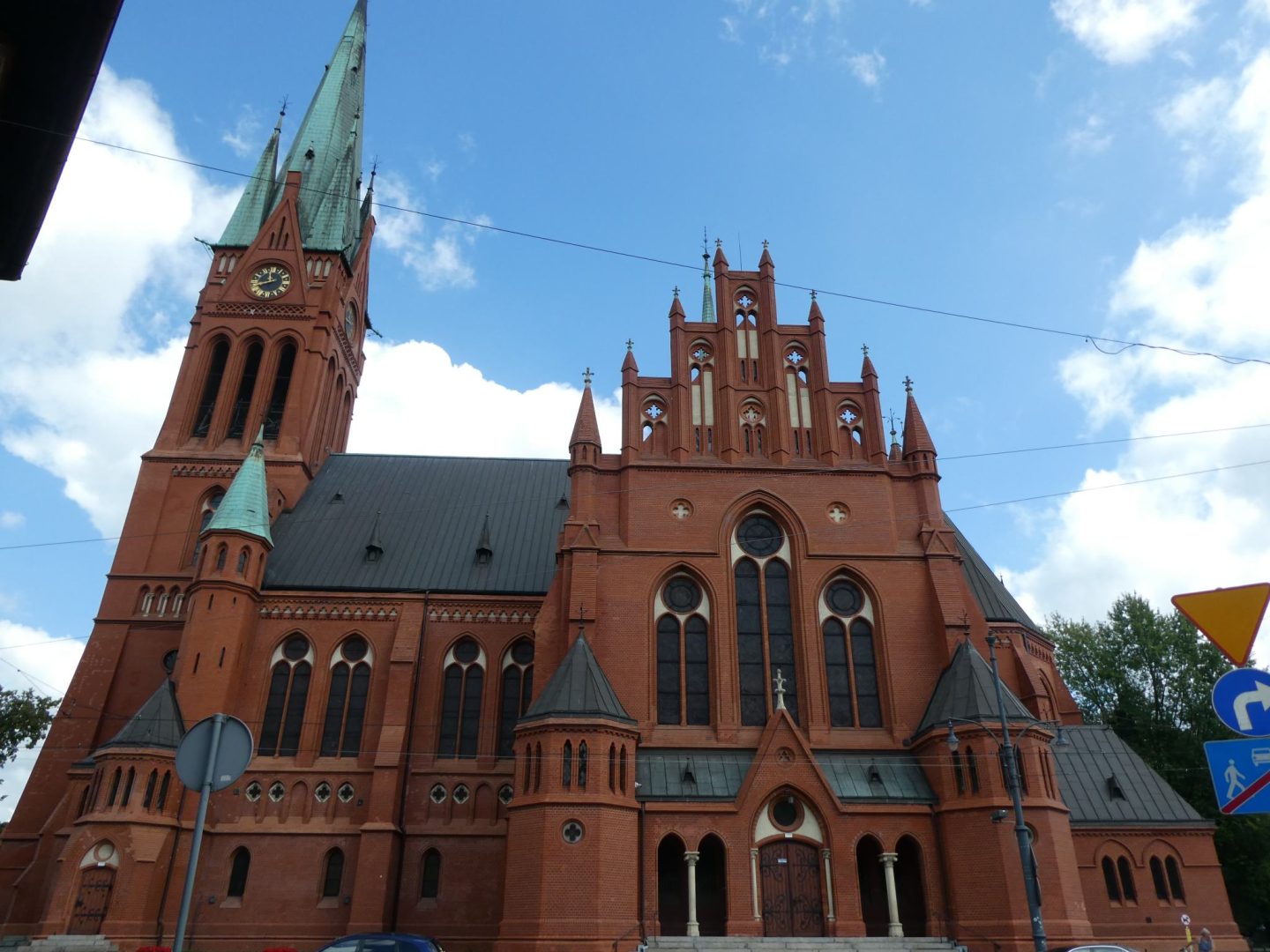

In 1787, English philosopher Jeremy Bentham came up with the idea of a circular prison. Cells would have bars instead of internal doors and guards could watch all the prisoners at once from a central internal guard tower. He called it a panopticon from the Greek words ‘pan’ meaning ‘all’ and ‘opticos’ meaning ‘to see’. He was unable to convince the Brits, but a few were built elsewhere, including this one in Torun completed in 1866. Its official name is Okraglak (rotunda) but locals call it the Beehive.
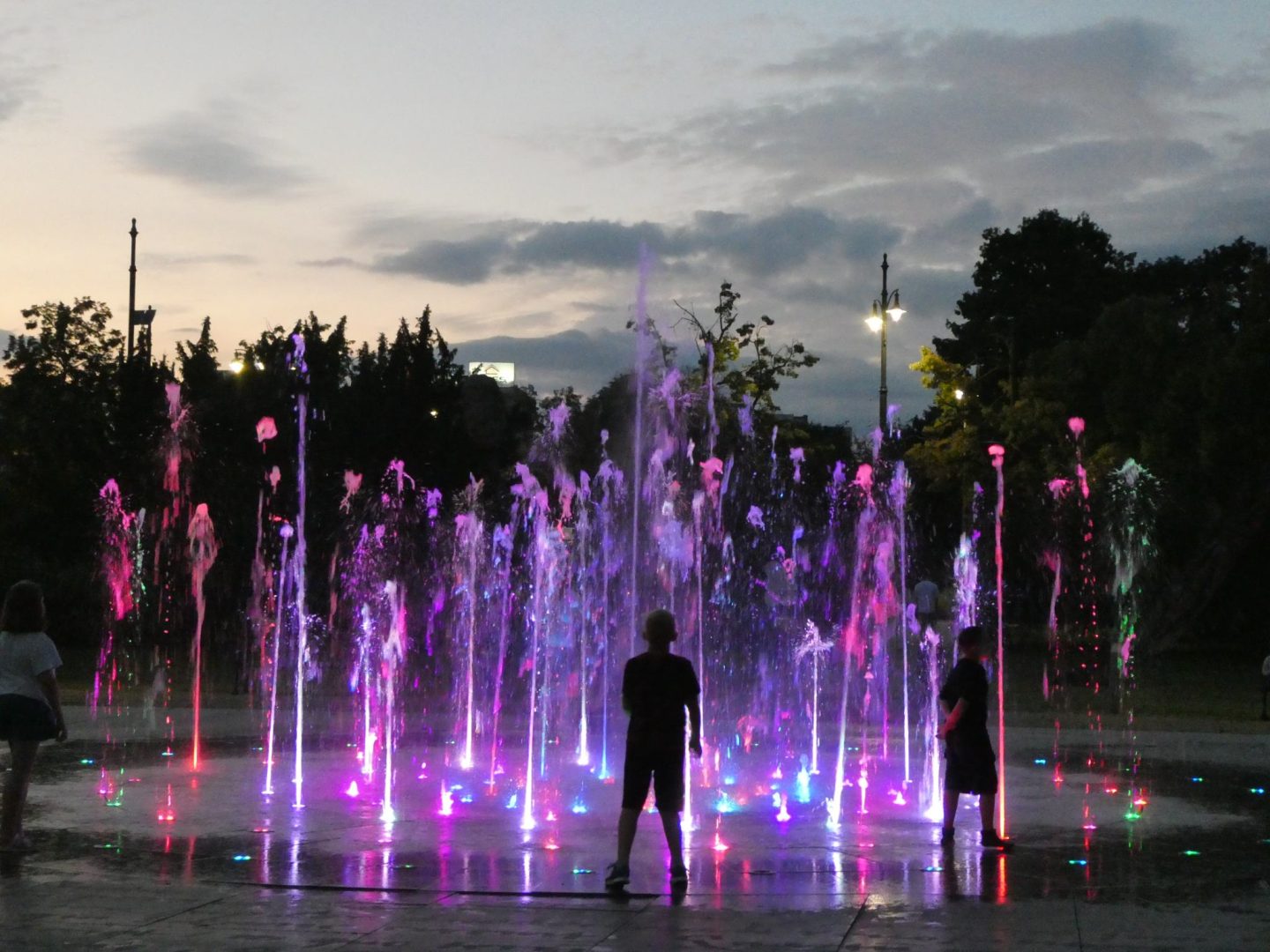
Torun has a fountain with co-ordinated lights and music at night. It was all classical music, so not as lively as the fountain with contemporary rock hits in Kosice, but kids loved it anyway.

And then there’s the gingerbread.
Torun gingerbread has been famous in Poland and throughout Europe since the Middle Ages. Rich local soils produced fine quality wheat flour, local villages made excellent honey, and bakers had access to cinnamon, cardamon and other spices from India brought by German traders plying routes from the Black Sea to Central Europe.
17th century poet Fryderyk Hoffman claimed the four best things in Poland were “the vodka of Gdansk, the gingerbread of Torun, the ladies of Krakow, the shoes of Warsaw”.
Chopin visited Torun at age 15. In a letter to a friend, he stated “what made the greatest impression on me was the gingerbread”. And after banging on at length about Copernicus, the city fortifications, the Leaning Tower and the Teutonic Knights, he added “yet all of this does not compare to the gingerbread”.
Little wonder locals are very proud of it. It is in the form of biscuits, but softer than classic gingerbread men. We prefer the bread-like gingerbread invented in Gertwiller in the Alsace region of France, but the biscuits aren’t at all bad.
There are still two gingerbread manufacturers based in Torun and one of them has a museum which charts the history of gingerbread making in the city, how it’s made and even has gingerbread making classes. It has a beautiful display of ancient gingerbread moulds.
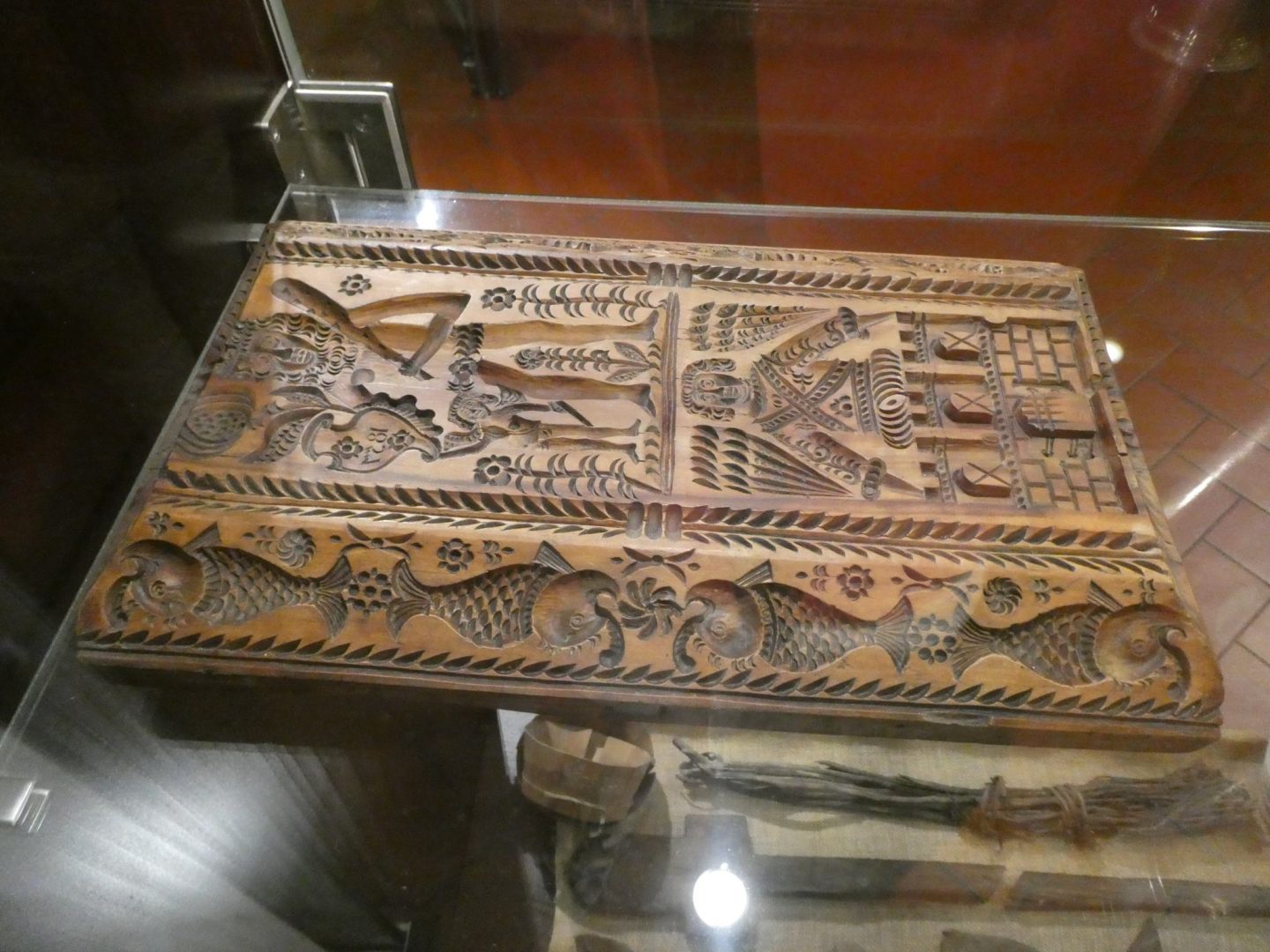

In the Middle Ages, figurative gingerbread emerged. Potash was added to the mix which caused the gingerbread to bake rock hard. They weren’t meant for eating, rather they were symbols of the owner’s wealth and would be hung on walls as decoration. It is claimed they were so hard they could replace the wheel of a cart.

The traditional shape of Torun gingerbread is known as a ‘little Kate’. There are a few stories about how they came about. We like the one about a local baker’s daughter who wanted to make gingerbread for her sick father. She couldn’t find his cutter so she used a small glass. But she put the circular dough pieces too close together on the baking tray and they spread and fused together during cooking.
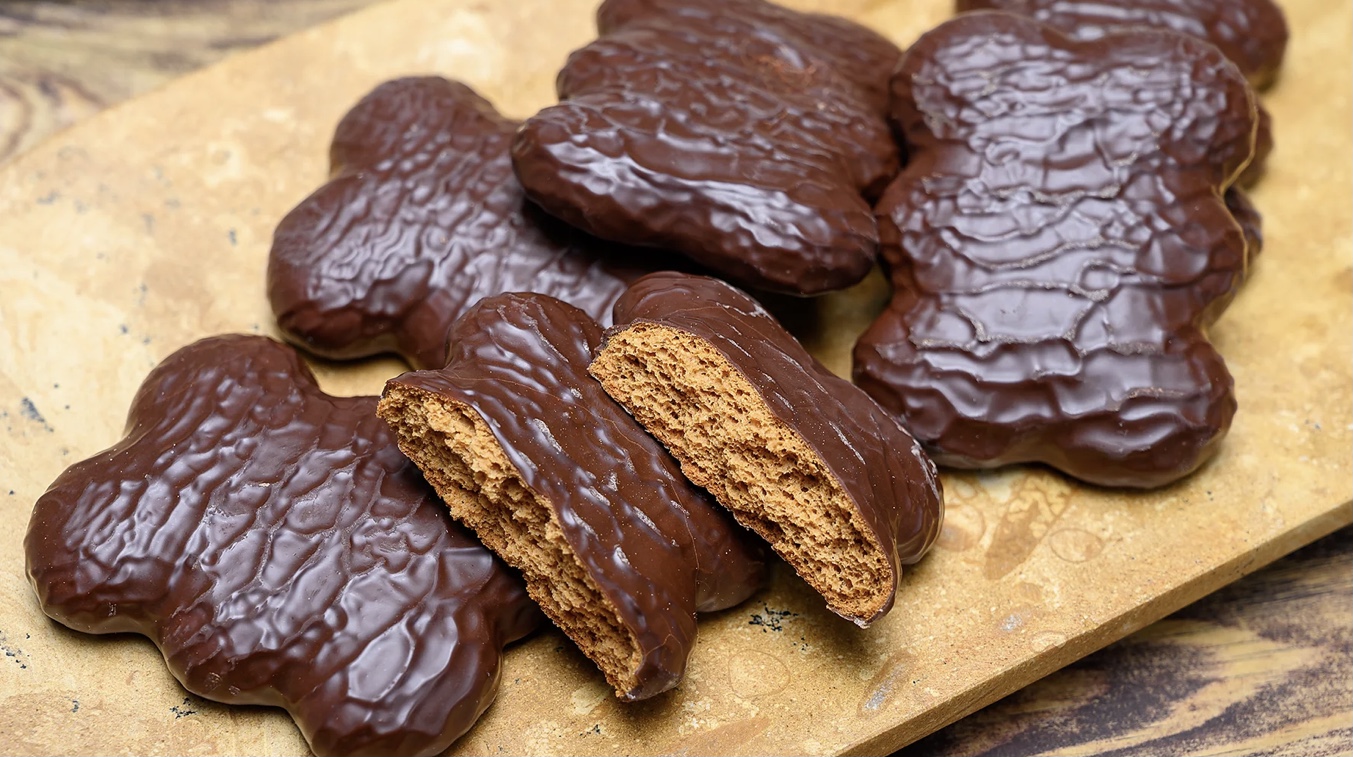
Our hotel had an enormous bowl of them on the desk for anyone needing a fix, and chocolate coated ones at breakfast.
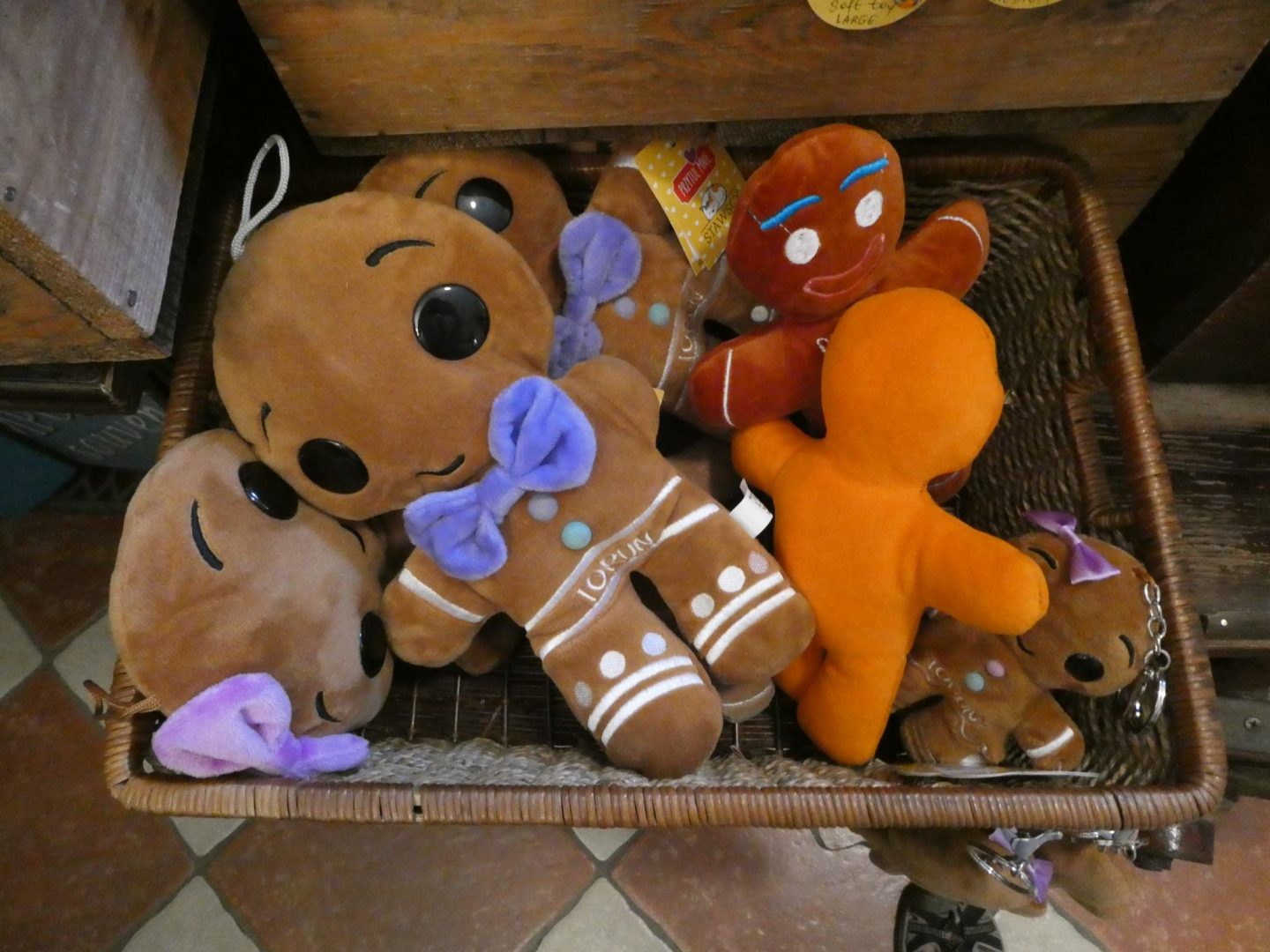
Shops all over town sell biscuit moulds and gingerbread themed toys and gifts.

And of course gingerbread cookies in all shapes and sizes. There’s everything from traditional to modern, and even ones in the shape of Copernicus.


And the museum had one with his diagram of the universe. Impossible to get away from that man in Poland.
 Torun was a fun place to stop. Poland continues to surprise us.

A very interesting read – lots of interesting characters & yummy gingerbread – great location to spend time on a holiday x
gingerbread cat – bet that is coming home ! gorgeous place love the commentary makes me put it on my bucket list ! thank you x
One of my favourite posts as how good is to have all those original beautiful buildings so well preserved as well as the sculptures of the faithful dog and pretty as a picture dragon. Not to forget , of course, that freely available gingerbread is a distinct bonus too 😉