And now for something completely different. If you’ve had enough of posts filled with African animals, read on. There are no lions, leopards or cheetahs in the French mountains!
From Namibia we flew to Rome and caught a train south for a couple of nights in Montepulciano and then five nights in Panicale, a tiny village on the border of Tuscany and Umbria. We spent a relaxing two weeks in Panicale in 2019 and blogged about it at the time. This was a catch up with friends, so no blog, but we must say, Panicale is as beautiful as ever.

Then to Lyon for a couple of nights of over-indulgence in the bouchons, the city’s famous restaurants which emerged in the 17th and 18th centuries to serve hearty, local Lyonnaise fare to workers in the silk trade.
We’d done the same in 2022 with our friend and walking buddy David before the three of us walked the Stevenson Trail North. We were back to do the Trail South, disappointed that David and Noreen couldn’t join us this time.
As a refresher – in the autumn of 1878, Robert Louis Stevenson bought a donkey named Modestine in the town of Le Puy en Velay and set about meandering across the forested hills of the Cévennes to St Jean du Gard, a journey of around 246km.
He kept a diary which he later used to write a book, Travels with a Donkey in the Cevennes. It wasn‘t one of his better known, and his journey was largely uncelebrated until the 1980s when a few hikers began retracing his steps. In the 1990s, the trail was marked out as a complete end-to-end route. Officially, it’s the GR70 but is known as the Stevenson Trail.
In 2022, we walked from the starting point in Le Puy to the midpoint town of Chasserades. We had other commitments which meant we couldn’t walk the rest of the trail, but always thought we’d return one day. And now we have.
The last photograph we took in 2022 was this one. So it seemed ‘right’ when it turned out the building with the blue shutters was the hotel where we would spent the night before commencing part two of the trail. More comfortable than the Chasserades inn where RLS complained he was one of six men in a room with only four beds.
 Chasserades to Le Bleymard
The walk has continued to increase in popularity, but it was very quiet. We would not have seen a dozen walkers all up. The official walking season ends on 15 October, as autumn begins to give way to winter. We knew we were late, and the weather may not be kind but hey, any walk in the French countryside can’t be bad.
It was a chilly start but quite pleasant for walking.
 We passed the Mirandol viaduct, inaugurated in 1902. The 230 metre long, 30 metre high structure was a massive undertaking for its time. And obviously was years in the planning – RLS refers in his book to talking to men employed in survey work for the rail, almost 30 years before that. They were “intelligent and conversible, and we decided the future of France over hot wine until the state of the clock frightened us to rest”.
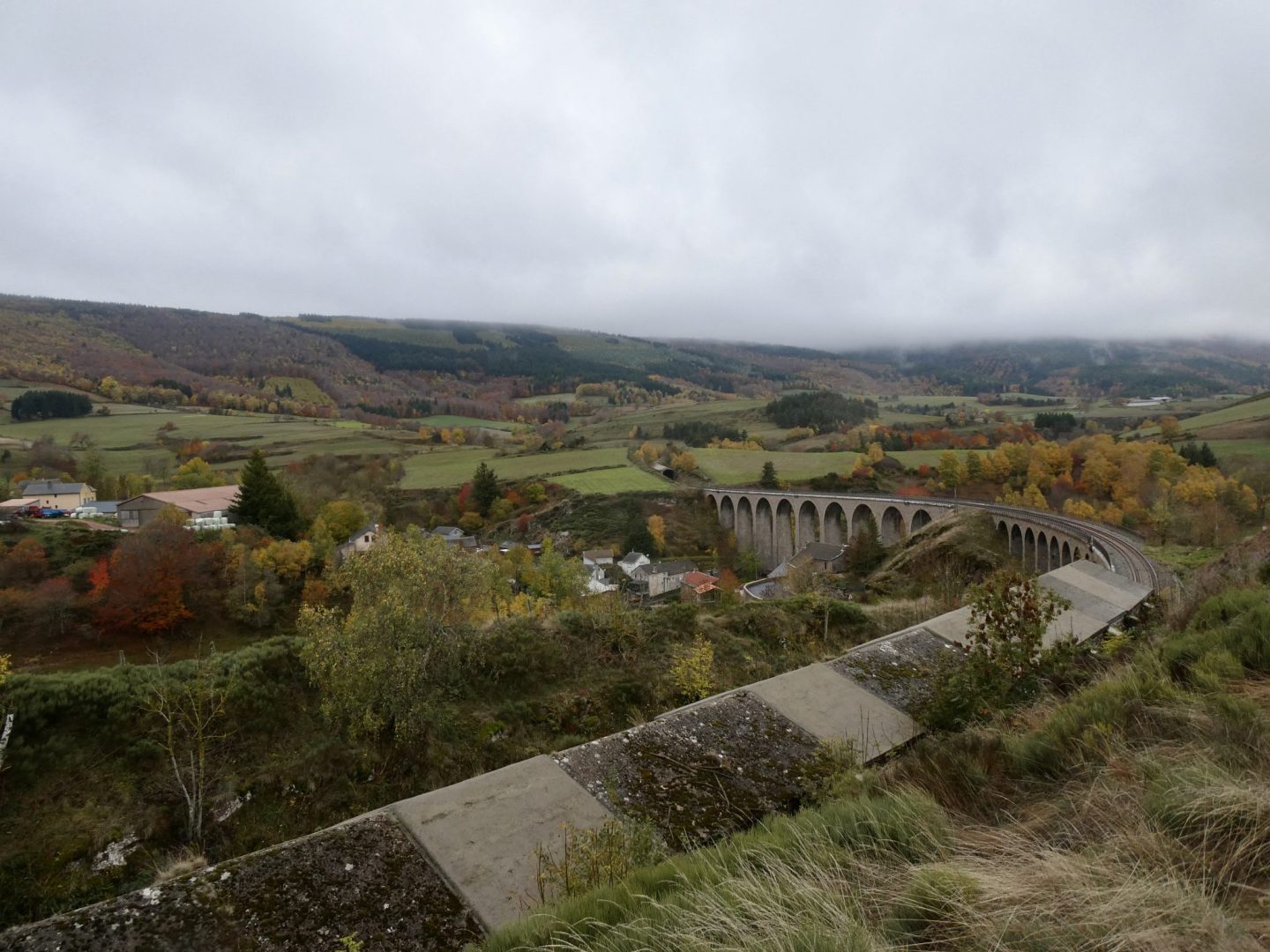
 After the viaduct, we walked through farmlands with a stunning autumn backdrop.

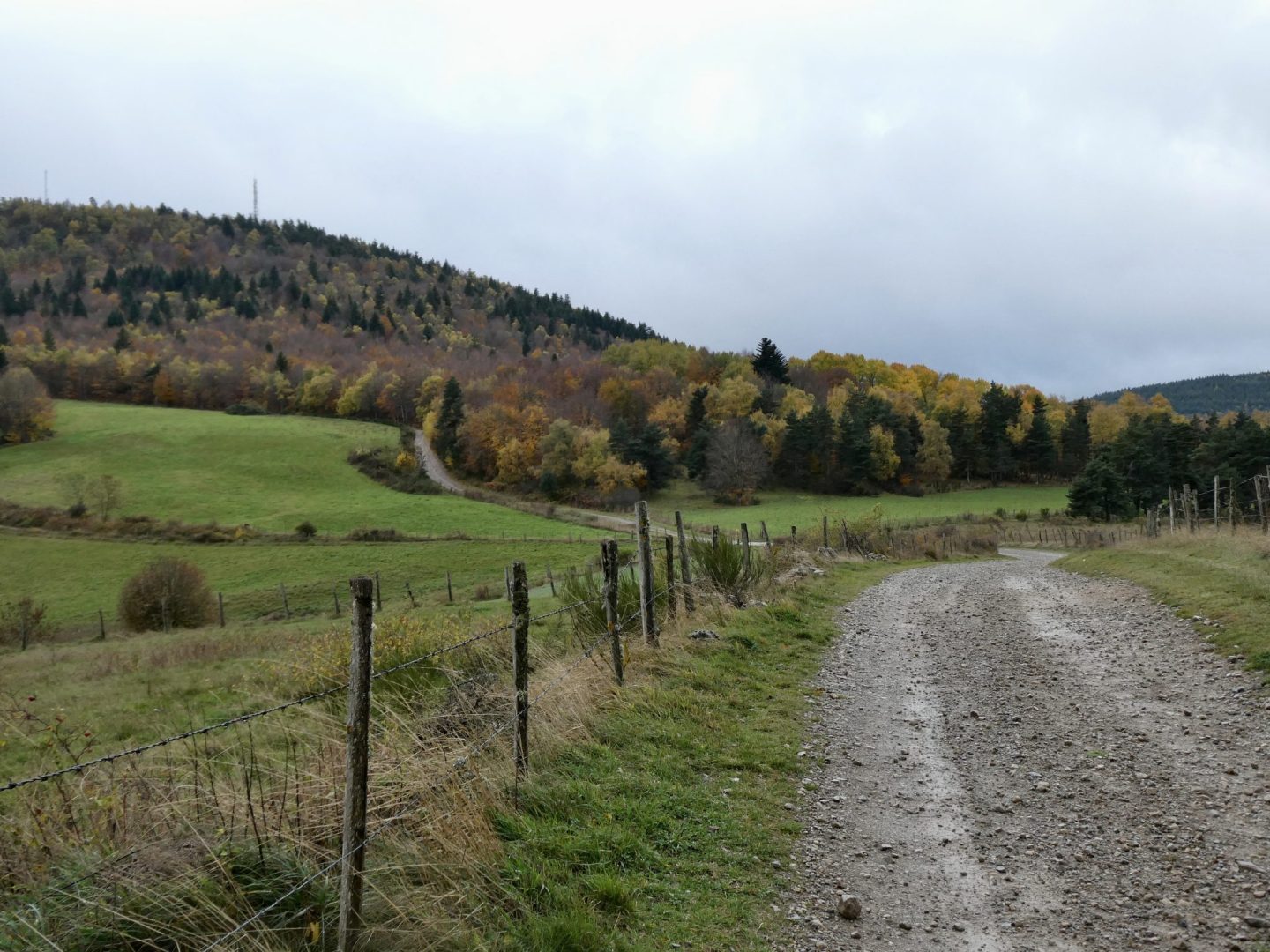
Then up and over the Goulet Massif, which felt like walking on a carpet of leaves.


It was a short day and easy walking, which was fine with us. After two months mostly spent bumping around in 4WDs, it was a nice way to ease back into exerting some physical effort.
We reached the quiet town of Le Bleymard in the early afternoon.

Then any exercise benefit we gained from the day’s walk was undone with the ‘Menu Stevenson’ at the hotel that night: salad of smoked duck and blue cheese, confit pork shoulder with lentils, chestnut icecream with chestnut cream. That set the tone – we ate great, provincial French food all week.
Total walk distance: 17km
Le Bleymard to Pont de Montvert
Leaving Le Bleymard next morning, it was considerably colder but the weather was still holding.
 In the forest, we noticed this sign.

With the added graffiti, it reads:
The forest is not a toilet.
[signed] The Bear
Was it an order from the resident bear not to befoul his territory, or was he asserting his right to exclusive use, thus answering the age old question, ‘Does a bear s#*t in the woods?”
Pondering this question, we cleared the tree line and followed a series of montjoies, ancient standing stones.

We ascended Mont Lozere on a trail which becomes a ski run in winter. It was definitely getting colder. In fact, sprinkles of snow which had fallen overnight were still evident.


We reached the Pic de Finiels, at 1,699 metres, the highest peak of the Cevennes. RLS wrote that this high point “in clear weather commands a view over all Languedoc to the Mediterranean Sea. I have spoken with people who either pretended or believed that they had seen, from the Pic de Finiels, white ships sailing by Montpelier”. We couldn’t linger in the stiff breeze that had sprung up, and we couldn’t see Montpelier or the coast, but the views were pretty fine.

RLS wrote “these are the Cévennes with an emphasis, the Cévennes of the Cévennes … an indecipherable labyrinth of hills”.

On the way down the other side, we found this vibrant mushroom the size of a bread plate. Erin Patterson would have killed for it. Or perhaps with it. Too soon?
 Down in the valley, it was considerably warmer and the sky had cleared to a brilliant blue.

 And then down another stunning trail in the forest.
 Into Pont de Montvert.

RLS seemed to like the town, stating he’d not seen a pretty woman since commencing his journey but here found two, “both more handsome than the average of women”. He described another young woman as having “a heavy, placable nonchalance, like a performing cow”. He moaned that “it seemed pitiful to see so good a model left to country admirers and a country way of thought”, outrageously adding that “her figure was unworthy of her face. Hers was a case for stays, but that may perhaps grow better as she gets up in years”. What a pompous ass!

Total walk distance: 19km
Pont de Montvert to Bedoues
The temperature dropped again. When we started in the morning the weather website said 6 degrees Celsius but with wind chill “feels like 3 degrees”. That seemed about right.
Low cloud obscured the hills.
 Crossing the Col du Sapet Pass was freezing.

 But again, the weather cleared as the day progressed and once we descended again to the protection of the trees, it was a pleasant walk.
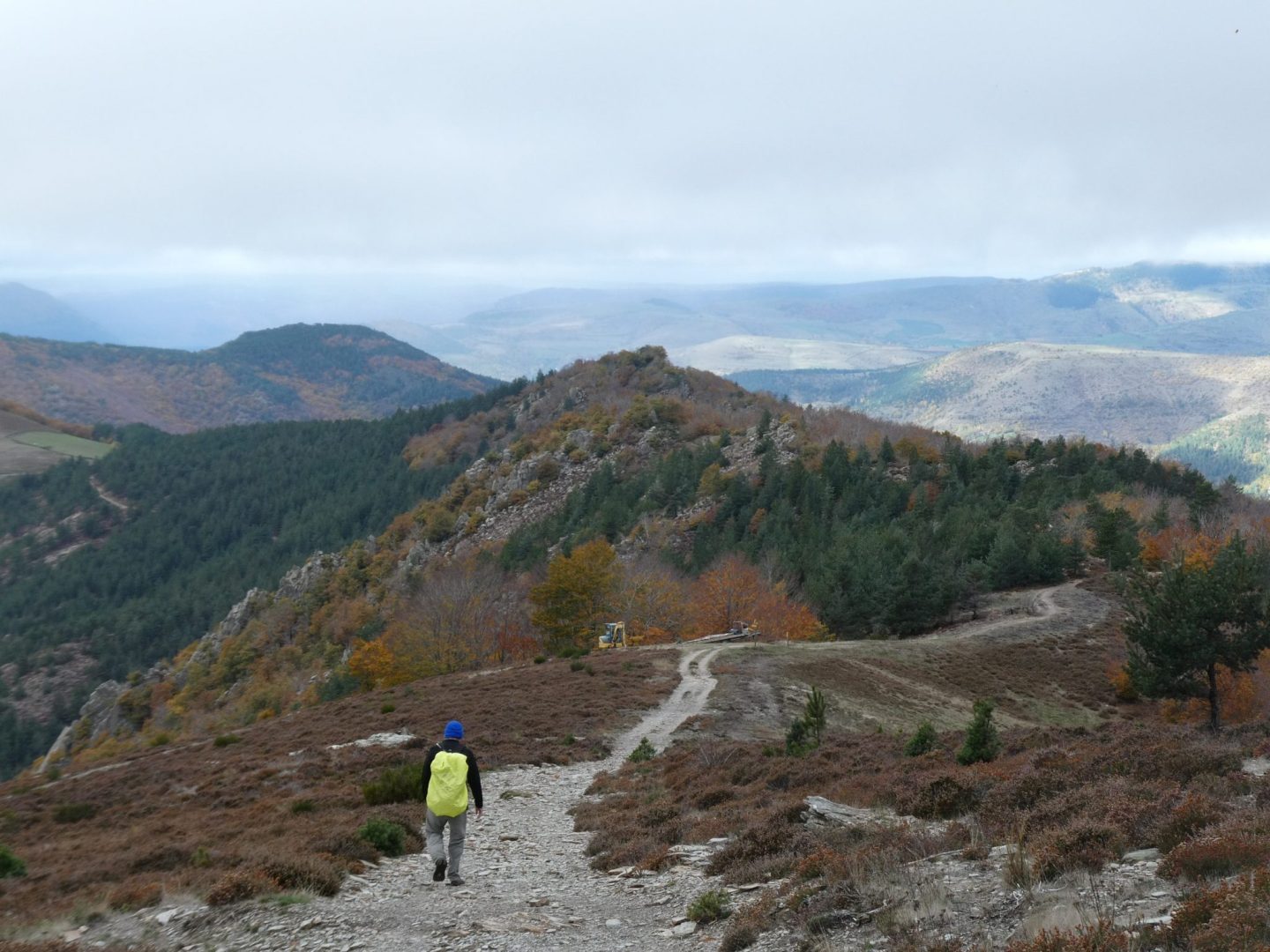
 With some of the best views of the week.

 We spent the night in the village of Bédouès. In 1363, Pope Urban V built a huge church here to house the remains of his parents. It was destroyed during the Wars of Religion which pitted Catholics against Protestants throughout France, and the current one was built in 1580 as a replacement. It’s slightly smaller than the original but still seems so out of place in a low key village of 280 inhabitants.

Total walk distance: 24km
Bédouès to Cassagnas
We left Bédouès in brilliant sunshine and within a couple of hours we were wishing we’d worn shorts.

 We saw our first and only donkey. Disappointing, as we love donkeys and had seen quite a few on our first Stevenson walk.

It was mostly easy walking with much of it on a re-purposed railway track with a couple of tunnels which meant no climbing hills.

But there was a sting in the tail. Even though RLS spent a night in Cassagnas, the modern day GR70 bypasses it, and the couple of accommodation options next to the trail have closed for the winter. It’s a 4km off-route slog up a very steep hill to the village. Not only was it exhausting at the end of a hot day, but added another 4km to tomorrow to get back on track.
We had a very entertaining evening with our hosts, Joel and the eccentric Maxine. They spoke zero English, but we muddled through. Joel cooked enough food for an army while Maxine urged us to “manger, manger, manger”. That’s “eat, eat, eat”, by the way. In the morning she appeared in a bright pink dressing gown, exuberantly miming how cold it was outside by chattering her teeth and snickering like Muttley, the cartoon character dog, from a long lifetime of chain smoking. It’s something we won’t forget in a hurry.
Cassagnas to St Etienne Valle Francaise
Overnight, the weather had closed in. It was damp and foggy, and the temperature had plummeted to close to zero. On the up-side, it wasn’t actually raining when we left, and initially the fog just made the landscape beautiful in a different way.

 For a while the trees gave us some protection from a steadily rising wind.

 But about 6km in, it started to rain. A steady drizzle, which quickly increasing to frigid, pouring rain.
It’s a very local weather phenomenon known as an ‘épisode cévenol’. In autumn, a change in the direction of currents in the Mediterranean Sea causes large masses of humid air to rise off the coast of Montpelier. Blown inland, the air strikes the cold Cévennes mountains. Condensation coupled with instability caused by the temperature variation creates thunderstorms which dump between 200 and 600mm on the area.
RLS reported seeing “peak upon peak, chain upon chain of hills surging southward, channelled and sculptured by the winter streams, feathered from head to foot with chestnuts, and here and there breaking out into a coronal of cliffs”. We saw plenty of chestnuts – they are in season now – but precious little else, and certainly no horizon views.
We walked in torrential, freezing rain for 24km. You will understand why there are no photos, and why we were so glad to reach the exquisite Chateau de Cambiaire, our hotel for the night.
Built by the Viscount of Alès in 1366, extended in 1775, spared during the French Revolution but badly damaged during the Nazis’ retreat at the end of WWII, it has a storied history. The last baron died in 1963 and the current owners are a couple who have undertaken the mammoth task of restoring and transforming it into a hotel.
We had a hot shower, draped our sodden gear on the industrial strength heaters content in the knowledge all would be dry by morning, and sat in a toasty warm drawing room with a pichet of red wine. By dinner, we were restored.
Total walking distance: 30km
St Etienne Valle Francaise to St Jean du Gard
An episode cévenol ends as abruptly as it starts. Next morning, the sun was shining again. A chance to see the chateau and the village of St Etienne Valle Francaise in their best light.
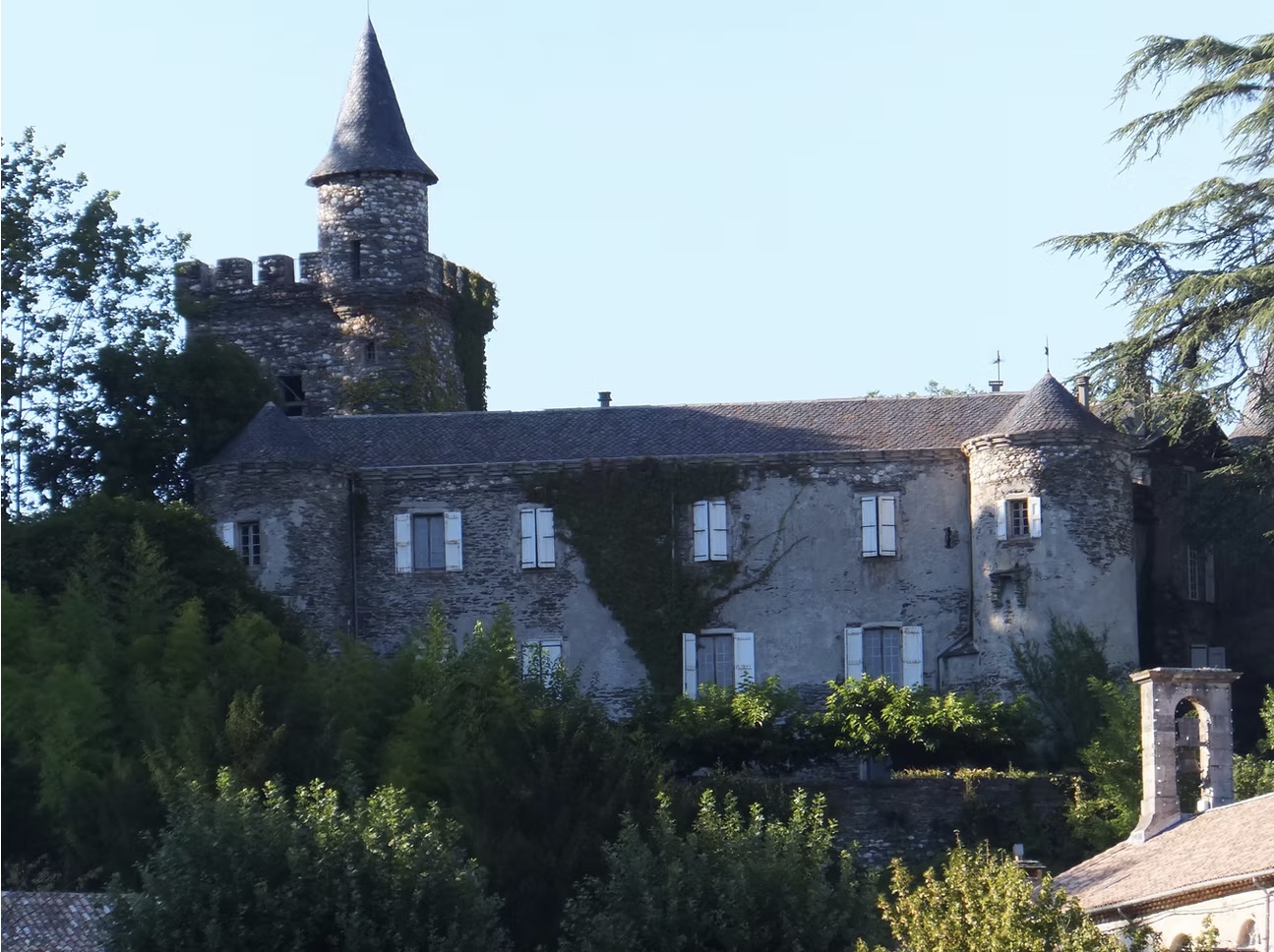
 The weather was brilliant and after leaving the village, we climbed to the summit of Col Saint-Pierre. RLS wanted to see the view from the top but left St Etienne so late that no amount of cajoling could hurry Modestine to the top in time. He got there well after dark. We fared much better.


He records sitting on a pile of stones at the top, sharing with Modestine what would be their last meal together. It could have been just here.

He claimed she “ate decorously out of my hand … for she had a sort of affection for me”. Given the extent to which she had objected to carrying his gear, obstinately repudiated his various ridiculous attempts at short cuts and refused to submit to his bullying and even whipping, we think he was kidding himself. We think she thought he was an idiot.
RLS recorded it was a steep downhill walk to St Jean du Gard. It still is.
RLS pushed Modestine so hard that on reaching the town, the ostler at his inn advised giving her two days rest. He was anxious to continue on, so he sold her within a few hours, describing it as having ‘bought his freedom’, and caught a coach to Alès. Heartless dill. We finished with a beer and a nice meal.
Total walking distance: 15km
The final paragraphs of RLS’ book are a touching tribute to Modestine, although they show his capacity for self delusion – “she had come to regard me as a god” – and his questionable attitude to his host country and to women – “her faults were those of her race and sex”. But he described them as “fast companions” and Modestine as “patient, elegant in form, the colour of an ideal mouse”, and admitted to weeping for the loss of her as his coach trundled on to Alès.
We, too, could not linger in St Jean du Gard, heading the next day to Alès, where we caught a train to Paris. We are in our now familiar, favourite apartment for a week, and then head home. See our Brisbane friends and family soon!
