“I always wonder in Copenhagen what they do with their old people – they must put them in cellars or send them to Arizona – because everyone, without exception, is youthful, fresh-scrubbed, healthy, blond and immensely good-looking. You could cast a Pepsi commercial in Copenhagen in fifteen seconds. And they all look so happy.” (Bill Bryson, Neither Here Nor There: Travels in Europe)
It’s true. And after our Brisbane – Doha – Copenhagen flight was cancelled, resulting in a 40 hour odyssey via Vancouver and London, we arrived feeling very un-Danish! Fresh-scrubbed and happy, we were not.
But Copenhagen is a perfect place to regain your equilibrium. Like its people, the city is genteel, orderly, elegant and stylish, earning it the nickname ‘Scandinavia’s capital of cool’.
It’s been the capital of Denmark since the early 15th century and by the 17th century was the country’s most important trading centre. Traces of Copenhagen’s heyday as a port can still be seen around Nyhaven. Its old merchant houses have survived plagues, wars and the migration of shipping activities to modern ports elsewhere. Nowadays, it bustles with bars, cafes and shops.


The 17th century also saw Copenhagen flourish as a centre of learning and science.
In 1642, Rundetaarn (‘Round Tower’) was constructed on the orders of King Christian IV so astronomers from the University of Copenhagen could observe the night sky free of smoke and light pollution. Europe’s oldest functioning observatory is famous for its equestrian staircase, a 7.5 turn helical corridor designed so that heavy astronomical observation equipment could be hauled by horse from ground level to the observation platform at the top. 1n 1716, Catherine the Great of Russia ascended the staircase in a carriage while her husband galloped up on a horse. In modern times it’s been scaled by car and bicycle, and an up-and-back unicycle race is held every year.

The Royal Library also dates to this period.

A number of its collections are inscribed in UNESCO’s Memory of the World International Register, including the Søren Kierkegaard Archives.
The ‘Father of Existentialism’ is Denmark’s most famous philosopher. His observation that “people demand freedom of speech as a compensation for the freedom of thought which they seldom use” seems especially relevant today.

When it was completed in 1745, Christiansborg Palace was northern Europe’s largest castle. A mere 50 years later, it was devastated by fire and the king moved on. But the building was repaired and now houses the Danish Parliament and Supreme Court. In our professional lives and travels we’ve visited quite a few Supreme Courts, but never one with horses grazing in the forecourt, a throwback to when the Royal Stables were here.


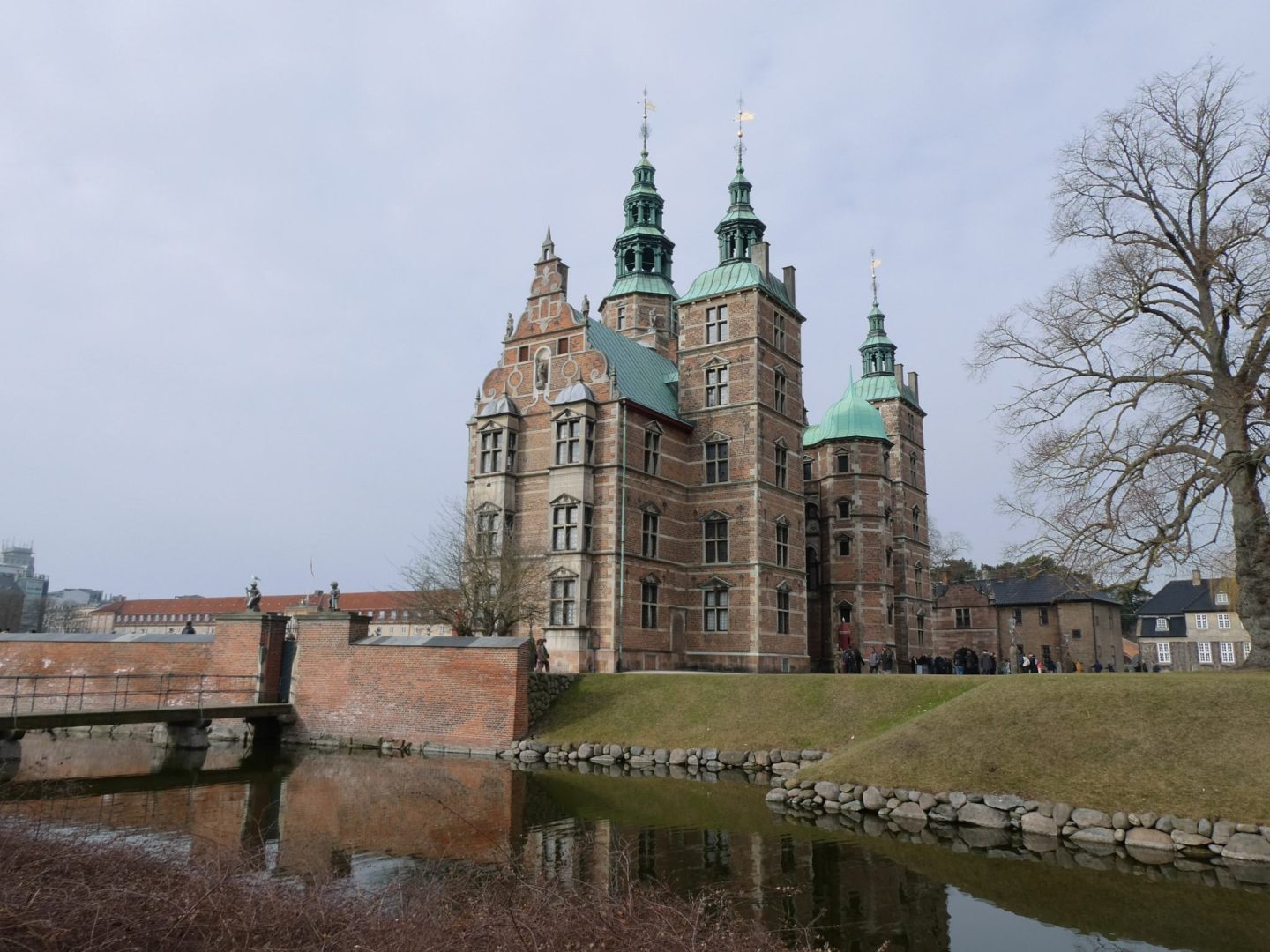
When the Christianborg fire left the king homeless, he moved his household to nearby Rosenborg Castle, which had been built in the early 1600s as a royal summer house. It now houses various royal collections including a hall of stunning tapestries and the Royal Treasury where the Crown Jewels are on display in a subterranean vault.
Perhaps one castle wasn’t enough space for the then king. A few years later, he took over four identical mansions built around an octagonal courtyard down town. Originally owned by noble families who were happy to sell them to their king in exchange for money and favours, the complex became the Amalienborg Palace and has been the official residence of the royal family ever since.
Currently it’s home for the family of King Frederik X and his wife, Queen Mary, the first and only Australian-born Queen. They met at the aptly named Slip Inn pub in Sydney during the 2000 Olympics and it must have been the most unlikely pick-up line ever:
Him: “Hi, there. I’m Fred. What’s your name?”
Her: “Mary. What do you do for a living, Fred?”
Him: “I’m the Crown Prince of Denmark. One day, I’ll be King”.
Her: “Yeah, right”.
And when he said, “Want to come back to my place?”, she probably wasn’t expecting this.

The palace is guarded by the Royal Life Guards, who have been protecting the monarch since their formation in 1658. Those hats are perfect for this climate.

Each day a squad marches from Rosenborg Palace for a changing of the guard ceremony in the courtyard of Amalienborg. Fred and Mary must be at home, because when the royals are in residence, the squad is accompanied by a marching band. We saw them outside Rosenborg forming up for the march.

The architect who designed Amalienborg also drew the plans for the nearby Frederikskirk, commonly known as Marmorkirken (‘Marble Church’) because it’s mostly constructed of marble. Conceived in 1740 to celebrate the 300 years jubilee of the ruling House of Oldenburg, it took another 150 years to be completed. It has the largest church dome in Scandinavia, with a span of 31 metres.

Out along the harbour is Copenhagen’s most photographed image. Locals cringe, but tourists flock to see The Little Mermaid. In 1909, Carl Jacobson, heir to the Carlsberg beer operation founded by his father, was so entranced by a ballet of Hans Christian Andersen’s The Little Mermaid, he commissioned a statue of the lady-fish to be installed on the waterfront.

Further along, and largely ignored by tourists, is the Genetically Modified Little Mermaid. This weird statue was sculpted by a professor at the Royal Danish Academy of Fine Arts in 2006 as “a provocative and humorous look at postmodern society.”
The figure’s pose is like the original but apparently “her twisted figure, with elongated skeletal legs and an unrecognizable head, is a criticism of genetic alterations”. A bit deep and meaningful for us.

For a completely different side of Copenhagen, you just have to cross a footbridge from the centre to the Christiania neighbourhood. In 1971, a group of anarchists occupied a long-derelict military bastion. They purported to secede from Denmark, creating a self-governing community based on principles of freedom and communal living. A democratic utopia.
Despite being illegal, drugs were openly traded from booths along what came to be known as Pusher Street. In the 1980s, motor cycle gangs muscled in. Violence skyrocketed, drug deaths brought unwelcome attention and the area became unsafe for both residents and visitors. Joint efforts between the community and police eventually shut down the trade in 2024. Locals literally dug up Pusher Street.

The area continues to be spruced up by the community with cafes, art initiatives and markets, and the hippie vibe has returned.


They even have their own troll, Green George.

And they still consider themselves seperate to the rest of Europe. On leaving the area…

Forty five minutes by train from Copenhagen, the town of Roskilde is one of Denmark’s oldest cities. It emerged as an important hub for Viking land and sea routes in the 11th century, and was capital of Denmark for over 300 years before the Royal seat shifted to Copenhagen.
Locals had always known ‘something’ lay in the shallow waters of a narrow channel into Roskilde Fjord. It was only in 1962 that painstaking excavation revealed what turned out to be the remains of five Viking cargo and war ships which had been deliberately scuttled in around 1070 to block the channel in order to prevent enemy boats accessing Roskilde by sea.
The ships were retrieved, preserved and are now housed in the Viking Ship Museum on the fjord shore.


Teams of researchers have also built replicas using the exact same tools, enabling them to confirm many aspects of Viking life, like how far these ships could actually travel. The answer, by the way, is ‘very far’. One of the original ships hails from Ireland and a team re-enacted that voyage in a replica a few years ago.
Fun fact: A ‘viking’ isn’t just the guy in the horned hat. The word also means the raid or overseas expedition itself, ie Hagar might well say “Goodbye, Helga. I’m going on a viking’.
In the summer, you can take a trip on the fjord in a replica, but in early Spring, you have to settle for a wander around the shipyard where replicas are still being made using the old methods.

A thousand years after five sunken boats was enough to protect the lands, Denmark’s territorial integrity is again threatened by a would-be invader. And while Denmark’s leaders fend him off with diplomacy, it’s clear what the general populace think.

Interesting times ahead.

It was good to see your blog come up. Good to know you are safe and happy.
I am very erratic in the way I read your blogs. Nothing and then a binge usually. But I hadn’t realised how comforting it is to see your blog come in. It’s like a little wave we’re ok.
Thank you
Love Liz xxx
Thank goodness I was worried about you ! Love seeing Mary’s House. Certainly upmarket from her Taroona abode ! Keep all your news coming.
All good here
A x
Love the Viking ships 😀