The Apennines are known as ‘the backbone of peninsular Italy’ – 12,000 mountains stretching 1,200km from just south of Bologna in the north to Calabria at Italy’s southern tip. We spent the next few days moving south-west through them.
Leaving Berceto we headed for the Cisa Pass, which marks the border between Emilia-Romagna and northern Tuscany. It was a fairly steep, steady climb. Eventually we cleared the tree line and could see a marker. Is this the top?

No. A bit further on… might this be it?

Again, no.
We should have realised – the Church always occupies the highest ground. Built in the 1910s, the chapel of Nostra Signora della Guardia (Our Lady of the Watch) is at the top of the pass. It’s dedicated to the Virgin Mary in her role as protector of travellers. Seems appropriate.

We’re almost half way through our hike. Only 562km to Rome now.

The descent was one of the most beautiful walks so far. Towering chestnut and beech trees, with occasional panoramic views when the trail cleared the forest.

Long stretches of stony path were tough on the feet.

We stayed a night at what has been our favourite accomodation so far, the lovely B&B Temperance.

Fortunately, temperance didn’t mean alcohol-free. A cold beer was very welcome at the end of that day. And the owner served a rustic ‘pilgrim’s dinner’ featuring testaroli. It’s a local ‘pasta’ made from a batter of flour, salt and water cooked over coals in a pan that looks like a massive flat wok to produce a thin round crepe the diameter of a huge pizza. It’s cut into diamond shapes, which are dipped in boiling water and served with pesto and parmesan. The taste and texture is more like a pancake than a conventional pasta. It was hearty and filling, and the pesto made from wild garlic shoots collected by the owner was just divine.

We followed ancient paths down through the forest.

The local equivalent of the Boy Scouts had been out building seats for hikers to rest on.

We emerged out of the greenery at Pontremoli, the most northerly town in Tuscany.

Pontremoli is known in Italy as the “City of Books” due to its tradition of wandering booksellers. In 1493, Sebastiano da Pontremoli travelled to Milan to learn the new process of movable type printing. He returned and began printing small, affordable books for sale. Impoverished local peasants became itinerant booksellers, walking to remote parts of Italy and further into Europe selling books from wicker baskets strapped to their backs. Ironically, most of them could not read.
By the 19th century, the wandering book trade was a massive seasonal business. The booksellers would gather at the Cisa Pass at the beginning of every spring and carve up the map of Italy and Germany, allocating specific areas to different families so they would not compete. Cartel behaviour being what it is, the families grew wealthy and by the early 20th century, many were able to establish permanent store fronts and, eventually, major independent bookstore chains which still survive today.
The original vendors displayed their stock on a small fold-up table called a bancarella. In 1952, their descendants established the Premio Bancarella literary awards in honour of their ancestors. Refreshingly, the jury consists entirely of independent booksellers, and winners are chosen based on books their customers love. No literary critics get a say! The inaugural prize winner? Ernest Hemingway for The Old Man and the Sea.
From 1938 to 1988, Arnoldo Mondadori’s company held the exclusive Italian publishing rights for Walt Disney comics and magazines. By some quirk, the Italian format of the comics required more content that the US version, so Mondadori employed a group of writers and artists to create more characters and content, making the Italian comics unique in the Disney world.
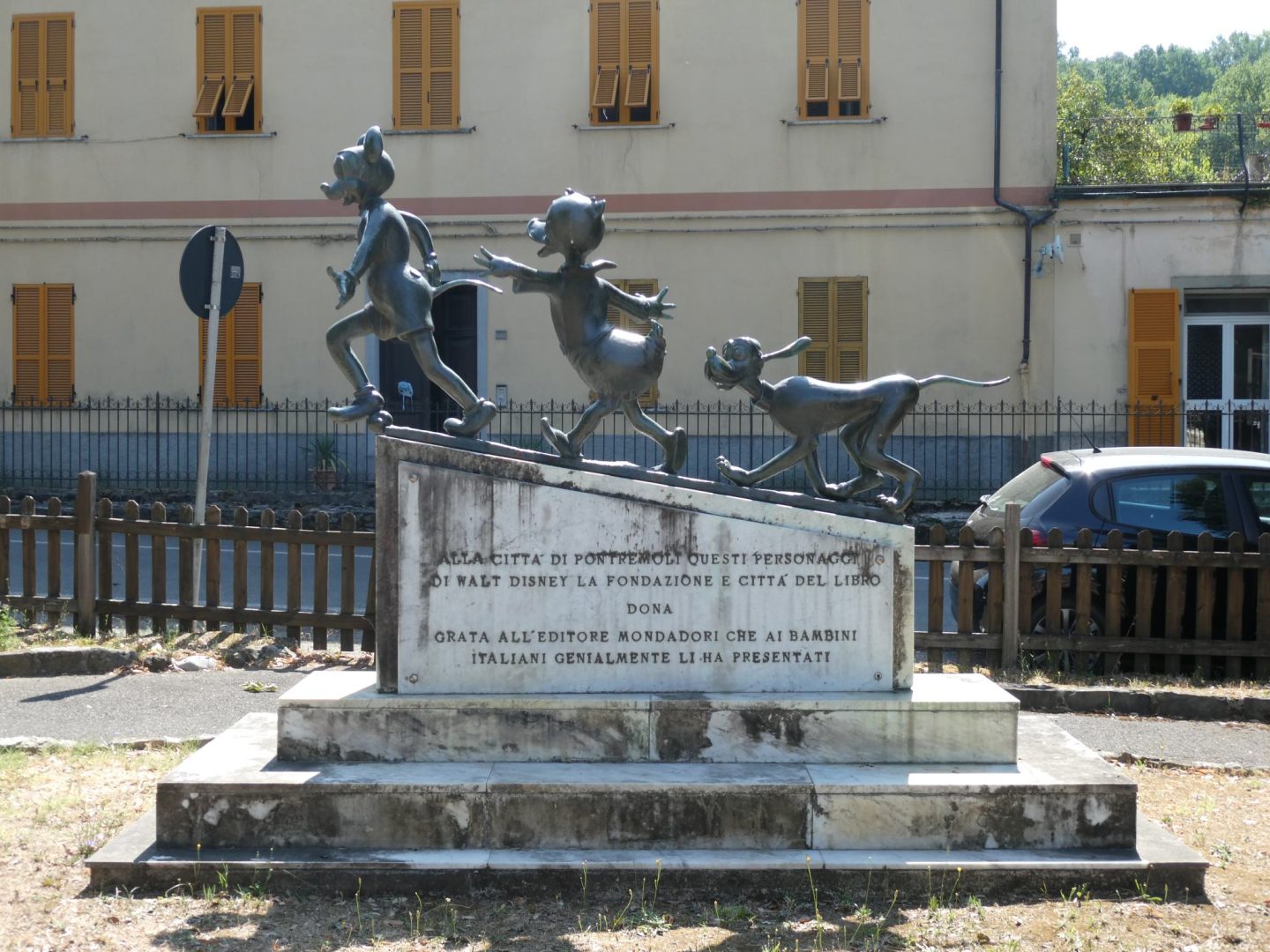
In 1968, the city erected a bronze monument of Mickey, Donald and Pluto as an expression of gratitude to Mondadori. The dedication thanks him for “brilliantly presenting Walt Disney’s works to Italian children”.
 And so our week continued – dipping in and out of the mountains, through more lovely little towns and villages.


As always there were random interesting things to see along the way.


John has long harboured a secret desire to own a Citroen Des Cheveaux. While admiring this one, he wondered if this fellow polishing his prized auto, had bought it new when they first came on the market in 1948.

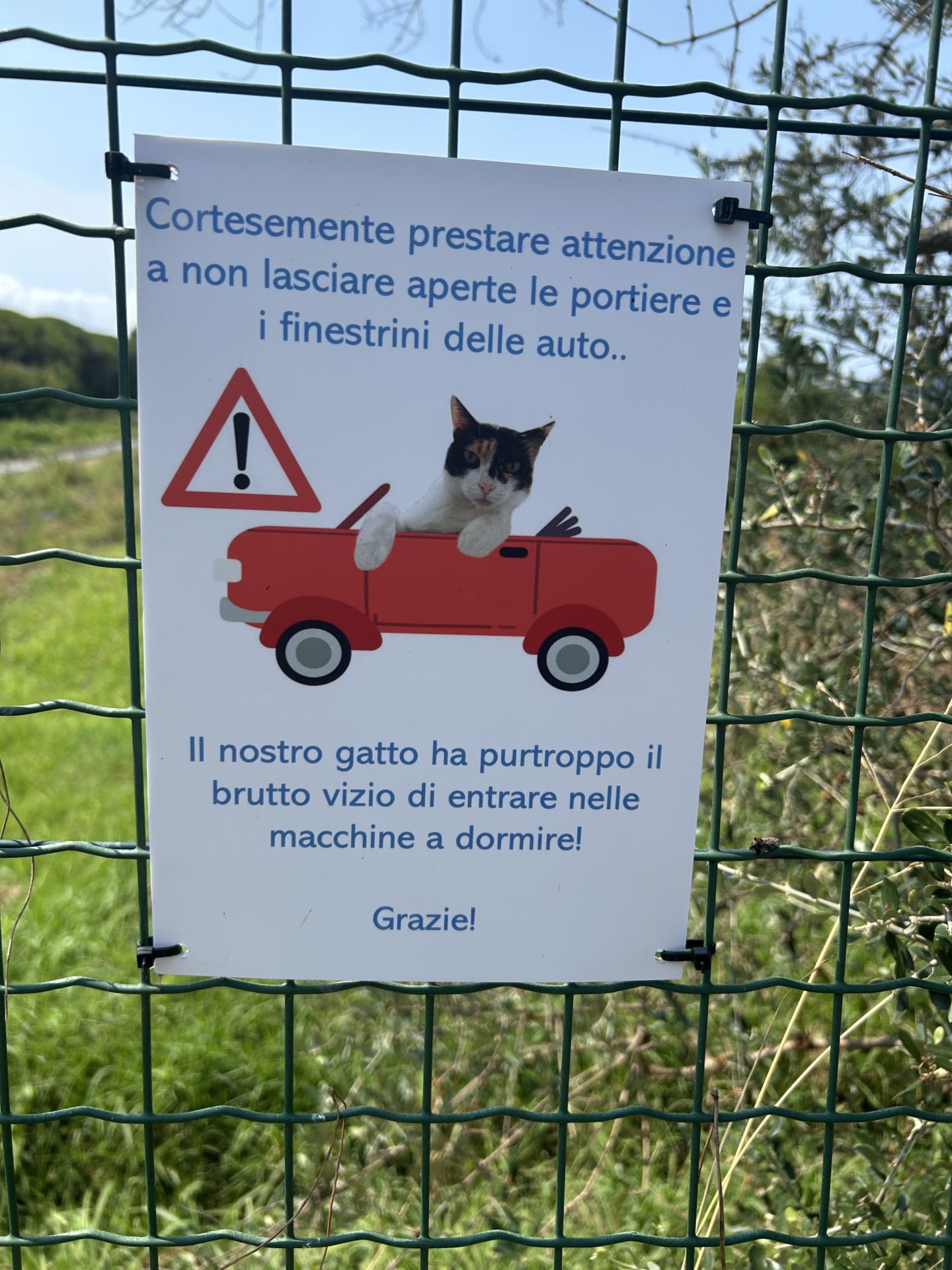
Outside Luni, a property owner had attached many copies of this sign along their fence and the boundary fence of the Roman ruins across the road. It asks “Please be careful not to leave car doors and windows open. Unfortunately our cat has the bad habit of getting into cars to sleep”.
Makes you wonder how many times unsuspecting visitors to the archeological site got half way to their next destination before realising they had a furry goldilocks on board.
We spent a night in Carrara, where they’ve been quarrying exquisite marble since around 150BCE.
In 1497, Michelangelo came here to personally select a block from which he carved his masterpiece Pieta. Carrara marble became his material of choice for important projects, including his famous David.
But trouble arose after the election of a new Pope in 1513. Over the next several years, Leo X pressured, cajoled and made scurrilous allegations against Michelangelo in an attempt to force him to use marble from quarries at Pietrasanta instead. They were owned by the Medici family and Leo was …. a Medici. So, powerful leaders using their position to advance their family interests isn’t new at all.
Michelangelo prevailed, and even entered into a joint venture with local masons through which he owned a slice of a Carrara quarry. More than 500 years later, Carrara marble is still being extracted for use all over the world, valued for its combination of distinctive soft white or blue-grey colour, delicate veining and a fine grain capable of taking a more silky polish than coarser grained stone.

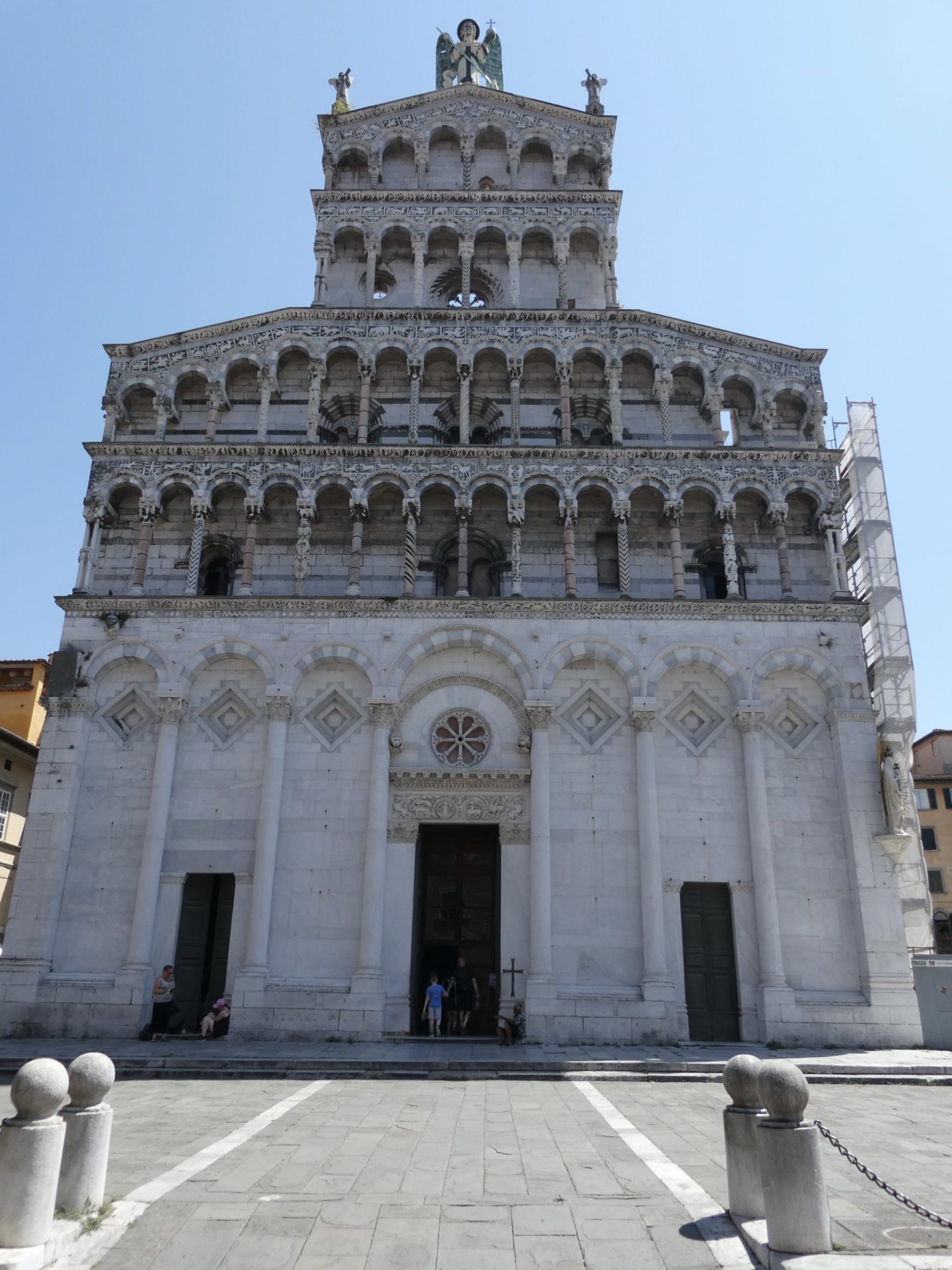
We ended the week in Lucca, rated as one of the best preserved medieval towns in Italy. It’s one of only a few with a completely intact 16th century perimeter wall. From various access points you can take a stroll around the top for an elevated view of the city.


Its easy to see where a lot of that white marble went.


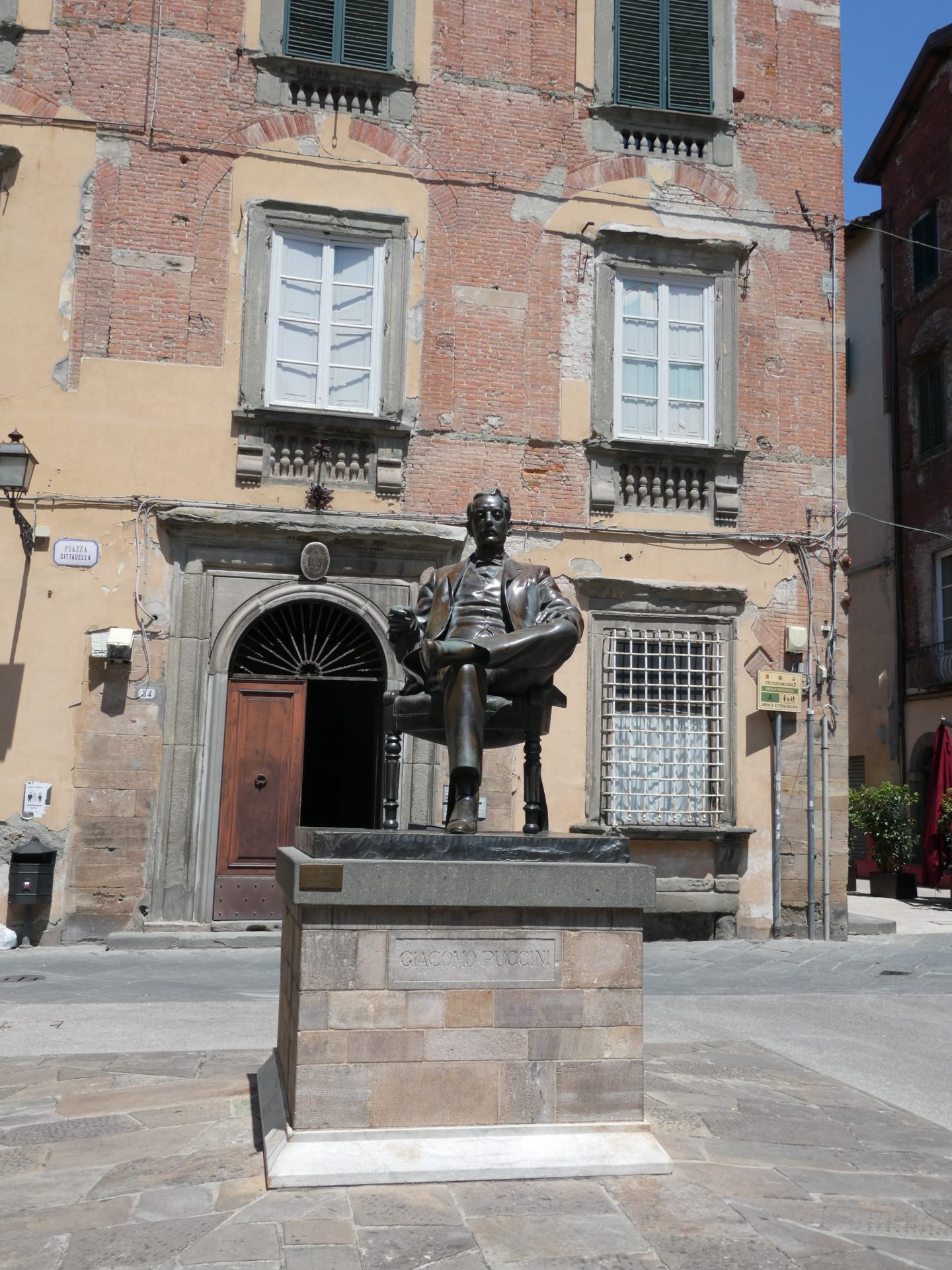
Luca’s most famous son is Puccini.
Guinigi Tower with its holm oaks growing from the top is one of the symbols of the city.

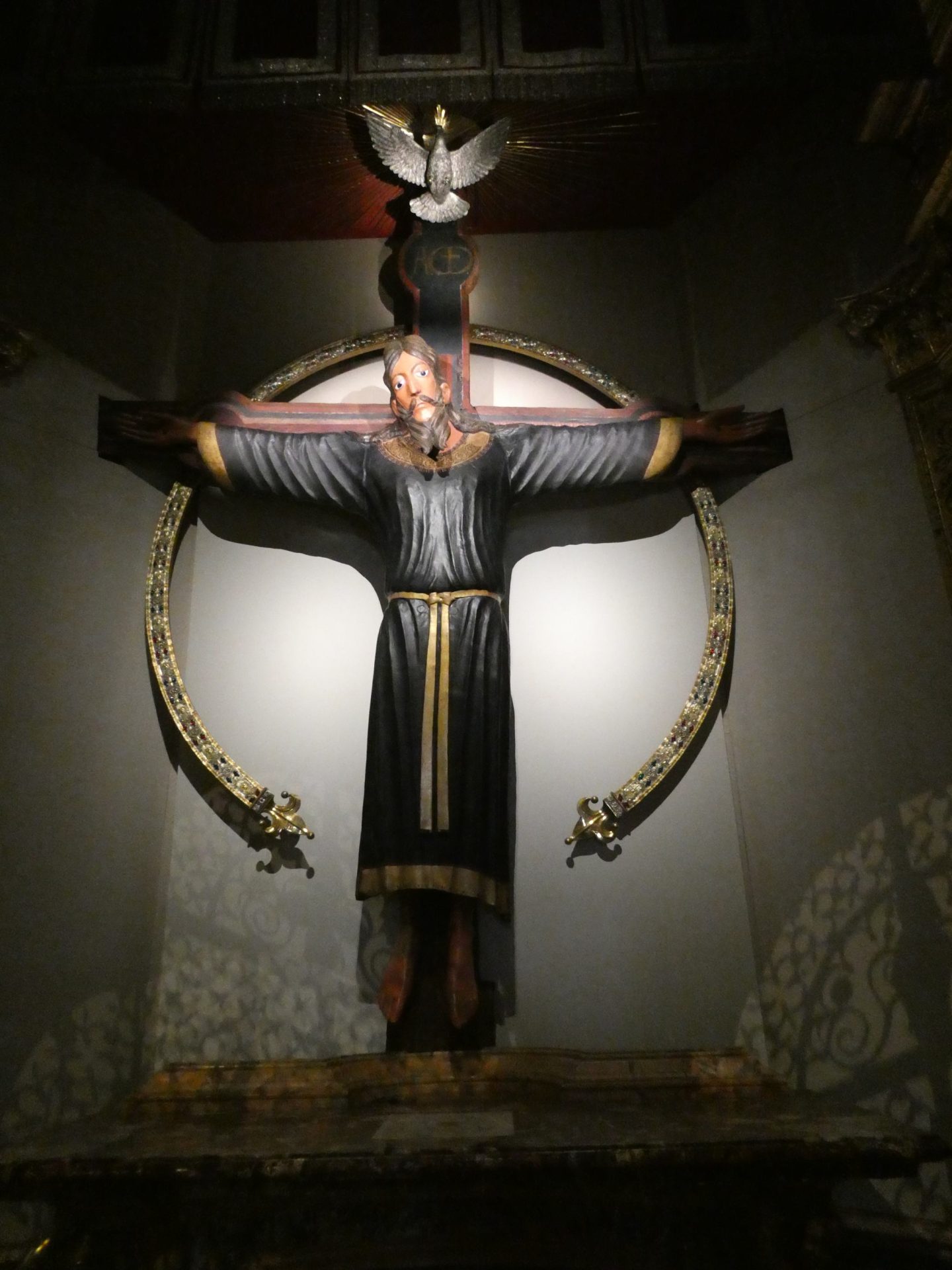
Inside the Cathedral of San Martino is a life-sized, painted wood carving of Christ on the Cross. Known as the Holy Face of Lucca, Catholic legend says it was carved by Nicodemus, who assisted placing Jesus in the tomb following his crucifixion. Carbon dating, however, places it sometime between 770 and 880CE.
Either way, it was apparently brought to Italy by boat from the Holy Land around the 800s. Once ashore it was loaded on an ox cart and the divinely directed beasts hauled it to Lucca without human intervention, proof that it was ‘meant’ to be here.
Its Eastern styling was unusual in Europe and copies were disseminated far and wide. In far flung lands, where the origin of the image was unknown, confusion set in. Instead of a loin cloth, the figure on the cross wears a long robe, suggesting it is a woman, but also has a beard.
To explain this, a new legend emerged of a pious young woman named Wilgefortis, whose father promised her in marriage to a pagan king. In an attempt to thwart his plans, Wilgefortis took a vow of virginity and prayed that she would become ugly. In answer to her prayers, she sprouted a luxuriant beard overnight. Repulsed, her intended husband called off the wedding. In a rage, her father had her crucified, explaining the image of a robed woman with a beard on a cross.
St Wilgefortis gained a cult following until she was scrubbed from the Church’s official list of saints in the 16th century, but in modern times has been revived as an icon in the queer community.
But back to the original. It’s here in Lucca in a a gilded octagonal tempietto (little temple).

And from whichever angle you approach, the eyes seem to be looking straight at you.

And finally, the Devil’s Stone of Lucca. According to this legend, in the 1500s the wealthy Bernardini family ordered the demolition of several buildings including a shrine to the Madonna to make way for their new palazzo. With the protection of the shrine gone, the Devil taunted the architect that the palazzo would never be finished. He touched a marble window jamb with his claw, causing it to bend unnaturally. No attempt to fix it has ever been successful, thus fulfilling the Devil’s boast.

David and Noreen, our friends and walking buddies from Cornwall, joined us in Lucca and will walk with us for a week as far as Siena. After we sweltered together through hikes in Corsica in 2023 and Sardinia in 2024, we all vowed we would never hike in southern Europe in August again. Yet, here we all are. Europe is having a record hot summer and the forecast is for daily temperatures in the high 30s Celsius. The big question: will they still be talking to us at the end of the week?
This week:
Day 24: Berceto to Groppodalosio: 20km
Day 25: Groppodalosio to Filattiera: 22km
Day 26: Filattiera to Aulla: 21km
Day 27: Aulla to Sarzana: 20km
Day 28: Rest day in Sarzana
Day 29: Sarvana to Carrara: 18km
Day 30: Carrara to Camaiore: 23km
Day 31: Camaiore to Lucca: 27km
Day 32: In Lucca
Total to date: 592km

The start of this leg of the walk seems to me to be the precise far, just beautiful !