In the 800s, Baldwin Iron Arm built a fortress near the head of a long sea channel called the Zwinn. He married Judith, daughter of Charles the Bald and sister of Louis the Stammerer. One of their daughters married Wilfred the Hairy.
Ah, the Middle Ages. When name calling didn’t get you cancelled.
By 1301 Bruges was so wealthy that French King Phillip the Fair’s wife, Joan of Navarre, declared “I thought I alone was Queen, but I see I have 600 rivals here”.
Bruges’ prosperity came from trade and the production of quality woven textiles made from wool imported from England. It’s access to the North Sea via the Zwinn made it an ideal gateway to northern Europe. But in the late 1400s, unrest caused many trading houses to move to Antwerp. More devastatingly, the Zwinn gradually silted up. No longer accessible by sea, Bruge fell into terminal decline.
All but abandoned for 400 years, it awakened to a new life in the early 1900s thanks to, of all things, French and British tourists passing through on their way to gawp at the Waterloo battlefield. Recognising the potential economic benefits, the city fathers made impressive efforts to preserve and restore the medieval town.
Almost miraculously, Bruges suffered very little damage in either World War and is now universally accepted to be one of the most perfectly preserved medieval towns in Europe. The Historic Centre of Bruges has been UNESCO listed since 2000.


The city’s best known landmark is the 13th century Belfry of Bruges with a carillon of 47 bells which are rung several times a day. In addition to being part of the Historic Centre listing, it’s also one of UNESCO’s World Heritage listed ‘Belfries of Belgium and France’.

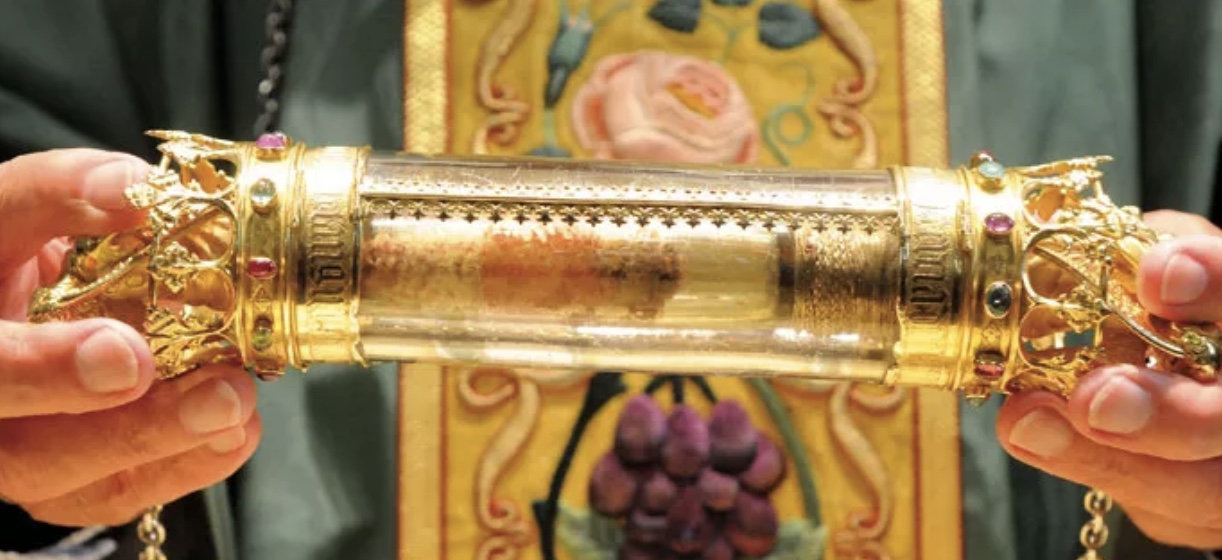
According to Christian tradition, after Jesus was crucified, Joseph of Arimathea wiped his body with a cloth and placed the body in a tomb. The Basilica of the Holy Blood houses a vial said to contain a scrap of that blood stained cloth. Popular legend has it that the vial was brought to Bruges from Jerusalem in the 1100s by Thierry of Alsace when he returned from the Second Crusade.
Unlike many relics, this one can be viewed up close. A stern priest in full regalia sits on a raised platform behind an altar, keeping a close eye on visitors filing past to see a red smear on a tiny scrap of coarsely woven cloth inside a rock crystal cylinder, itself under a glass cover. Of course, photos aren’t allowed, so here’s one from Visit Bruge’s website.
The main squares and streets are insanely crowded with day trippers and the city is much nicer in the smaller lanes and areas a little further out, particularly along the canals which distinguish Bruges from most other medieval towns.


From one of the bridges you can spot a tiny window where a city official would watch for merchants trying to sneak into town without paying the required toll. It’s the smallest window in Bruges, and said to be the smallest Gothic window in the world. Did some official from the Guinness Book of Records travel the world measuring small Gothic windows?

Outside the City Theatre is a statue of Papageno, the depressed birdcatcher who accompanies Prince Tamino on his quest to rescue his princess in Mozart’s The Magic Flute. We have no idea why he’s relevant to Bruges.

Because of its canals, Bruges is inevitably referred to as the ‘Venice of the North’ despite bearing little resemblance to that city.
In the hilarious 2008 movie, In Bruges, crime boss Harry, played by Ralph Fiennes, is told Bruges ‘isn’t Ray’s thing”. He cannot believe it, exclaiming [expletives deleted]:
“It’s a fairytale town, isn’t it? How’s a fairytale town not somebody’s thing? How can all those canals and bridges and cobbled streets and those churches, all that beautiful fairytale stuff, how can that not be somebody’s thing, eh? … Is the swans still there? How can swans not be somebody’s thing?”
Yes, there are lots of canals and bridges and cobbled streets and churches.


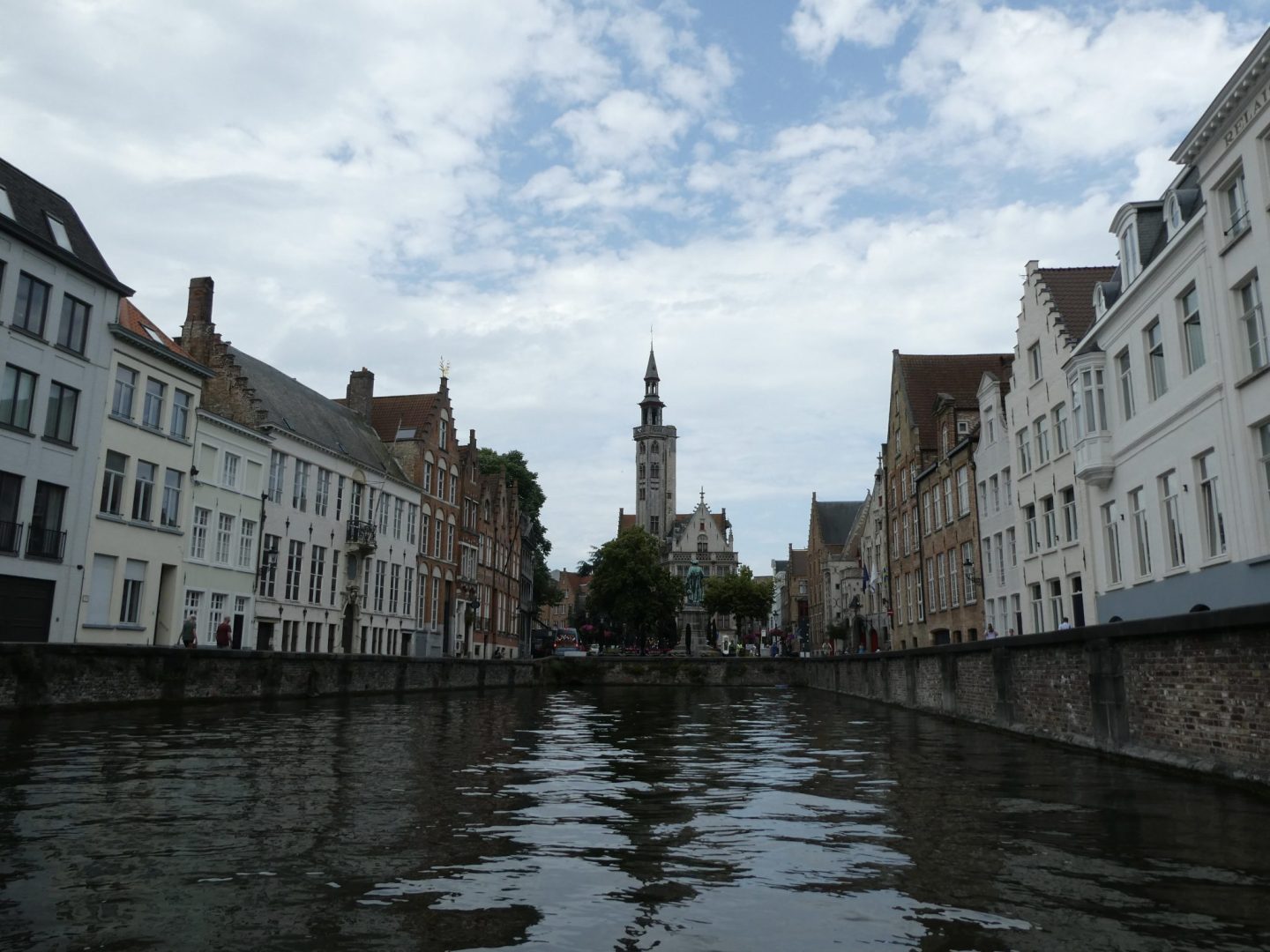
And yes, the swans are still here.


Eight million, yes that’s right, eight million tourists come to Bruges every year. And given it’s enduring popularity and the way every blogger, influencer and travel writer raves about Bruges, it seems most visitors share Harry’s viewpoint.
Ray, played superbly by Colin Farrell has a different perspective. He loathes hiding out in Bruges and considers giving himself up or killing himself. But then [again, expletives deleted]:
“I thought … at least in prison and at least in death, you know, I wouldn’t be in Bruges. But then, like a flash, it came to me. And I realised, maybe that’s what hell is: the entire rest of eternity spent in Bruges. And I really really hoped I wouldn’t die”.
We didn’t hate it as much as Ray but when everyday life in a town is replaced by streets and streets of chocolate shops and trinket stores, it ceases to be interesting, irrespective of how pretty it is. And those jostling crowds really wear you down.

You can get some respite by staying a few nights so you can see the city in the early morning or evenings when the day trippers aren’t around. We did that, and stayed on a barge hotel moored just outside the city walls. Very pleasant.
Or by taking a canal boat trip, provided you arrive first thing to avoid queue-ing for hours. It’s one of the best things to do here. Since 2020 electric boats have been introduced, gliding quietly where the foot tourists cannot go.


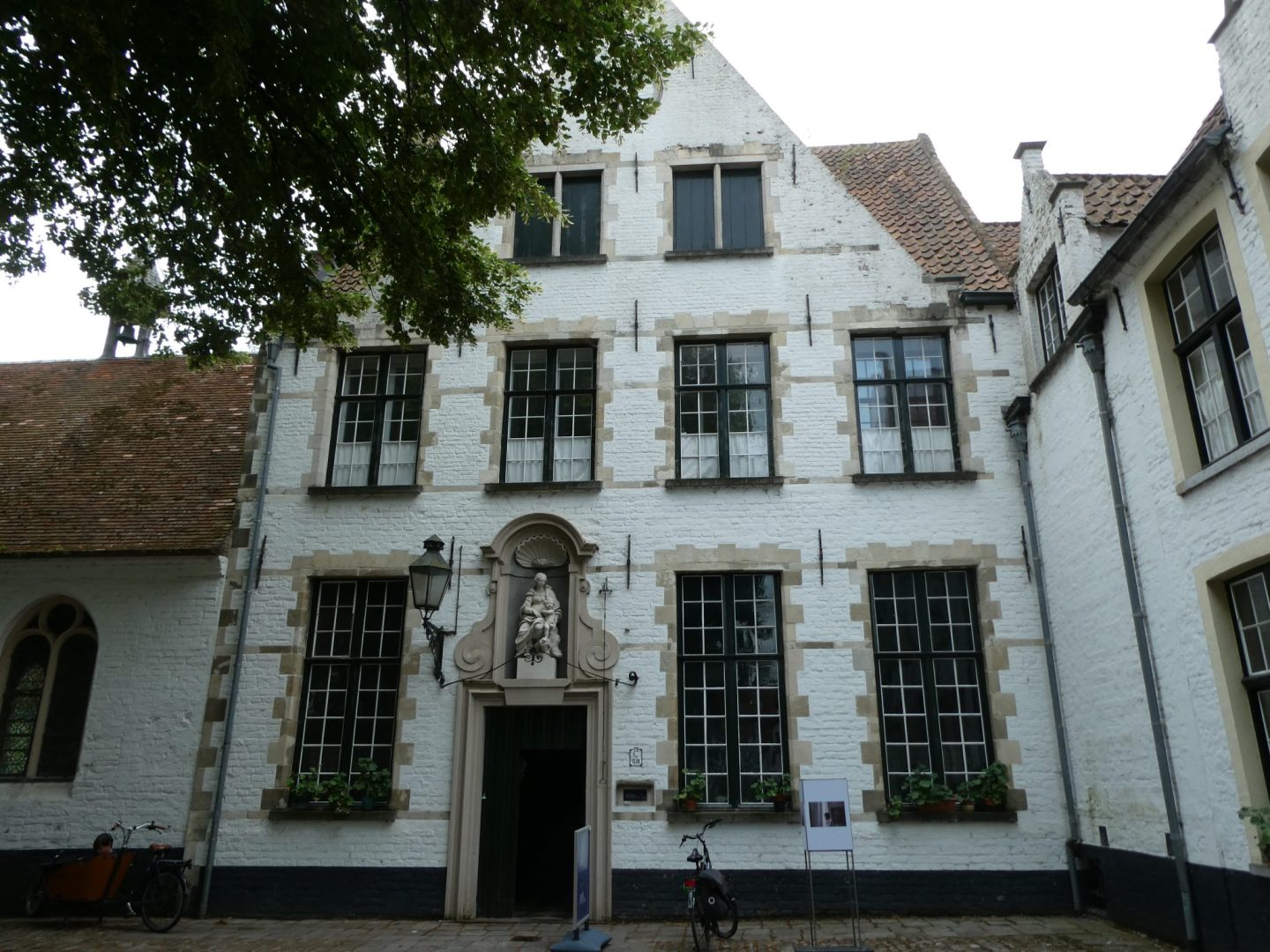
And it’s peaceful at the Princely Beguinage Ten Wijngaerde, a UNESCO listed beguinage complete with Gothic church and about thirty houses dating from the 16th, 17th and 18th centuries. Like the begijnhofs we’ve discussed in our posts on Amsterdam and Antwerp, the complex was once home to lay Catholic women who lived a semi-cloistered life dedicated to service in their community. The other two became secular when the beguines era ended. In 1927 this one became, and remains, a Benedictine convent.


Actually the most fun we had in Bruges was at the Belgian Fries Museum.

Who’d have thought you could pull together so many fun facts about potatoes.
Belgium claims to have invented potato fries. They acknowledge the French had already discovered the benefits of frying whole potatoes. But they say the fried chip started here. It is claimed that in the 1750s, people living along the Meuse River who were used to frying small fish, experienced a series of particularly harsh winters. The river froze and no fish could be caught so they cut potatoes into fingers of similar size, fried them and thus invented the fried chip.
Truly traditional ones are fried in a mixture of unrefined beef tallow and horse fat. We’re guessing that’s not often the case these days.
So why do the Americans and others call them french fries? Allegedly, in WWI, some Belgian soldiers gave their American counterparts some fries. The Yanks loved them, but as they thought the soldiers were French, called them ‘French fries’.
That must be annoying to the Belgians. Potato frying is a profession here, and they take it very seriously. The Belgian Union of Potato Fryers even has a medals system.

Did you know you can power a clock with two potatoes?

Or make a potato gun from ordinary household materials? This is a patator, or potato launcher. A chamber is filled with deodorant and sealed. An electric spark causes the mixture of deodorant and oxygen to combust, launching a potato capable of travelling more than 100 metres. At the rate at which Russia is losing military hardware to Ukraine, maybe they should crank up production of potato launchers instead of turning all their potatoes into vodka.

Belgian fries are good. So is Belgian beer. One final stop in Belgium before we head to France.

What a shame such an appealing city is inundated with tourists. The stay so one can appreciate the quiet times of the day sounds like the go as it is in places like Cinque Terre.