In the Middle Ages, Ypres (Ieper in Dutch) was a major textiles trading centre, particularly renowned for linen. Ypres’ Cloth Hall, built between 1200 and 1304 was one of the largest commercial buildings of the Middle Ages. Canals ran through it, enabling cloth merchants to load and unload their goods directly into the Hall. It’s currently receiving a facelift.

For over five centuries, the 70 metre high Belfry was the scene of heinous acts of felicide. If your Latin is a bit rusty, felicide is the killing of cats.
There’s some uncertainty as to how this started. Middle Ages superstitions about cats and witches is one suggestion. But the most likely seems to be something more unique to Ypres.
In its day, the Cloth Hall wasn’t just a trading room. It was also the warehouse for the city’s cloth stocks. As such it attracted lots of rodents. Rats and mice don’t eat fabric as a first choice, but they will chew on natural fibres and they like to shred cloth and line their nests with the scraps.
In an attempt to control the vermin, a few hungry cats were released in the Hall. The cats did indeed snack on the rats. But they also rather liked the warm, dry environment and abundant soft furnishings. They started breeding like, well, like un-neutered cats. Their numbers expanded at an alarming rate. To try and control this, an annual ‘cull’ was carried out. Cats were rounded up and thrown from the belfry. Shockingly, this practice continued for hundreds of years, until the last recorded ‘cull’ in 1817.

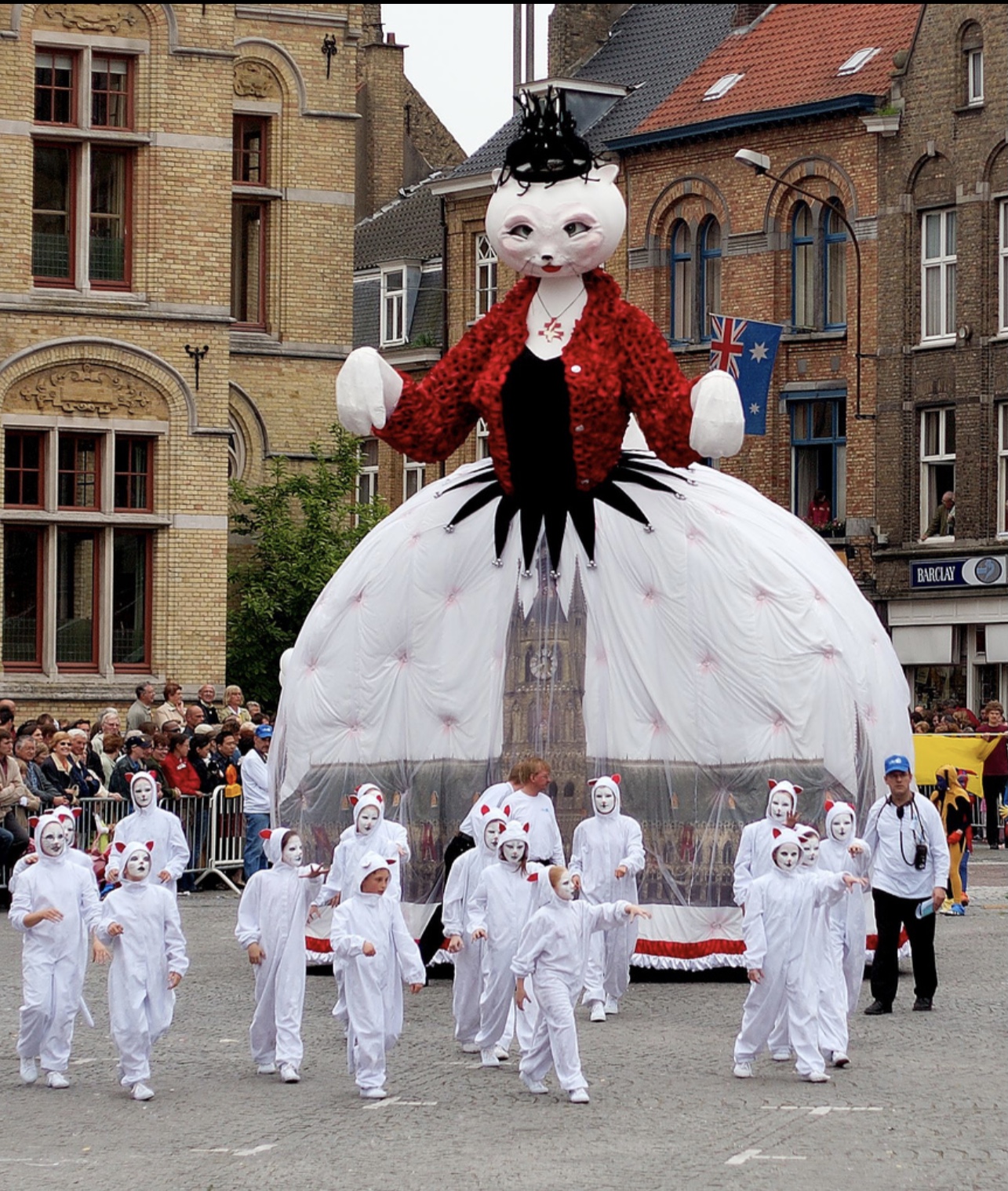
In the 1950s locals must have realised something needed to be done to atone for their forebears’ crimes against cats. Beginning in 1955, every three years the city celebrates Kattenstoet (Festival of the Cat) with a parade of giant cats, floats, street performers and brass bands. The festivities culminate with a jester in the Belfry throwing soft toy cats to children who gather below.
It’s a huge deal, attracting up to 50,000 spectators. Sadly, 2025 isn’t a festival year, but here’s a shot from a previous parade.
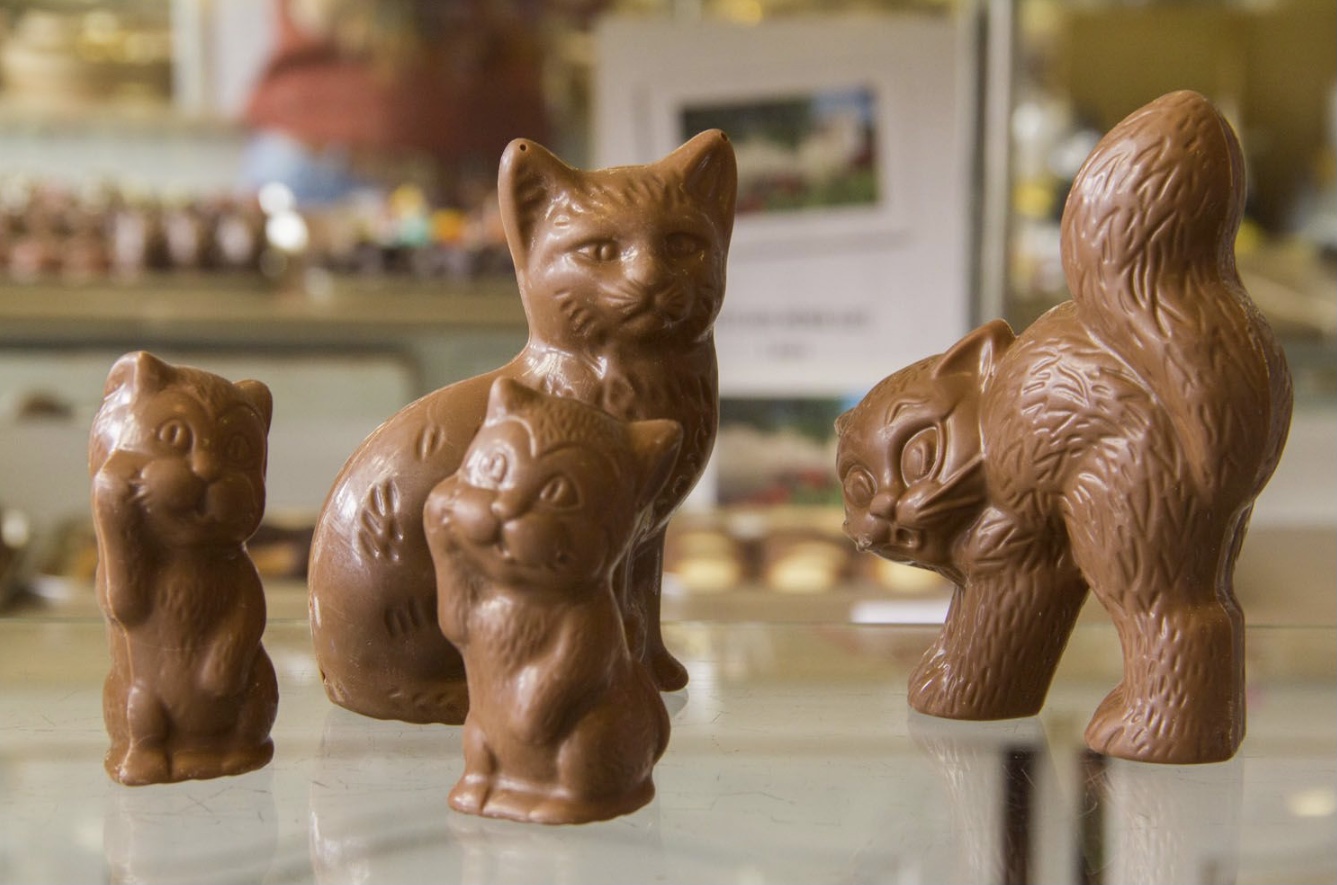
And all year round there’s plenty of cat-related products to buy. Belgium is famous for chocolates so, of course, there’s chocolate cats.
And why not cat liqueur. The dark one below is Iepers Katje (Ypres Kitten) aperitif.

For most of us, though, Ypres is best known for its role in World War I.
Under the German war strategy, Ypres was a key target. Taking it would enable them to sweep across Belgium and into France from the north. But French and British troops occupied the city from only a few days after the German army arrived in the area. Both sides dug in, establishing the Front Line along a saucer shaped area around Ypres known as the Ypres Salient. For the Allies, Ypres was designated ‘hold at any cost’.
Ypres never fell to the Germans, but was reduced to rubble from constant bombardment. Almost no building was left standing.
The Cloth Hall was meticulously reconstructed between 1933 and 1967 using salvaged materials where possible, and otherwise faithfully reproducing the original based on records and photographs. It now houses the fantastic In Flanders Fields Museum with detailed exhibits on the Ypres Salient battles.
For just over three years, the allied forces of Belgium, France, the United Kingdom and Commonwealth countries held Ypres and the Ypres Salient. Trench warfare in which both sides gained little territory at tremendous cost in lives.
Allied troops headed to the battlefields would pass the Menin Gate, one of the medieval entrances to Ypres. An estimated 300,000 British and Commonwealth soldiers who marched from here, never returned.
In accordance with then convention, where possible soldiers were buried in cemeteries created near the battlefield where they fell. But for many, there were no remains to bury or remains were never found.
After the war, the Imperial War Graves Commission funded construction of the Menin Gate Memorial to the Missing in honour of those who died in Belgian Flanders and whose graves are unknown.

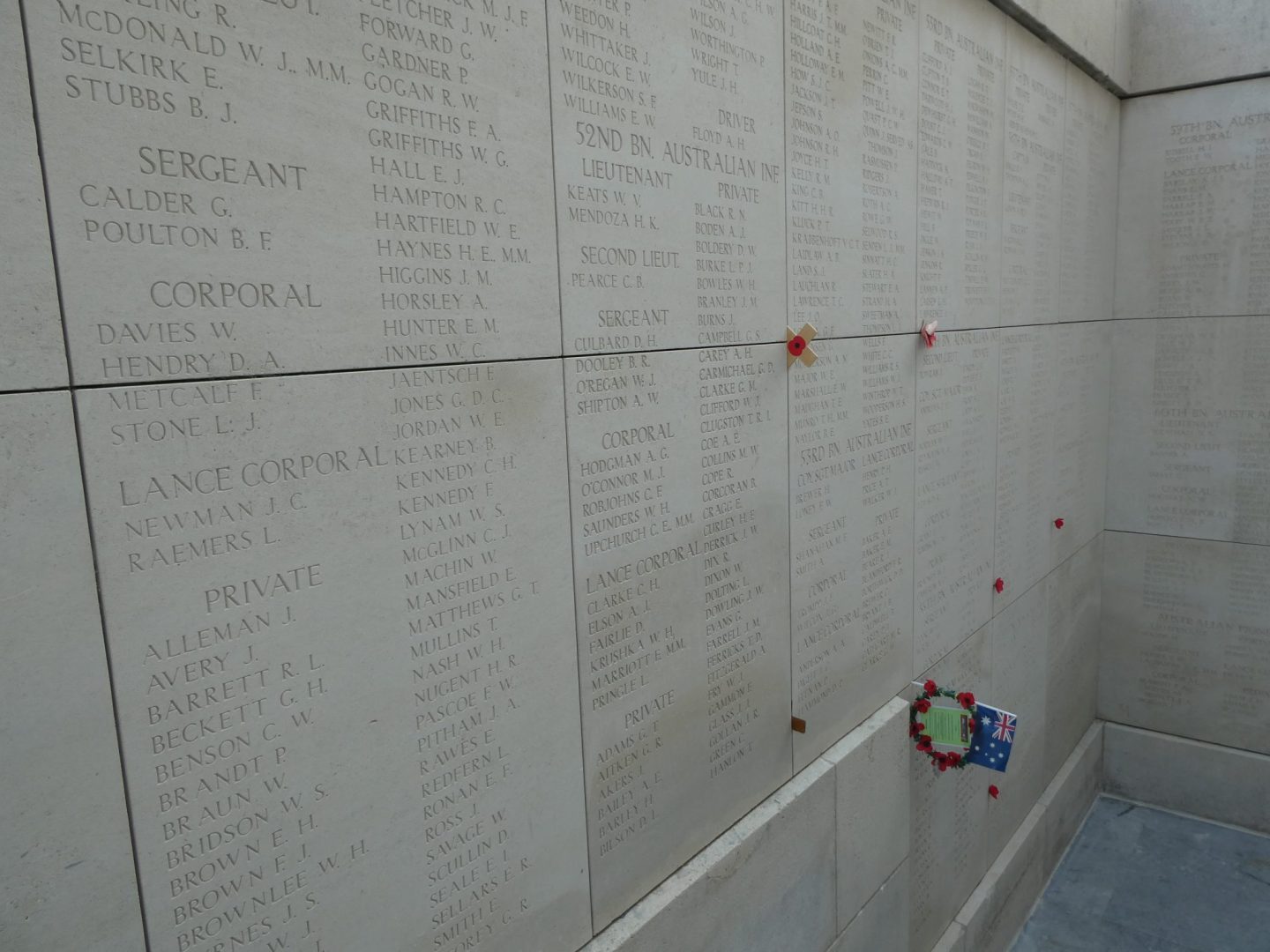
When it was finished, however, there wasn’t room for all the names. Covering the walls of the arches are the names of the 54,395 Australian, Canadian, Indian and South African troops, as well as British soldiers who died up to 15 August 1917, with no known grave. The names of the 34,984 British who died after this date with no known grave are inscribed on the Memorial to the Missing at Tyne Cot Cemetery nearby. The Menin Gate Memorial also does not list the names of the missing from New Zealand and Newfoundland, who are honoured on memorials elsewhere.
There’s a heartbreaking number of Australians.

Since medieval times, the Menin Gate had been flanked by two stone lions. By the end of the war, the lions had been damaged by schrapnel but remained intact. In 1936, the city of Ypres gifted the lions to Australia in recognition of the contribution of our troops. More than 13,000 died on Belgian soil in the course of the war.
The Australian government restored the lions and they have been at the entrance to the Australian War Memorial in Canberra since 1991, except during 2017 when they came back to their original spots at the Menin Gate on loan for the Centenary of the First World War.
In 2018, exact replicas were installed at the Menin Gate using the same stone and crafted by Belgian stonemasons, a gift from Australia to thank the Belgian people for their commitment to remembering Australia’s sacrifice.

Since the opening of the Menin Gate Memorial in 1927, at precisely eight o’clock every night, traffic is stopped, those gathered observe a minute’s silence, wreaths are laid, a piper plays and buglers sound the Last Post. It’s incredible to think it has been done every night now for almost 100 years.
The only time it wasn’t was when the Germans prohibited it during their occupation of Ypres during WWII. It’s perhaps a sign of how important it was to local people that the ceremony was resumed on the evening of the very day Ypres was liberated, even though heavy fighting was continuing in other parts of the town.
Its very moving.


Ypres played a smaller but still significant role in WWII. As the German invasion proceeded at pace through Belgium and France at the beginning of the war, the British Expeditionary Force waged a fighting retreat at the Ypres-Comines Canal. Although ultimately unsuccessful in halting the Nazis advance, it was one of the delaying actions which enabled the successful mass evacuation of troops at Dunkirk.
The British dead of both wars are honoured with this memorial in town.

More on Dunkirk in our next post.

The story of the Lions is very moving. So lovely that they remember the Australian contribution.