After a day’s R&R in Bilbao, we farewelled David and Noreen. They’ve hired a car and are off to the vineyards of Rioja. We wondered if this was a wiser choice than ours as we headed out of town under black clouds and with an ominous chill in the air. But the sky cleared as we entered the countryside and we’ve now completed the second week with not a drop of rain. Hooray!

Leaving Basque country, we were now in the province of Cantabria.
We put a little more pressure on the accelerator, covering 139km from Bilbao to Santander in five days, including two 35km days. Although there’s allegedly an ‘official’ route, there were lots of meandering variations. You can choose different paths depending on your preference for longer distances through the countryside versus more road walking – always the former for us – or coastal versus inland etc. We found that we might start the day thinking we’d walk 14km to our next destination and end up walking 20km, or 30km became 35km.
Somehow, the variations never seemed to shorten the day. But the walking was mostly great scenery, so no complaints. Here are some highlights from the week.
The 45 metre high, 160 metre span Vizcaya Bridge in Portugalete is the world’s oldest transporter bridge. Known by locals as Puente Colagante (‘hanging bridge’), it’s been in continuous operation since its inauguration in 1893, except for four years during the Spanish Civil War.

Opened in 1893, it was designed by Alberto Palacio, a follower of Gustave Eiffel. His pioneering use of iron technology and steel cables was copied around the world as a new way of building bridges. In awarding World Heritage listing to the bridge in 2006, UNESCO described it as “one of the most remarkable achievements of the Industrial Revolution in the field of metal architecture”.
It was an elegant solution to the problem of enabling passage between Portugalete and Getxo across the mouth of the Nervion River without disrupting maritime traffic to the upstream Port of Bilbao and without the need to build massive on/off ramps.
A gondola slung by wires shuttles vehicles and foot passengers back and forth every eight minutes.

The town of Portugalete was pumping.

It also had a very convenient set of outdoor travelators, the kind you see in airports. We stayed one night in Portugalete and next morning, it was a good way to start a long walk.

We could have used one later in the day on this path out of Pobena.

Our next stop, Castro-Urdiales has one of the Norte’s largest Gothic cathedrals, dramatically located on a promontory beside the remains of a Templar castle.

Along with some installations paying tribute to its past as a major whaling port.
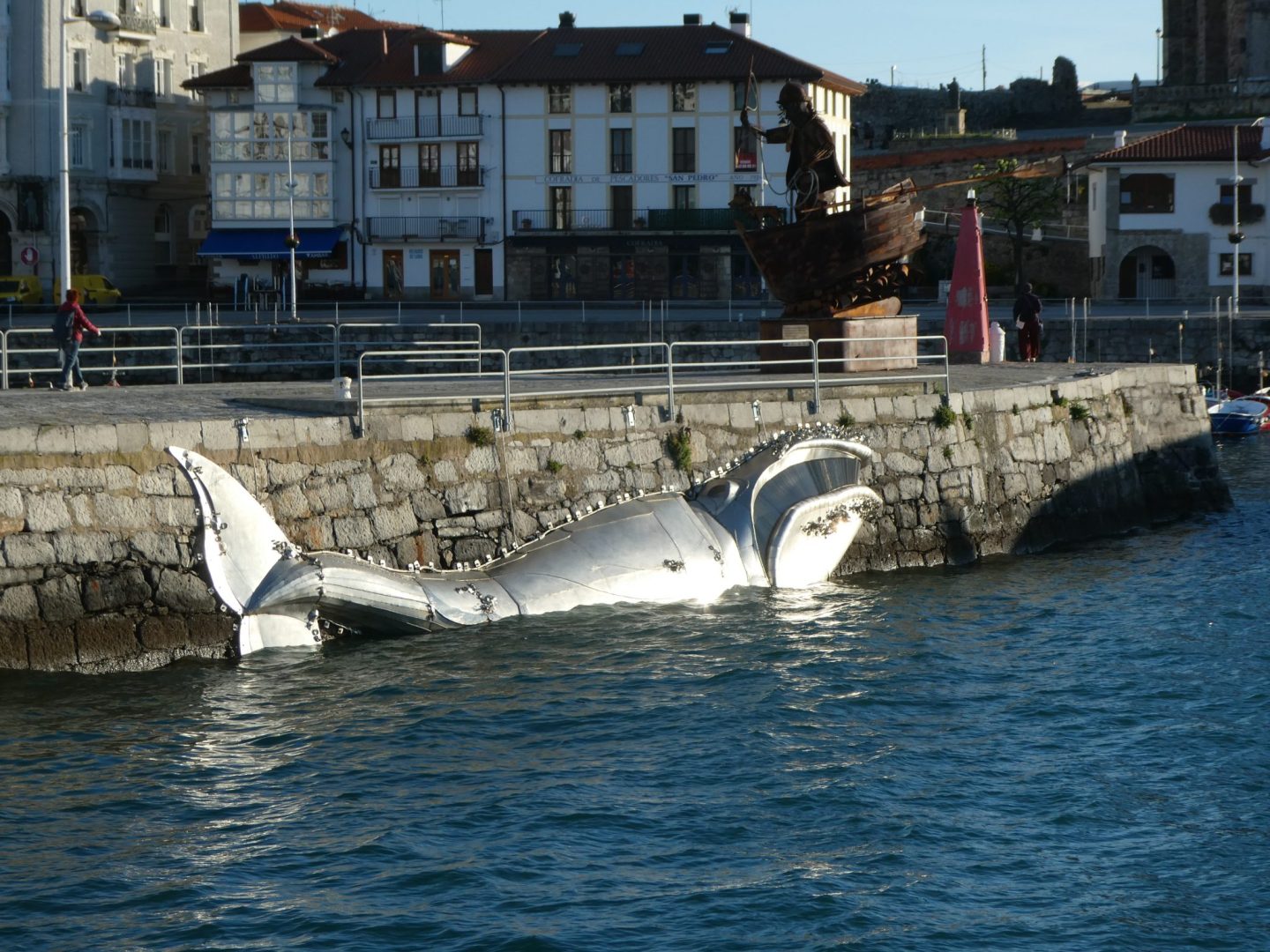

The coastal walking on this segment is said to be some of the best on the Camino del Norte. It didn’t disappoint.


And when the route meandered inland it passed through lots of quiet, picturesque villages.


As well as through serene farmlands.


We stayed in some interesting hotels. This one was the 19th century residence of a Spanish sugar cane magnate.

Just kidding. Not that one. This one.


Shuffling into Laredo after a surprisingly hot day with 35kms up and down hills, we may have been a little delirious. John asked, “What’s in Laredo apart from dead cowboys?” Unless you’re over 65 or had parents/grandparents who loved 1960s American country and western music, you’ll probably have to look that one up. Hint: try googling Streets of Laredo, and no, not the 1990s TV show.
The answer to his question, however, is that Laredo is now Cantabria’s largest resort town, with a promenaded beach that seems to go on forever, dotted with funky art to pretty up the loos!


A small ferry takes passengers from the end of Laredo beach to Santona, saving walkers a 13km arc around the mouths of two rivers.

On the other side, there was a reminder that we still have quite a journey ahead.

Santona is where Christopher Columbus’ boat, the Santa Maria, was built. It was owned by Juan de la Cosa, navigator and cartographer, who sailed with Columbus on his first voyages to the Americas and went on to create the first world map to include those newly discovered territories.

Toward the end of the week we took an unscheduled detour on our way to Noja and what should have been an easy stroll around the base of a ridge turned into a monster climb up and over. Great views from the top though.


That’s why they say to always expect the unexpected when hiking, but this was out of left field. On the last leg of this week’s walk, yes, that’s a camel grazing in the front yard of a house.

And later. Look, there are llamas. Apologies to Monty Python.
 A baby donkey with a mullet of which any western suburbs’ boy would be proud.

A cow using a power pole to scratch an itch she couldn’t reach.

Which reminded us of this horse we saw in week 1 doing the same.

The Camino scallop shell symbol kept popping up.


And we saw some artwork for which royalties may or may not have been paid.


Eventually we arrived in Santander where we are enjoying a rest day.
There’s not much of the medieval centre left, thanks to a major fire in 1941. Just the cathedral and a few other surrounding buildings.


But lots of belle-epoque architecture. And the striking Centro Botin cantilevered over the sea, designed by Renzo Piano and housing the Museum of Modern Art.

And now we are rested, laundry done and ready for week 3.
This week:
Day 8: Bilbao to Portagulete: 20km
Day 9: Portagulete to Castro-Urdiales: 29km
Day 10: Castro-Urdiales to Laredo: 35km
Day 11: Laredo to Noja: 20km
Day 12: Noja to Santander: 35km
Day 13: Rest day in Santander
Total so far: 269km.

Stunning scenery and I love the array of animals. I think mullet donkey takes the cake 😀
You guys are really pumping out the kms. What’s the gradient like ? We’ve had a lot of fairly serious ‘up’ but are only averaging maybe 15-18kms a day, though we did clock up 25km on one day in Rome ( not so hilly).
Author
The gradient isn’t anything like our hike in the Accursed Mountains in Albania last year. More like consistent up and downs, although there’s been a few lung busters along the way!
Loving all the photos and commentary and agree, the mullet donkey is amazing.