We made it!
871km after setting out from San Sebastián, we arrived in Santiago de Compostela. Since our previous post we’ve walked another 203km in a final nine days from Ribadeo.
Leaving Ribadeo, almost immediately the Galician landscape seemed quite different to Asturias. Softer curves to the hills and even greener, although that could have been because spring was quietly advancing toward summer.


The way markers changed in Galicia, too. Standard format and much more frequent. A short time out of Ribadeo, we came to this one.

We were certain we hadn’t walked 187,540km, although our feet seemed to think so. Some nights if we lay quietly in bed we could hear them muttering and grumbling to each other about the unreasonable demands we were placing on them.
Of course, the sign post meant metres. Only 187,540 metres to go. Thanks, that sounds so much better than 187km.
The wind turbines on the hills in the background of the next photo – we knew what lay ahead.

On Day 34 the promise of sweeping views again seduced us into taking the ‘high level variant’. A long steep climb indeed, but the reward was definitely worth the effort. At the top we walked for hours along an undulating ribbon of road, with only a couple of horse riders for company.


After a couple of days climbing the hills, the next few were on leafy lanes and forest trails. Tranquil and very beautiful.
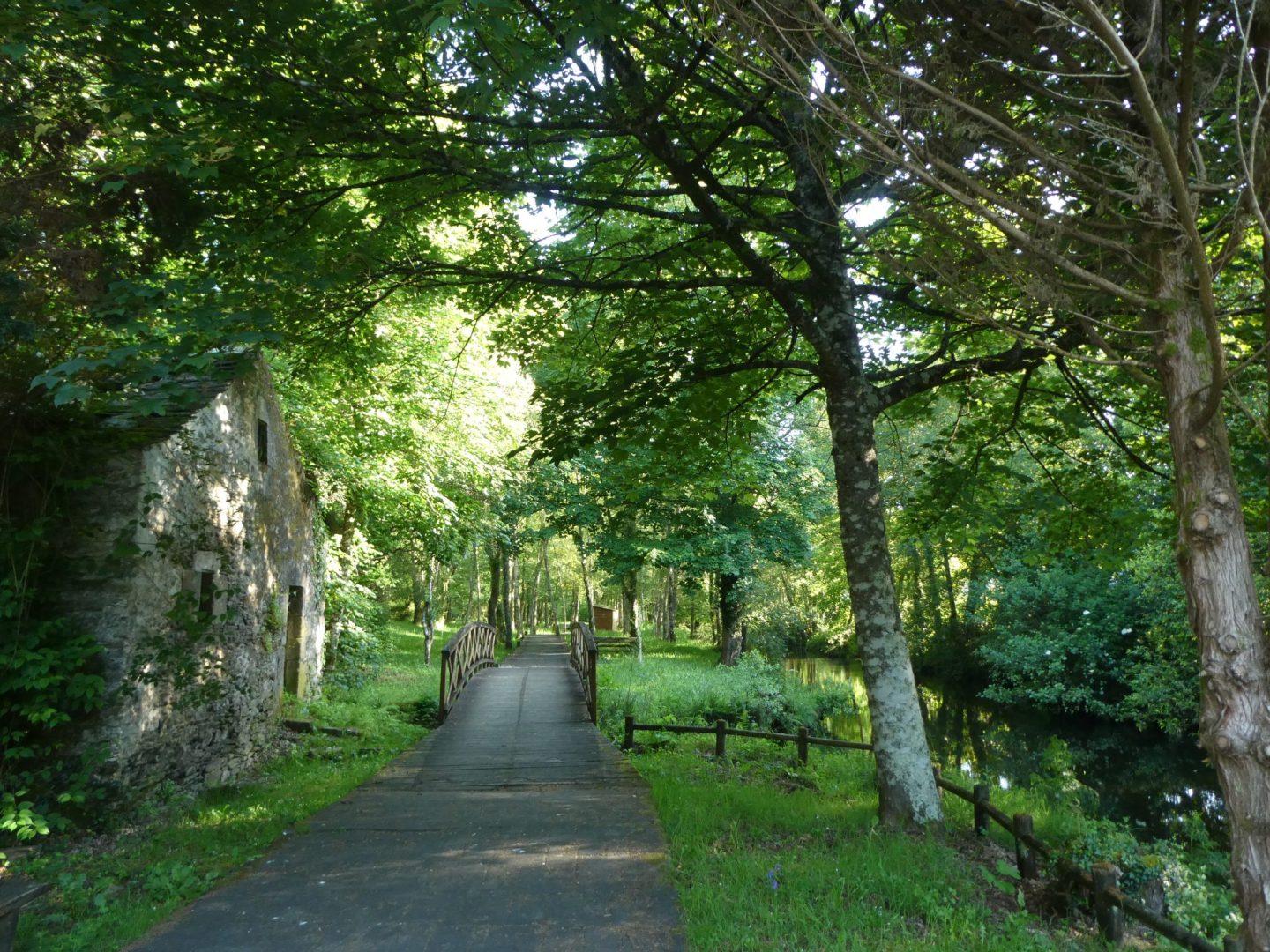


In the first weeks of the hike we were seeing new leaf growth and buds, now everything was blooming.


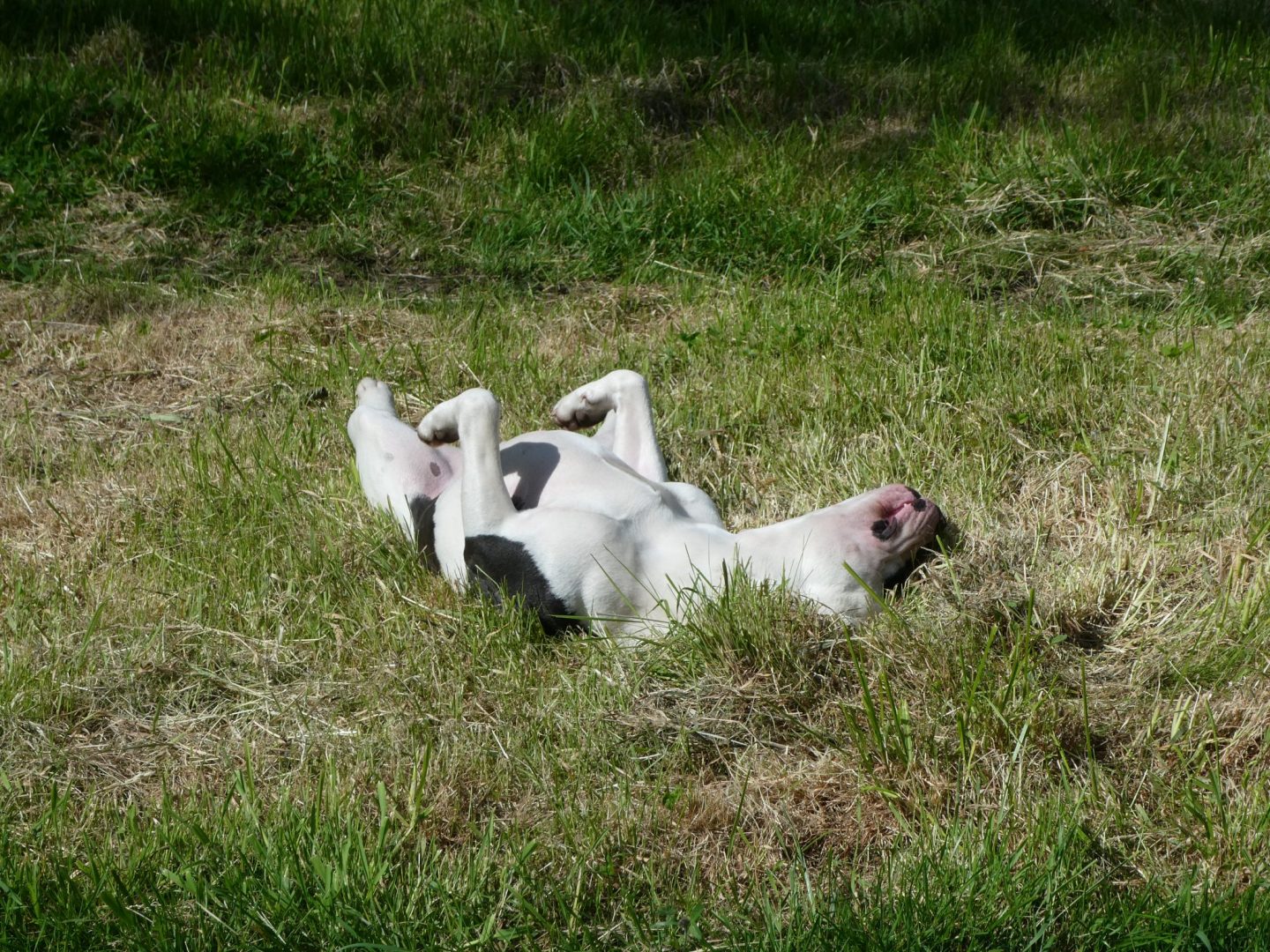
Summer is almost here. The days were long, sunny and the temperature was rising a couple of degrees per day. This dog was loving it.
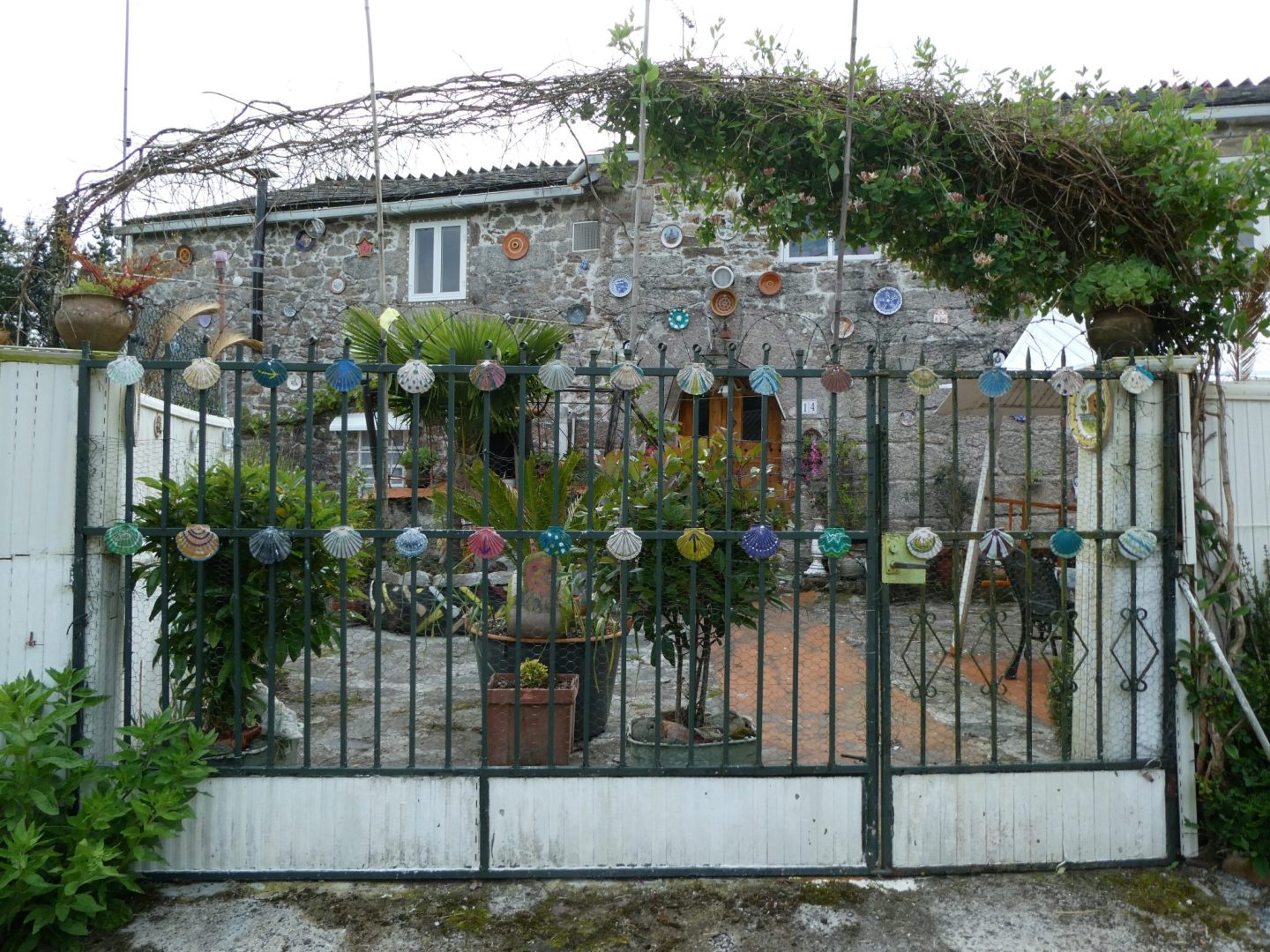
This was a different way to declare true love.

And for the final time, here is our ‘cow of the week’.

In the grounds of the church in Baamonde is this magnificent 700 year old chestnut tree.

A few years back, the local council planned to chop it down to widen the road. Protests ensued. The council relented. Look closely and there’s a shrine at the base of the trunk and another on a high branch. Can’t mess with a sacred tree.


It hasn’t always been this way.
Between 1837 and 1839 the Spanish government confiscated monastic lands across the country, supposedly because the monasteries were not using them to full capacity. The government claimed that the land would be re-distributed to enable ‘ordinary’ folk to own property. They paid no compensation to the religious orders for the land grab, but then didn’t give the land away, they sold it off. And since most ‘ordinary’ folk couldn’t afford to buy, the confiscated lands were mostly snapped up by already wealthy landowners. So, in reality, the outcome was reducing the power of the church, profit for the government and an increased concentration of land ownership with the gentry.
Most of the confiscated monastery buildings crumbled to ruin, which might partially explain the extraordinary number of derelict church buildings we came across in the course of the walk.

Decades after the confiscations a very few of the monasteries were handed back and have been restored. Like the Monastery of San Salvador in Lourenza, founded in the 10th century by a local noble. He’s interred in the monastery in an ornate sarcophagus which, according to legend, he carried himself on a pilgrimage to the Holy Land. Try fitting that in a backpack.

The stone facade was designed by the same mason who went on to design the cathedral in Santiago de Compostela and despite the surrounding lands being nabbed by the State, the monastery and church survived and have been beautifully preserved.

And the Santa Maria Monastery in Sobrado dos Monxes. Founded in 951, it was confiscated by the State in 1835 and the abbey lay derelict for over a hundred years until reconstructed by Trappist monks in the 1950s.


On Day 36 we passed another milestone – just 100km to go.

We were used to seeing scallop shells everywhere by now.

But surely it’s reached peak shell symbolism when even the sewer pits bear the emblematic scallop.

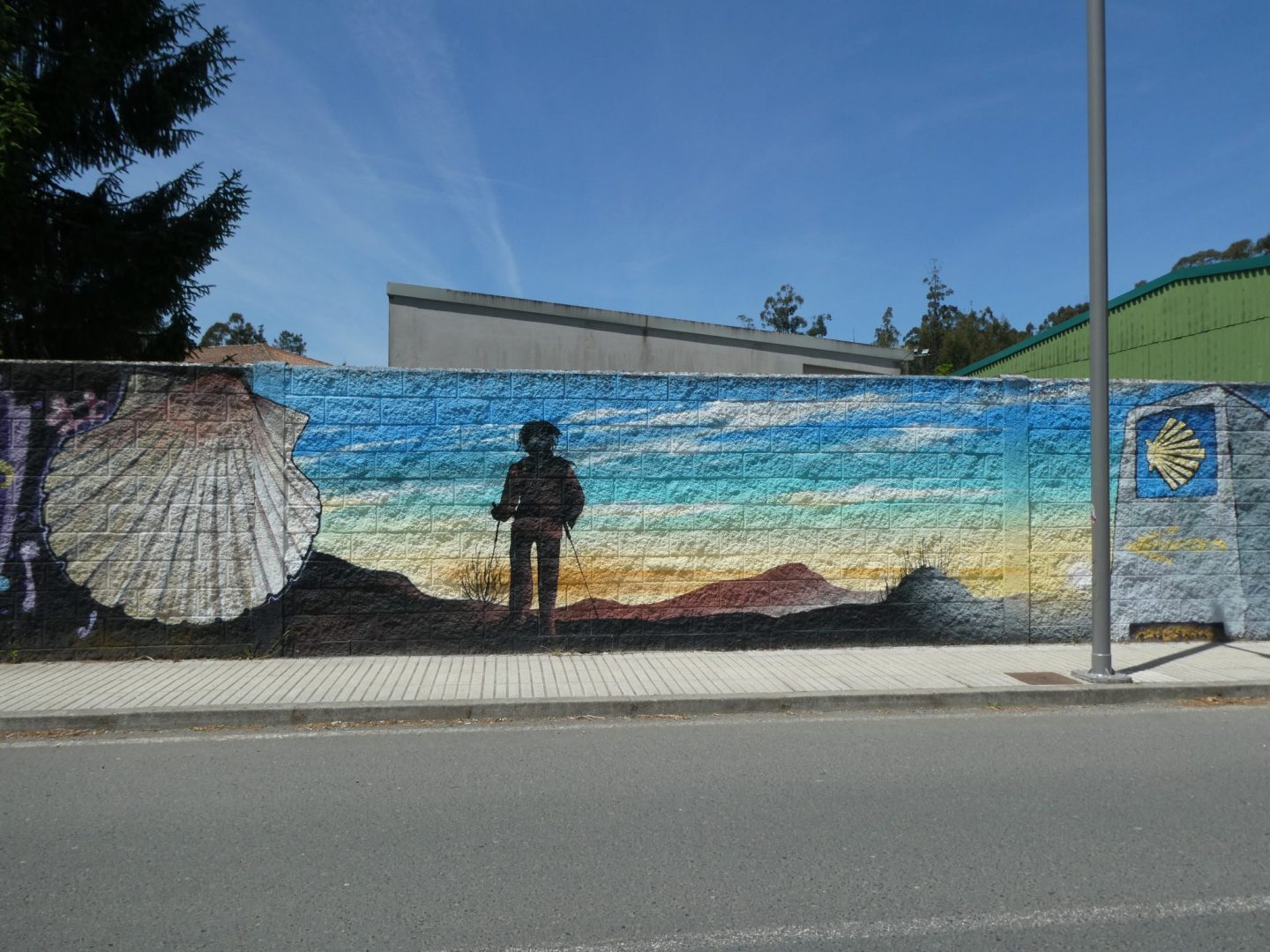
We’ve seen very little graffiti, but we liked this cutie.

There’s a well known phenomenon called ‘pilgrim shock’ experienced by walkers from the Norte when they reach Arzua. Here, just 40km from Santiago de Compostela, the Norte joins the Camino Frances for the last stretch into Santiago de Compostela.

After five weeks of peaceful trails where we might see a handful of other walkers in the course of a day, suddenly there were walkers everywhere. Arzua bustles with hostels and the plaza was full of walkers sprawled in the sun, day packs and hiking poles carelessly strewn everywhere.
It’s a different demographic to the Norte where most of the walkers were singles or couples, and most were around our age. Here we encountered larger groups, and most were in their 20s and 30s. And there was a different vibe – more like heading off to an outdoor concert than coming into the home straight of a long and somewhat meditative journey. We suspected many were doing the short version – just walk the last 100km and you qualify as a ‘pilgrim’. Good luck to them, but instantly we missed the solitude of the Norte. That’s pilgrim shock.
You can call us anti-social, even misanthropic, but this photo, taken as we left Arzua, shows exactly why the Norte was the right choice for us.

The last couple of days went quickly. On the outskirts of Santiago, we passed this encouraging sign.

And suddenly, or so it seemed, we arrived.

The end point of all the Camino de Santiago routes is the Cathedral de Santiago de Compostela, the resting place of the bones of St James. This photo was actually taken at dawn the next day – the only time it’s possible to get a shot without a zillion self congratulatory high-fiving hikers clogging up the foreground!

We were here a few years ago and much of the interior was under scaffold for restoration. That work is now complete and the results are stunning.


Hanging above the chancel is the botafumeiro, the cathedral’s famous censor. It’s the largest in the world, weighing 53kg and measuring 1.5 metres in height. This one is a brass replica made in 1852 to replace a solid gold one stolen during the French occupation. A second silver one is held in the cathedral library and brought out for use on just eleven special religious feast days each year.

The censor is filled with 40kg of incense and charcoal, lit and repeatedly swung almost to the roof of the central nave via a rope and pulley system operated by eight red-robed men called tiraboleiros. Here’s a picture from the cathedral’s website showing it in operation.
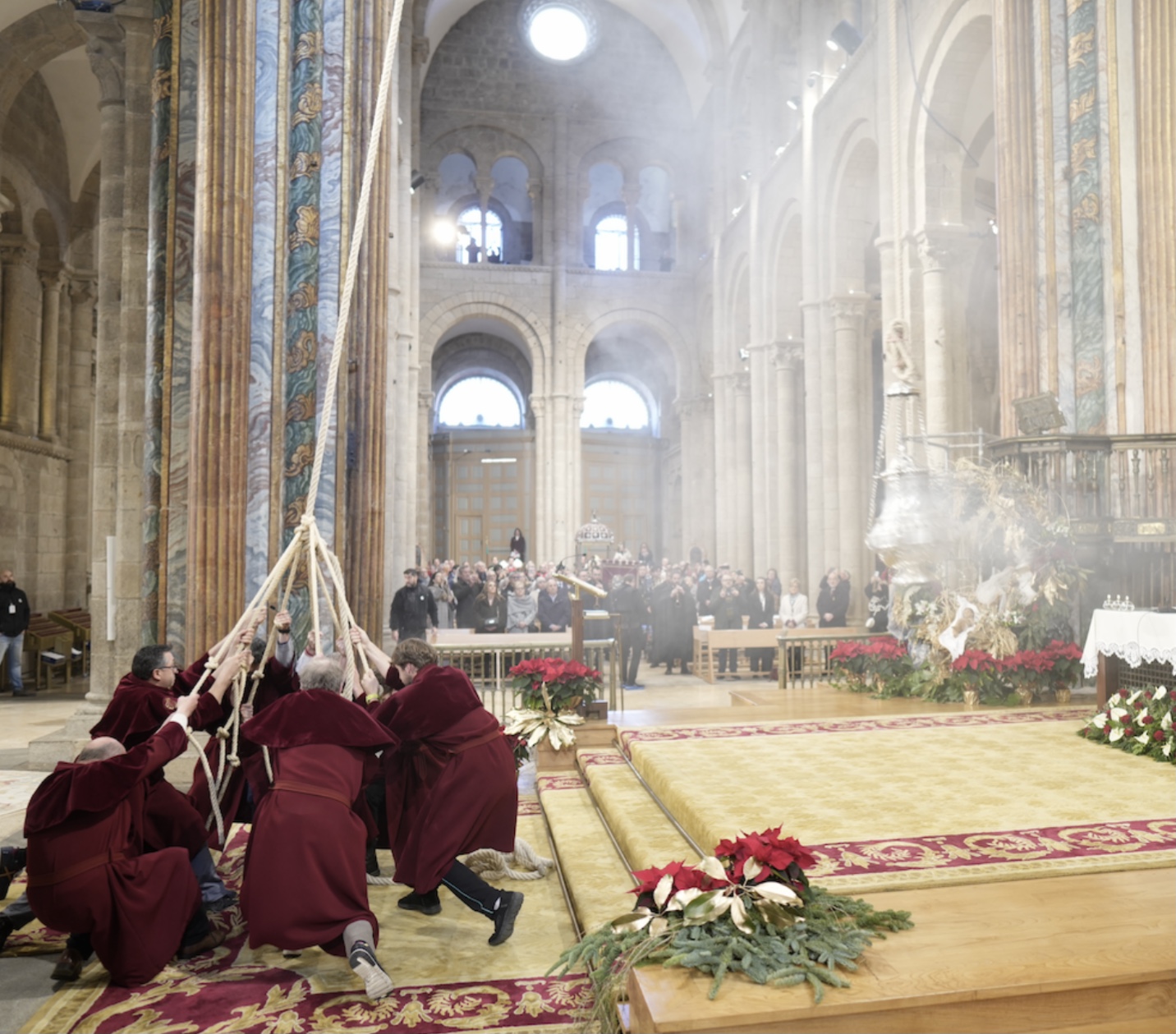
It was once traditional to hug or kiss the statue of St James behind the altar. Since Covid that’s no longer allowed but pilgrims still file down to the crypt to pay their respects to his bones, which are locked away in a silver casket.

Santiago is awash with hikers. Even after showering and packing away the walking gear, many can still be identified. John called it ‘the pilgrim duck walk’. It’s that stiff, strained or lopsided hobble which says blisters, sore feet, shin splints, creaky knees or just plain leg muscle fatigue. We were all members of that community for a few days!
Armed with a pilgrim passport known as the Credential, pilgrims can collect stamps from hotels, churches, museums and businesses along the route.

Julie diligently collected the stamps for both of us along the way.

Provided you actually walk the last 100km and have two stamps per day, dated, you can collect your Compostela at the Pilgrims Office in Santiago. The Compostela is a certificate written in Latin, proof of completion and status as a bona fide pilgrim.
On arrival, you take a ticket at the Office and wait to be called. We were numbers 814 and 815 for the day. The website has a real-time daily count and on our finish day more than 2,500 were issued. That also gives some insight as to how packed the last 100km of the Frances route is.
So now we have ‘skip the line’ tickets for when we front at the Pearly Gates.
As regular readers know, we don’t take selfies and we don’t post photos of ourselves on the blog. So here is the proof we made it.

And we walked all 871km of it. Some tough walking but lots of magic moments. As novelist Elizabeth van Arnim wrote:
“If you go to a place on anything but your own two feet, you are taken there too fast and miss a thousand delicate joys that were waiting for you by the roadside”.
This week:
Day 32: Ribadeo to Lourenza: 30km
Day 33: Lourenza to Abadin: 24km
Day 34: Abadin to Vilalba: 21km
Day 35: Vilalba to Baamonde: 22km
Day 36: Baamonde to Miraz: 16km
Day 37: Miraz to Sobrado dos Monxes: 26km
Day 38: Sobrado dos Monxes to Arzua: 23km
Day 39: Arzua to O Pedrouza: 21km
Day 40: O Pedrouzo to Santiago de Compostela: 20km
Grand total: 871km

Congratulations. Amazing journey and I have loved reading it all.
Congratulations. I am in awe. What on earth are you going to do next?
What an amazing achievement 🏆🍾 and I love this:
“If you go to a place on anything but your own two feet, you are taken there too fast and miss a thousand delicate joys that were waiting for you by the roadside”.
Leafy lanes & forest trails more my thing . The mere mention of ‘high level variants’ sends me into a tail spin. The confiscation of monastic lands benefiting wealthy landowners is a very common theme. Love the pics of St James cathedral & the quote by Elizabeth von Arinim – happy you will be home soon x
What a fabulous achievement! Sit back and put your feet up for a while! I’ve enjoyed following your walk! Cheers
Big effort obviously well worth it. Congrats. If only there was a low person variant at the end. We spend our entire travels trying to avoid the high tourist areas. That last day would definitely induce Pilgrim Shock.
Sounds great and the photos as always special
Pleased you have your paper work.
Xx