Deep in the dense jungle where the borders of Uganda, Rwanda and the un-Democratic Republic of Congo converge, live the world’s last remaining mountain gorillas.
In 1980 there were only about 250 left in the wild. The population had fallen to a species-critical level due to habitat loss, poaching, diseases from human and livestock contacts, and being hunted for food in Rwanda and Congo by people displaced by war.
Conservation measures have turned the tide, and it is estimated there are now approximately 1,000 spread across the three countries. But that’s still a tiny number. They remain listed as Endangered on the IUCN Red List. As one poster we saw states, ‘there’s just one mountain gorilla for every eight million people on the planet’.
Almost half of them live in the Bwindi Impenetrable Forest in Uganda. The rest are spread between Congo, Rwanda and the Mgahinga National Park near Bwindi.
Congo is effectively off limits to tourists. There’s only one group in Mgahinga, and they’ve been known to disappear for long periods to places too far for tracking. That leaves two practical access points from which to see mountain gorillas – Volcanoes National Park in Rwanda and Bwindi Impenetrable National Park in Uganda.
We chose Bwindi over Rwanda for a few reasons.
Both have well managed programs for trekkers, but Bwindi has the greater number of gorillas.
Also, the Rwandan ones are very close to the Ugandan border and regularly move back and forth across it. Neither trackers nor trekkers are permitted to do that, so if a family group has crossed into Uganda, they cannot be tracked.
There were lots of other things we wanted to see in Uganda so it made sense to visit the gorillas from the Ugandan side.
And lastly because, well, how could you not want to visit somewhere called an Impenetrable Forest.
It’s an apt name.

After a safety briefing, we set out as a group of eight trekkers with a guide, three porters and two security guards. It can take up to two hours to find them, and however long it takes, the group is allowed one hour with the gorillas.

Trekkers are encouraged to hire a porter on the basis that the terrain is tough and a porter will help hoist you up and guide you down the slippery slopes. But for people used to hiking, the terrain is manageable. The better reason to hire a porter is that they are from the villages on the edge of the park which are no longer allowed to collect food from and use the forest. It’s a way of putting money directly back into the local community, and recognising that these people have been forced to sacrifice an age-old traditional right of use in order that the gorillas and other forest animals be preserved.
The trekking was not as difficult as we imagined it would be. It was humid but cool due to the altitude and for the most part was on trails that switchbacked around the slopes. But once our family group was located by the trackers, it was a steep, unstable slither down to reach them.
Busy concentrating on not falling, Julie was so totally focussed on her feet that when she reached the first bit of stable ground and looked up, she was startled to see, right there, about five metres away, the silverback lying still in the foliage.
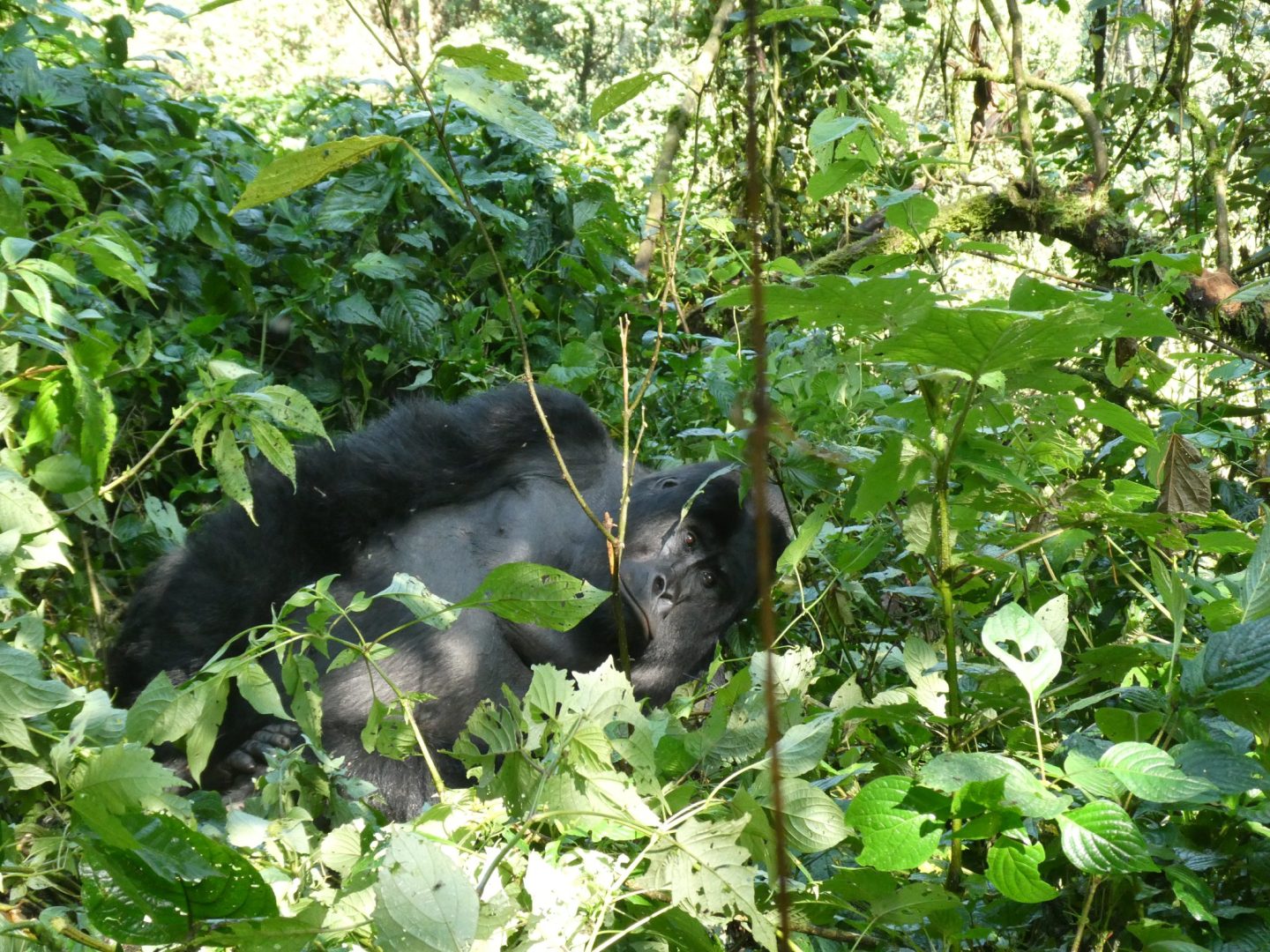
Average males reach a standing height of 160 to 170cm and weigh between 120kg and 190kg, but they can get bigger. The tallest ever recorded was 1.95cm – that’s 6 ft 6 in – and weighed 219kg. The heaviest ever recorded was a whopping 267kg.
Despite their size and strength, they are generally shy and gentle. It’s still a shock to come suddenly face to face with one.

When we’d all got to the spot, we just stood mesmerised, watching him. He didn’t move.
We were starting to think he might have been like the Norwegian Blue in Monty Python’s ‘Dead Parrot’ sketch. “The only reason it had been sitting on its perch in the first place was that it had been nailed there”.
But then he registered our presence. Whoa!
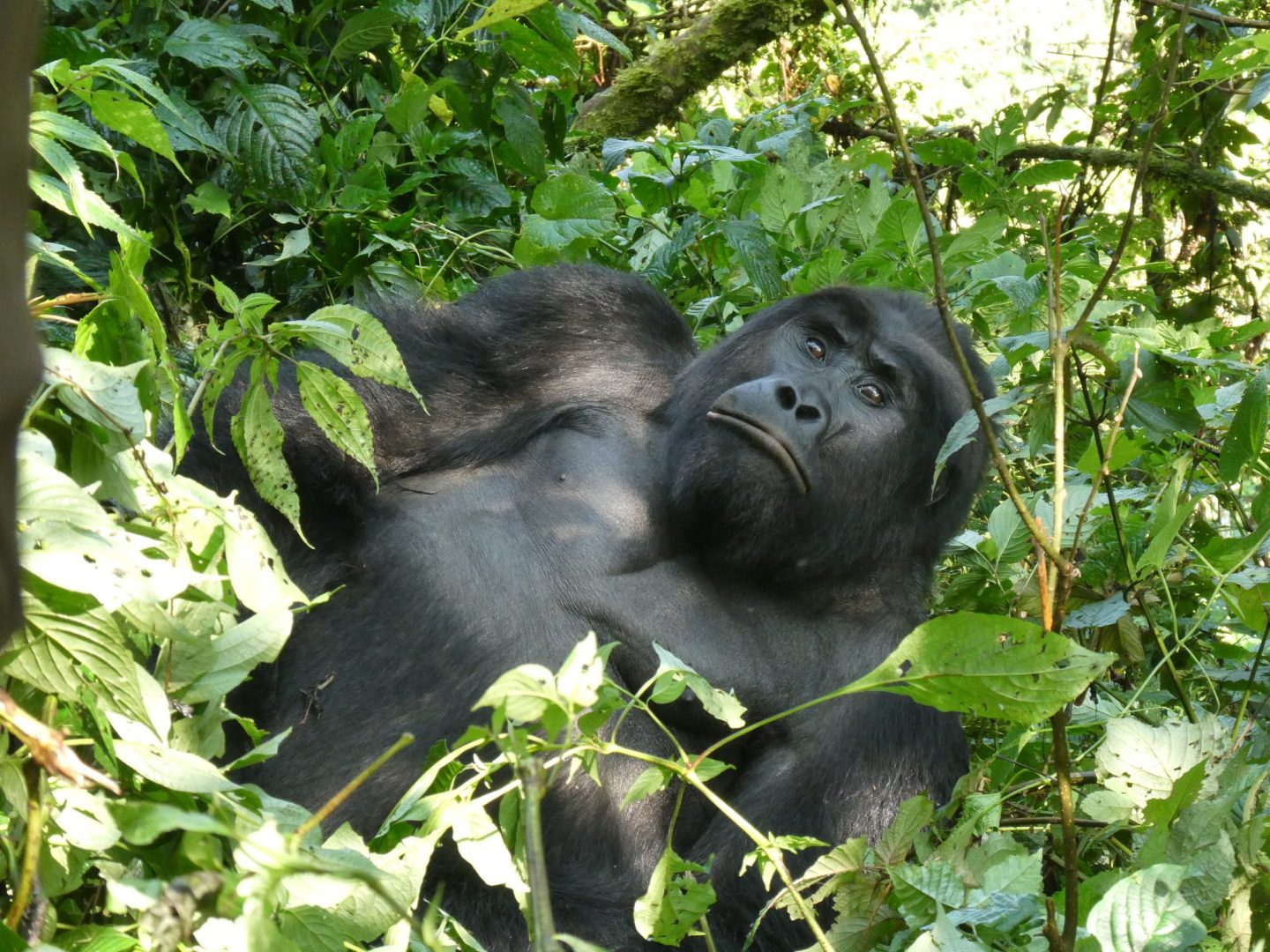
Gorilla groups typically consist of one silverback, three or four females and several young. So it wasn’t surprising when two females eventually revealed themselves in the trees above where the silverback was relaxing.
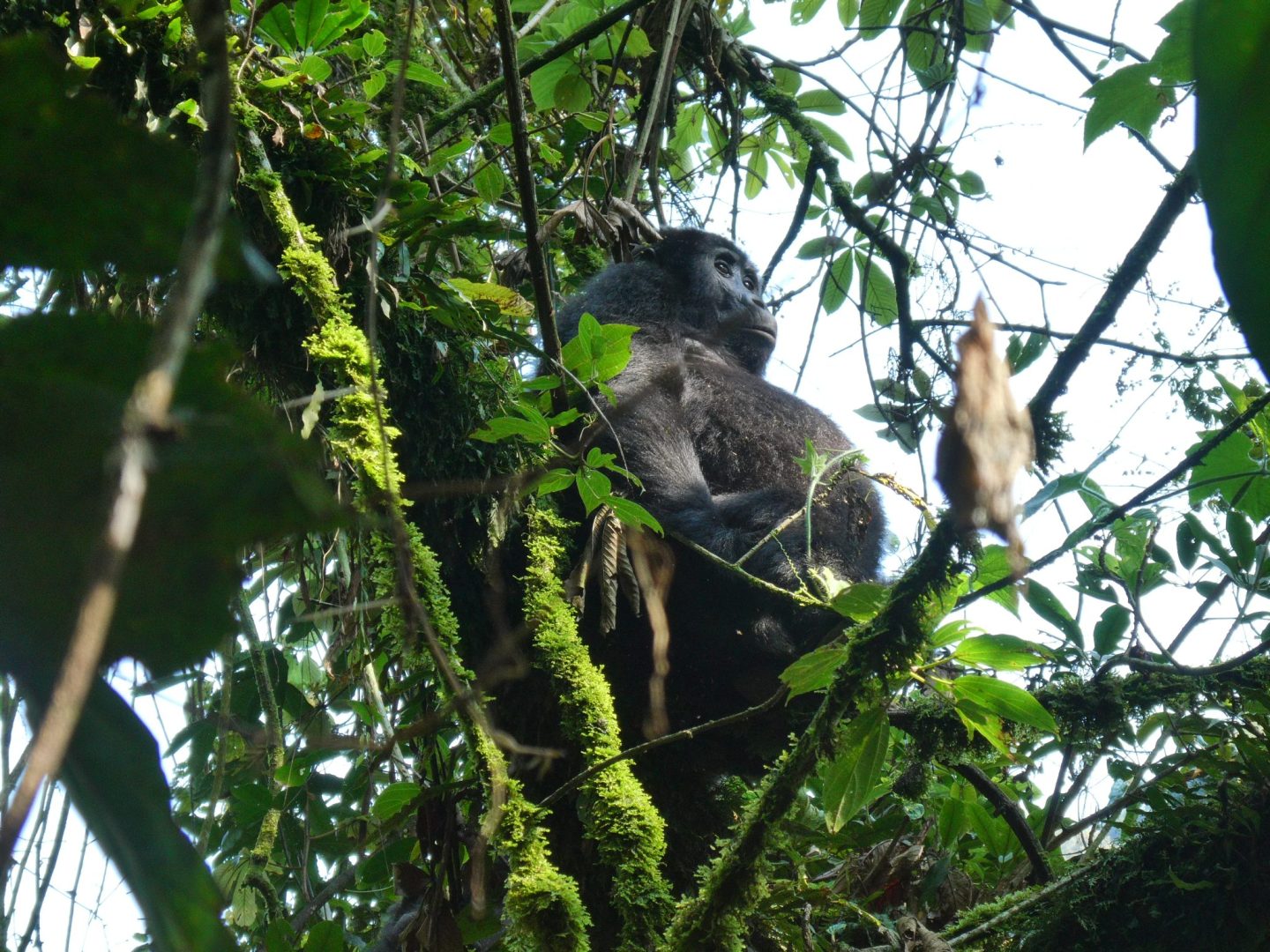

Mountain gorillas are mainly herbivorous, eating leaves, shoots and stems, and occasionally also small invertebrates. The females were still having breakfast.

Young gorillas play wrestle and chase each other. As we sat watching the silverback and females, a couple of small ones came tumbling out of the forest and rolled around enjoying themselves.

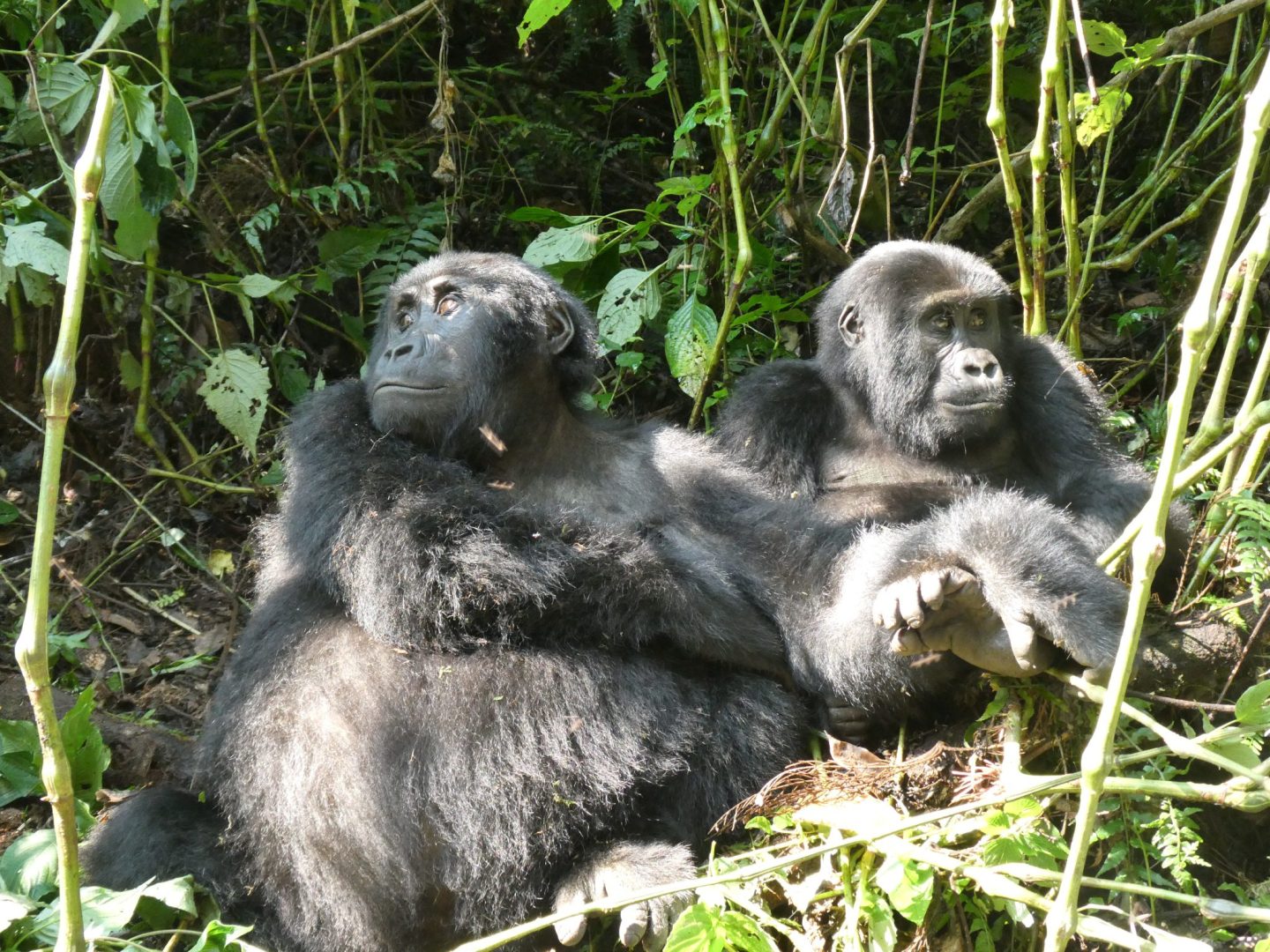


It was mostly fun and games until one got a bit antsy.
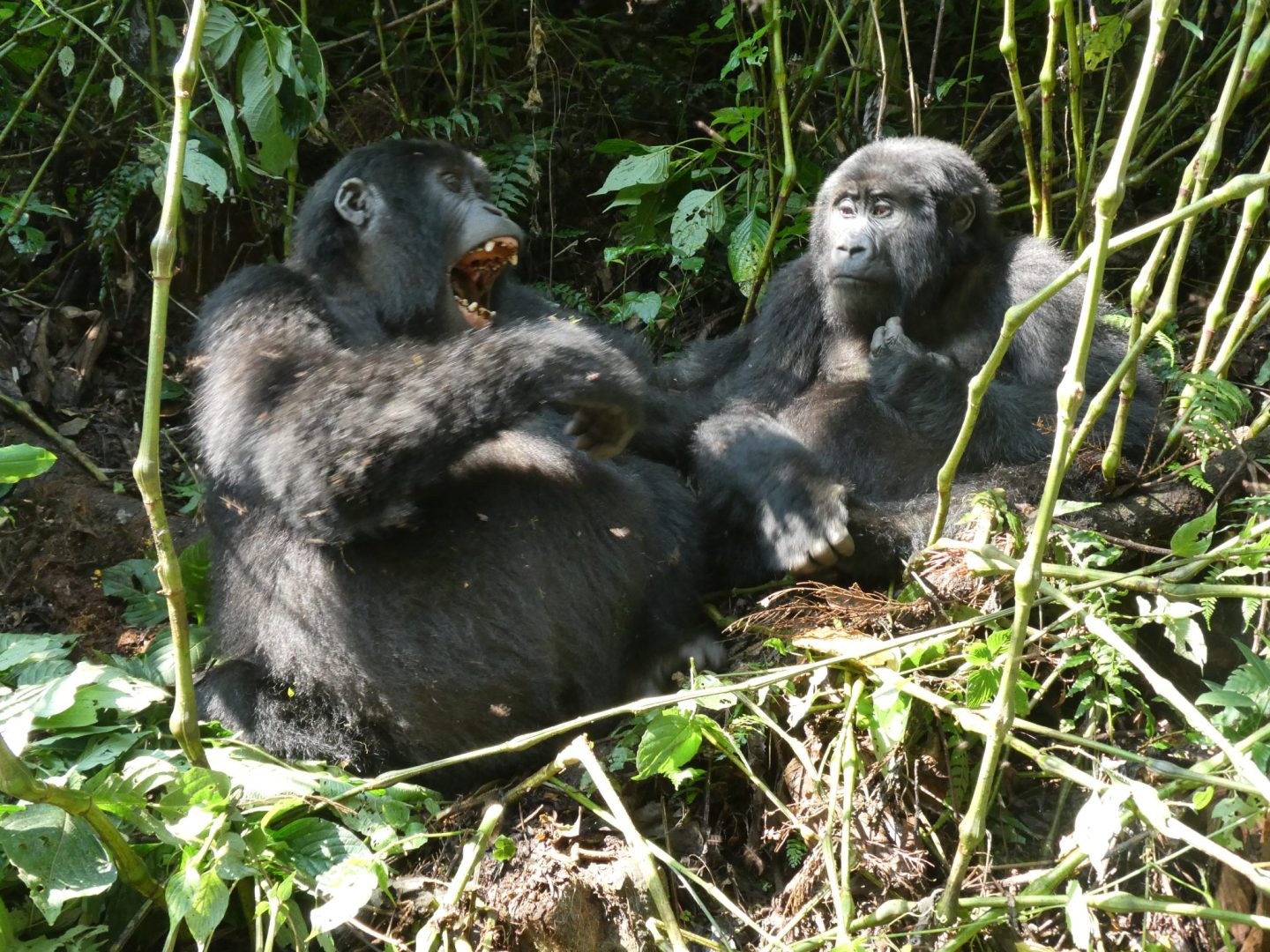
He gave the other one the cold shoulder and settled down to chew some stems.
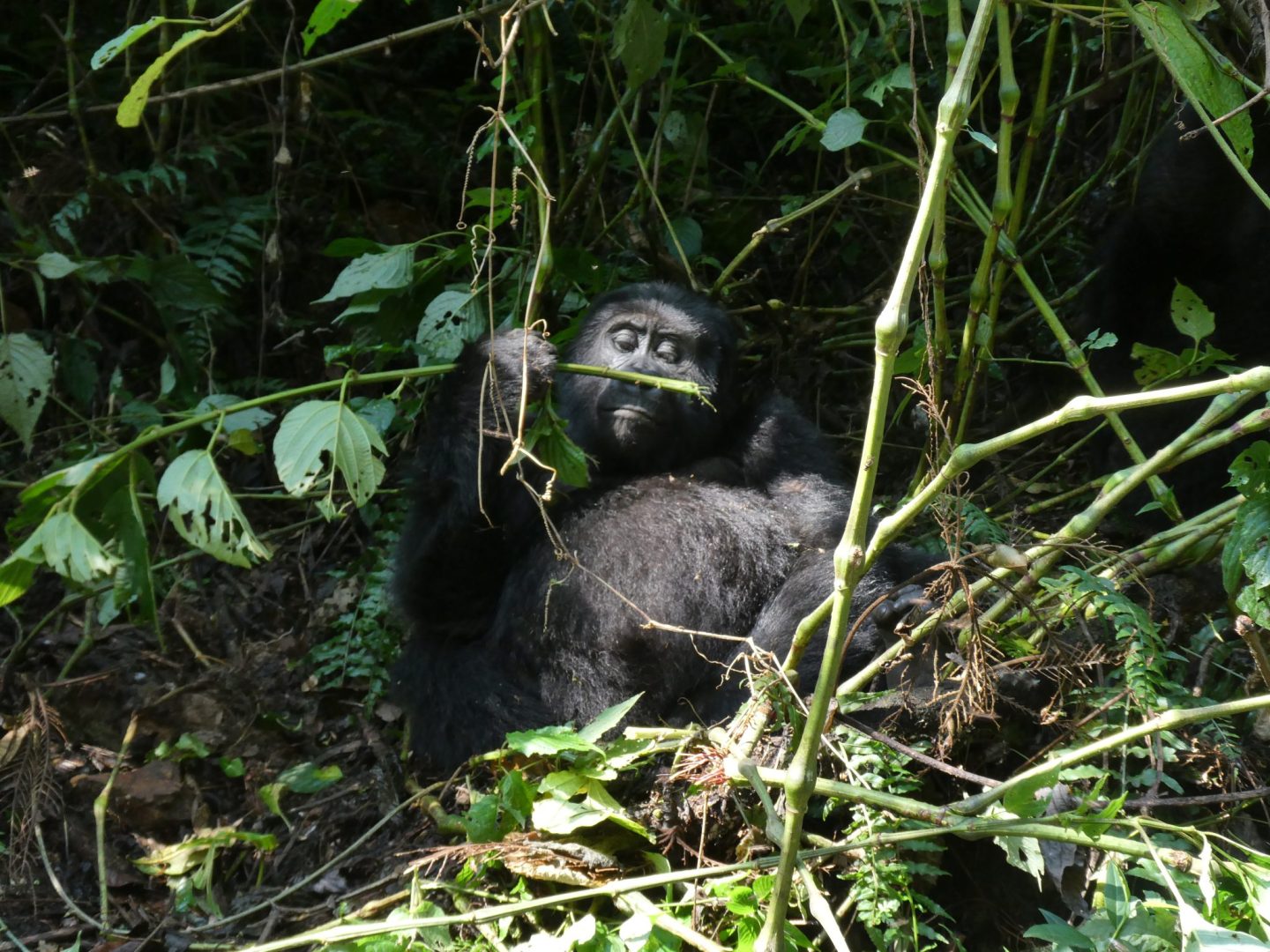
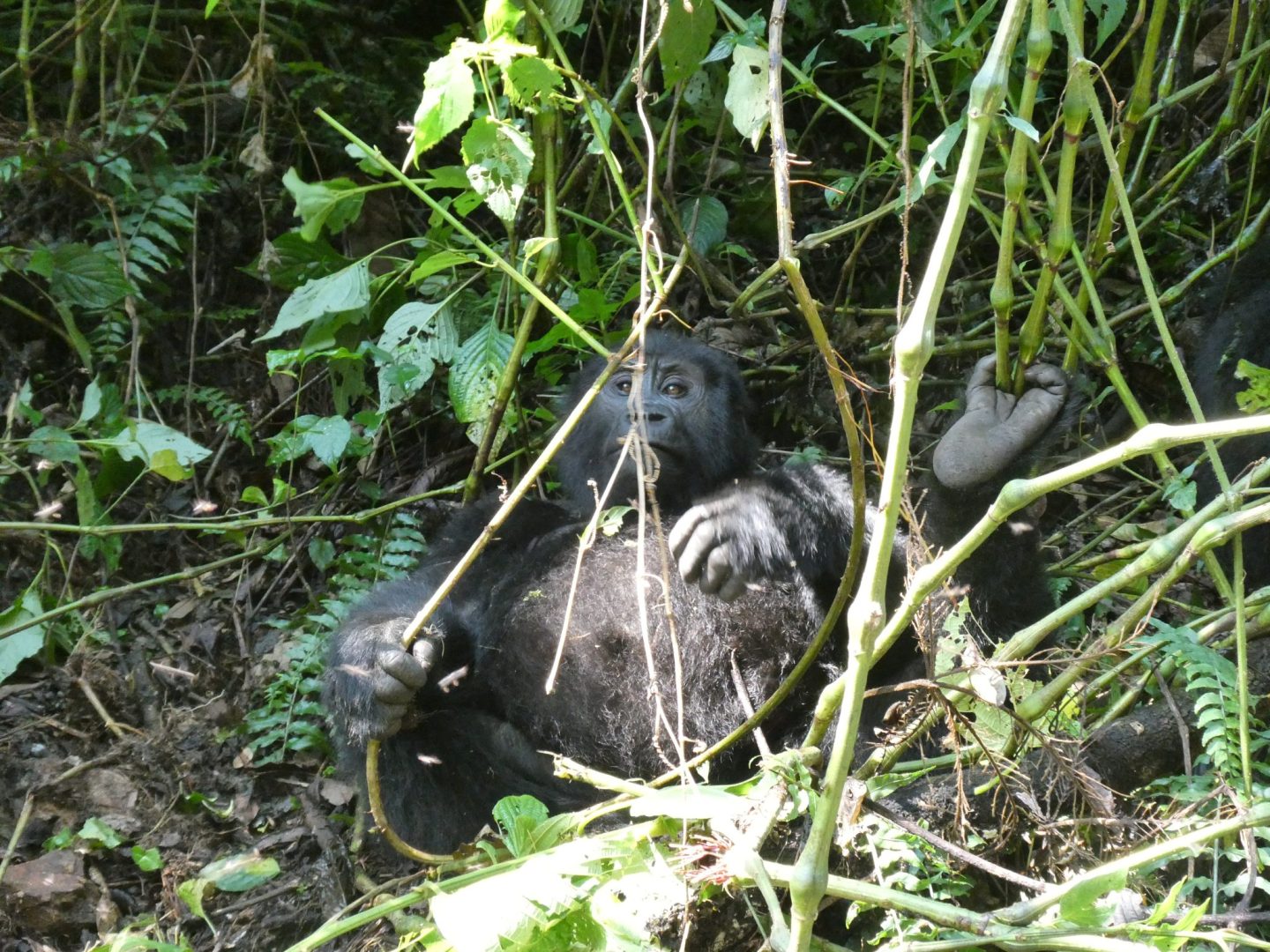
Notice how their feet are much more useful than ours for grasping.
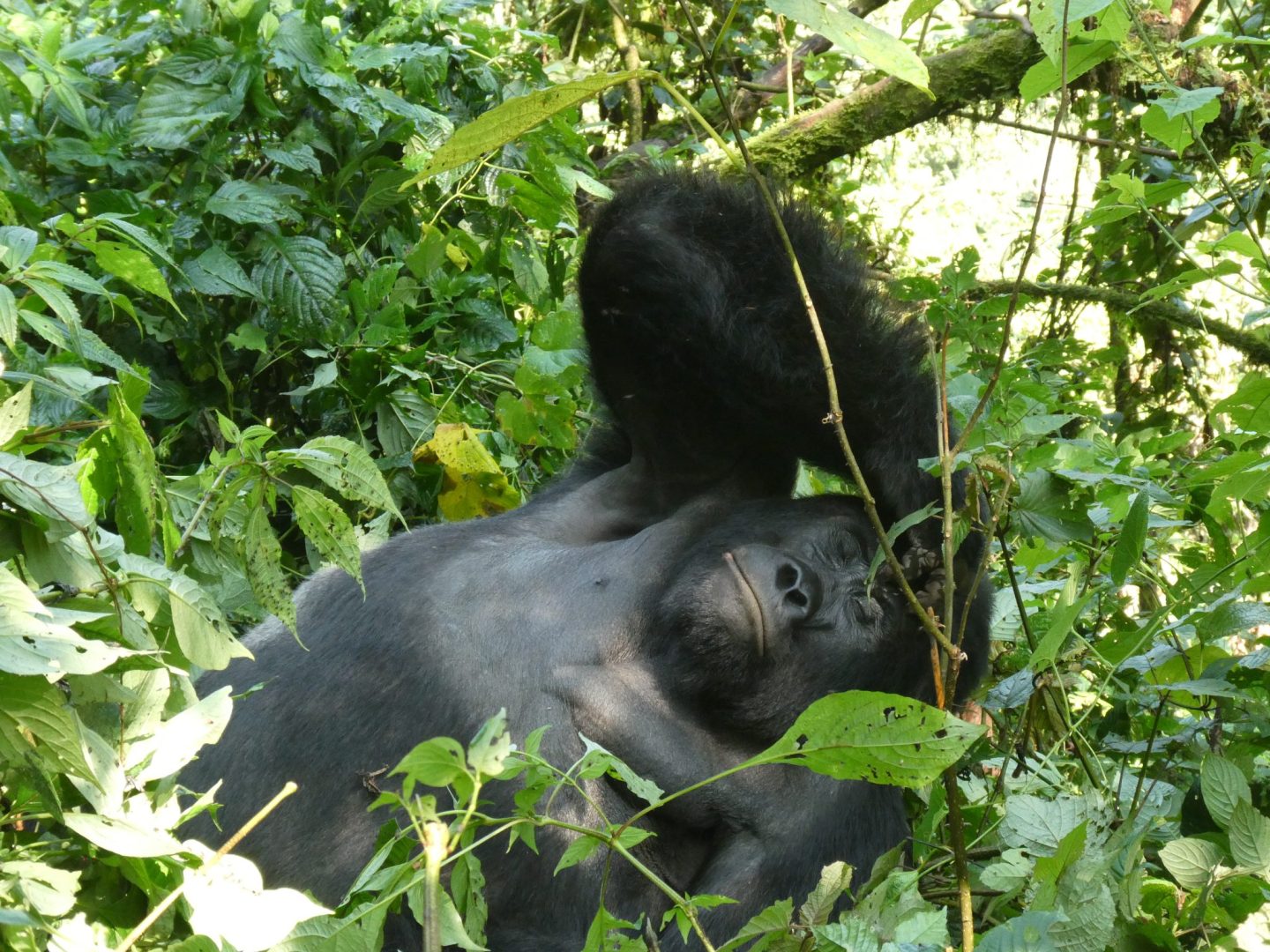
Then there was movement with the adults. The silverback had a crippling attack of flatulence.

Seriously, if a gorilla asks you to pull his finger, don’t. It looked like it gave even him a headache.

The females were at it as well. What is in those leaves???

But they all recovered and the silverback returned to contemplating the meaning of life or some similarly deep philosophical issue.
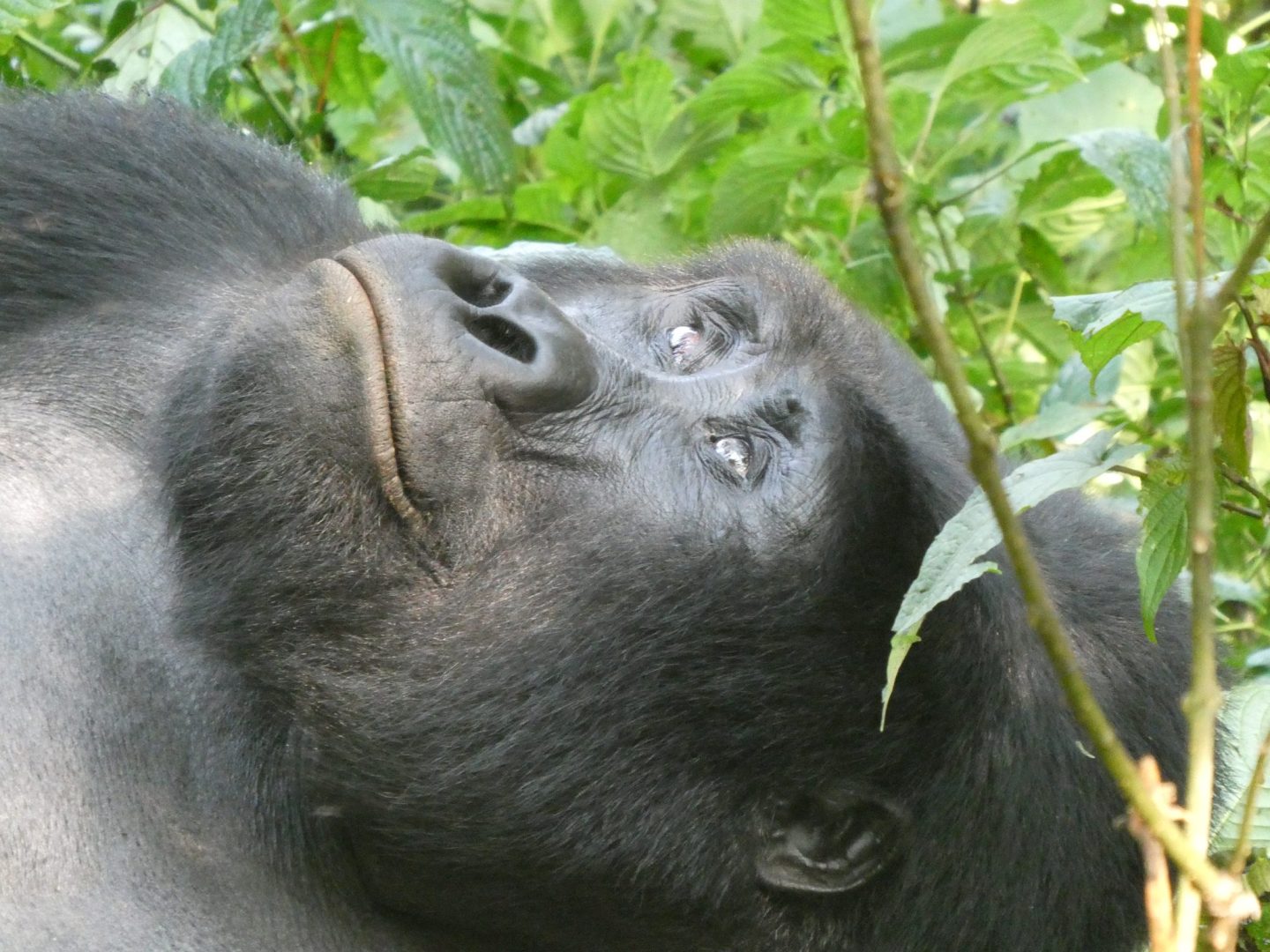
And the young ones lay back contentedly.

We were perched on a near vertical slope, maintaining position by digging in with our boots, using trees and vines for stability, so we couldn’t move much. But we had a relaxed time watching them as they didn’t move any distance the way the chimpanzees had. Then all of a sudden, the females started to come down.


One made a toilet stop on the way.

Then the silverback roused himself, showing us his back just to prove his credentials.
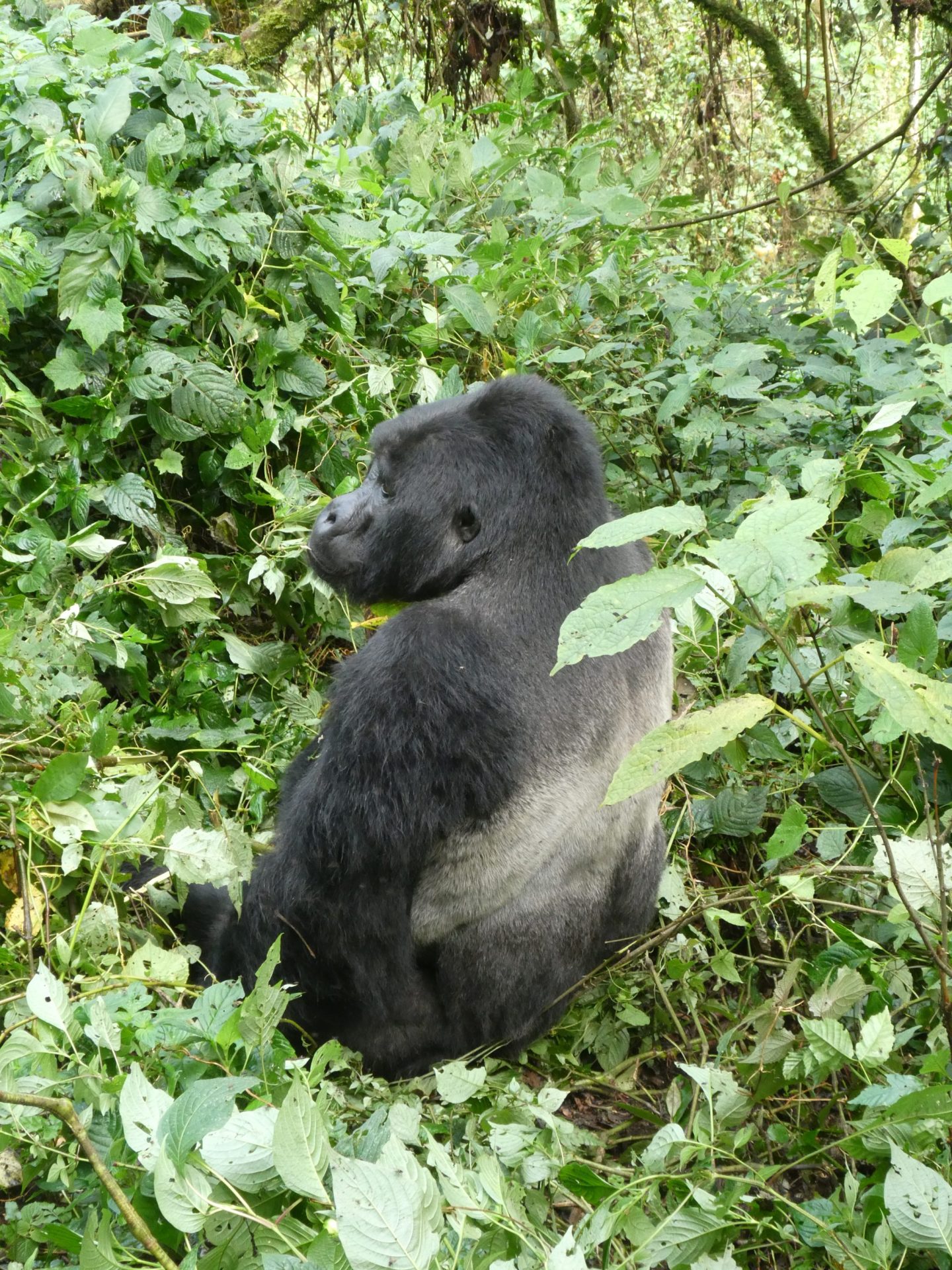
He ambled into the foliage and the females and young ones followed.

We’d been with them exactly one hour. It was almost like they had a watch!
It was a fabulous experience.
Next day we headed over to Mgahinga. It may be near Bwindi as the birds fly, but this is the end of the road to the most remote corner of the country. It goes nowhere but the national park and the last of it is simply atrocious. Worse than Kidepo, worse than the shockers in Madagascar. But the Virunga Mountains, of which Mgahinga is the Ugandan section, is the last untouched habitat for the highly endangered golden monkeys. They eat fruits and particularly love a bamboo which is found only here.
The forest is slightly more open than Bwindi, and whilst we walked much further before finding them, the terrain was easier. Trackers preceded us but in this remote corner of the world, there’s no phone signal. They communicate with the guide by calls that sound like bird calls to let him know where to come. Amazing skills.
In what was becoming a familiar process, once the guide was advised of their precise location, we went off-track, clambering through the forest to reach them.
We first saw some in the grasses.


And picking fruits.

They are excellent at climbing and leaping through the trees. They were the opposite of the gorillas – so fast moving it was hard at first to photograph them.


 This beautiful one sat still long enough for us to watch it plucking leaves to eat.


This one looked like a naughty schoolboy caught having a sneaky cigarette behind the toilet block.

Another naughty one peed from a great height all over John. A golden shower from a golden monkey.
Fortunately for us, they settled down to grazing and playing at ground level, so we were able to get up close to them for a long time.

They were exquisite. Except for the peeing bit.


When it was all over and we were back at our lodge at Bwindi, John said, “Do you realise we just spent six hours bumping there and back again, plus three hours trekking in and out, to spend one hour with a bunch of monkeys? And I got peed on.”
Yes, and it was soooo worth it!

A sign of good luck Jonno !!😉
Buy a lotto ticket 😎
Wow those silver backs are something else – great to hear numbers are increasing but sad to think we keep wrecking their environment. Yes, it was so worth it – all that trekking to send us these fantastic photos of gorillas- 🦍 loved it – thanks 🙏 Julie & John x
Classic comment from JC ! Love love love the pics…and how apt – this morning we wake to the news of the passing of Dame Jane Goodall who did so much for the chimps raising awareness for us all to understand them more. Thank you X
Author
She was a remarkable woman, both for her work campaigning for conservation awareness and for her chimp research. Vale Jane Goodall.