The Slovak Republic has only existed as a fully independent nation since 1992, following its so-called Velvet Divorce from the Czech Republic. But Kosice has existed as a town continuously since at least the 1200s. In the 15th century it was one of the most important cities in Upper Hungary and among the biggest medieval cities in Europe.
Thanks to that pedigree, it has one of the largest preserved historical centres of any Slovak town, with heritage protected buildings in Gothic, Baroque, Renaissance and Art Nouveau styles.
The first building we saw when we reached the Old Town was Jakab’s Palace, built in 1899 in Neo-Gothic style by architect Peter Jakab as his family home. For several years after WWII it was the offical residence of the President of Czechoslovakia. To us it looked like it would fit right in on a mountain in Transylvania, which actually isn’t too far from here.


The Palace was built partially from stone left over from re-construction works undertaken on the Cathedral of St Elizabeth. This enormous church dates back to the 1300s and has been extended, embellished, refurbished and added to over several centuries until reaching its current form in the late 1800s. It’s the westernmost Gothic cathedral in Europe and the largest place of worship in Slovakia, with room for 5,000 congregants.

Next to the Cathedral is St Michael’s Chapel. Also Gothic and dating to the 14th century, it was designed for funerals. Today it’s a popular choice for weddings. Ample space unless you’ve got 5,000 guests. Then you’ll have to go next door.

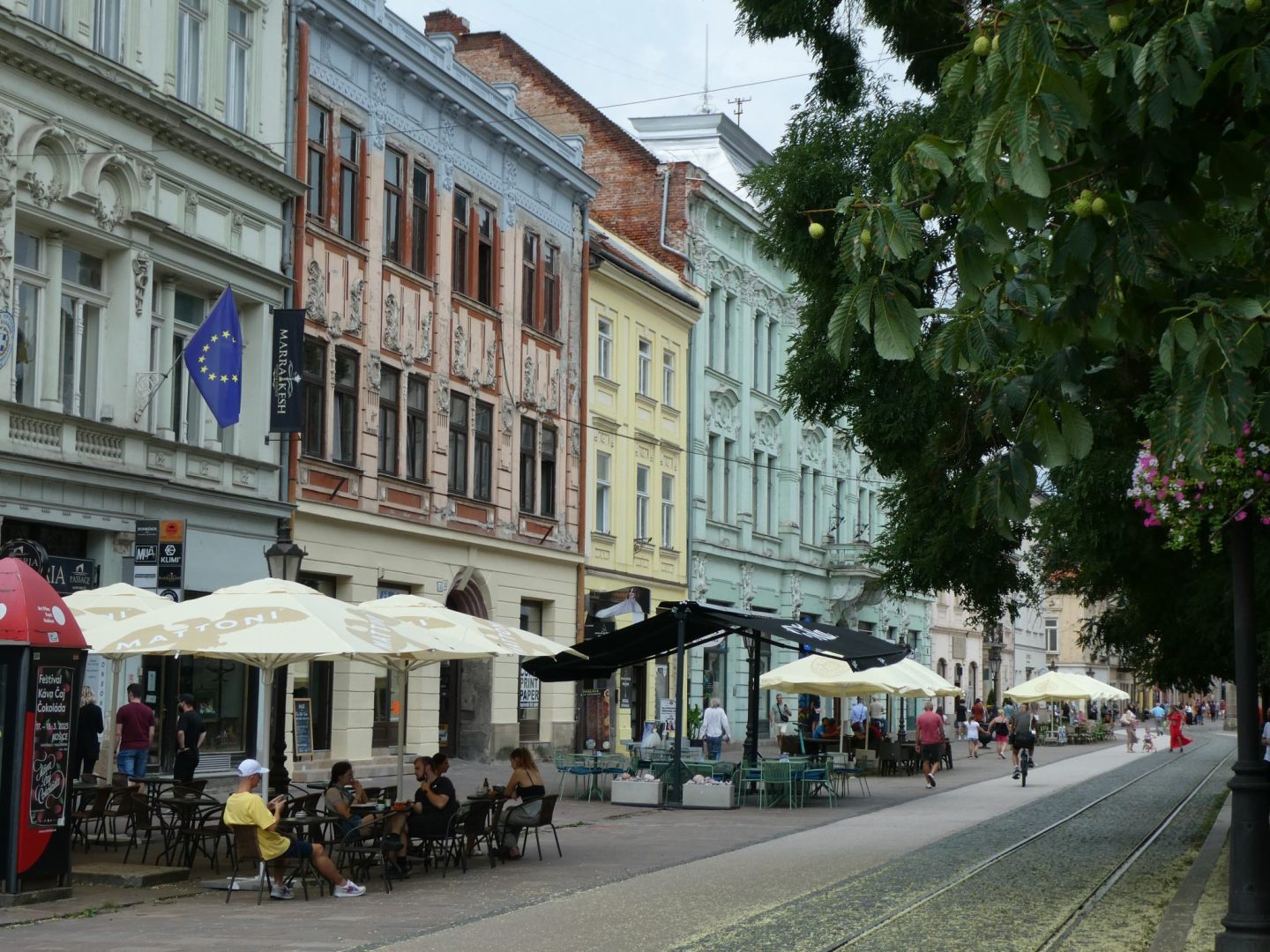
A stroll along the main pedestrian boulevard of Košice reveals a succession of architectural treasures.


This one is the State Theatre.

The Baroque column known as the Plague Pillar was erected in the 1720s on the site of a former gallows to thank the Virgin Mary for curing the city of an epidemic of plague in 1709-10.
 Lots of these lovely buildings have been repurposed into cafes and shops. The third photo below is the largest icecream parlour we’ve ever seen, taking up the entire ground floor.


Founded in 1872, the East Slovak Museum is one of the oldest and most important museums in the country. Its headline exhibit is the Gold Treasure of Kosice.
In 1935, excavations for a new building in the city centre uncovered one of the largest collective finds of gold coins ever discovered in Europe. In a plain metal tin about the size of a biscuit barrel were 2,900 gold coins, three gold medals and a heavy gold chain.

The oldest coin is a priceless one minted in Thrace – in the area of modern day Turkey – around 300BCE.
Why, when and by whom the treasure was buried is still a mystery. A large number of the coins are Hungarian and Dutch ducats in use in the first half of the 19th century, suggesting this was the currency of the day for the owner. The most recent coins were minted in 1859, so the tin could not have been buried any earlier than that year. In 1862, a rebellion in the city caused upheaval and political uncertainty.
From these facts, experts surmise that either an official seeking to protect treasury assets or a wealthy citizen hid the collection in 1862 for fear of looting or confiscation by the rebels. Whoever it was never got the chance to retrieve it.
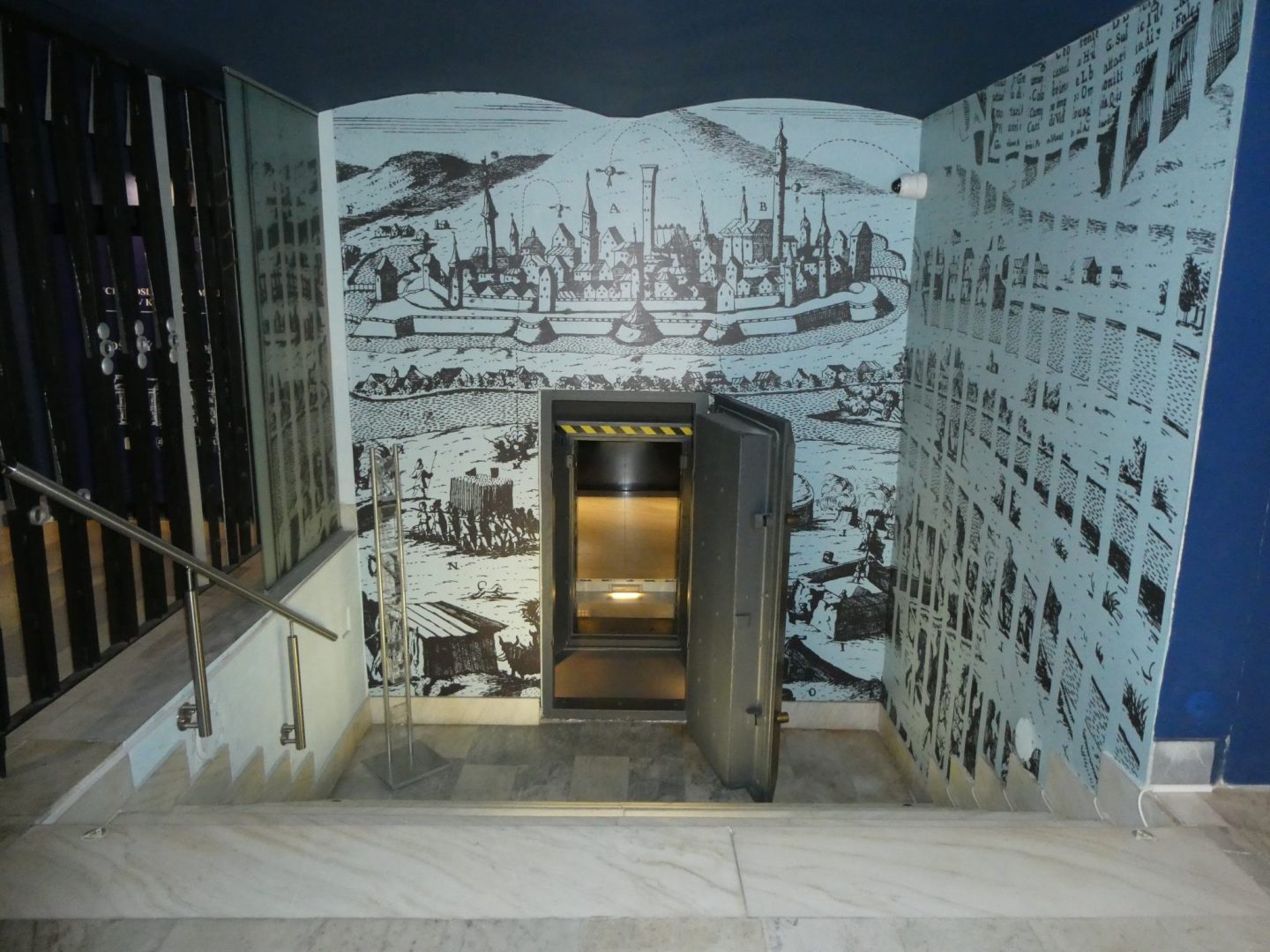
The workmen who found it wanted to keep a few coins for themselves but were thwarted. The treasure was sent to Prague to be studied but WWII intervened. Hidden during the Nazi occupation of Poland, the collection finally went on full public display in Kosice in 1967. It’s housed in an impressive vault in the basement of the museum.
Wooden churches were once common in Eastern Slovakia. Only around 50 are still standing. The Church of Saint Nicolas the Bishop was originally built by Greek Catholics in the village of Kozuchovce in 1741. It was brought to Kosice in 1927 and reconstructed in the museum grounds as a rare example of its kind.

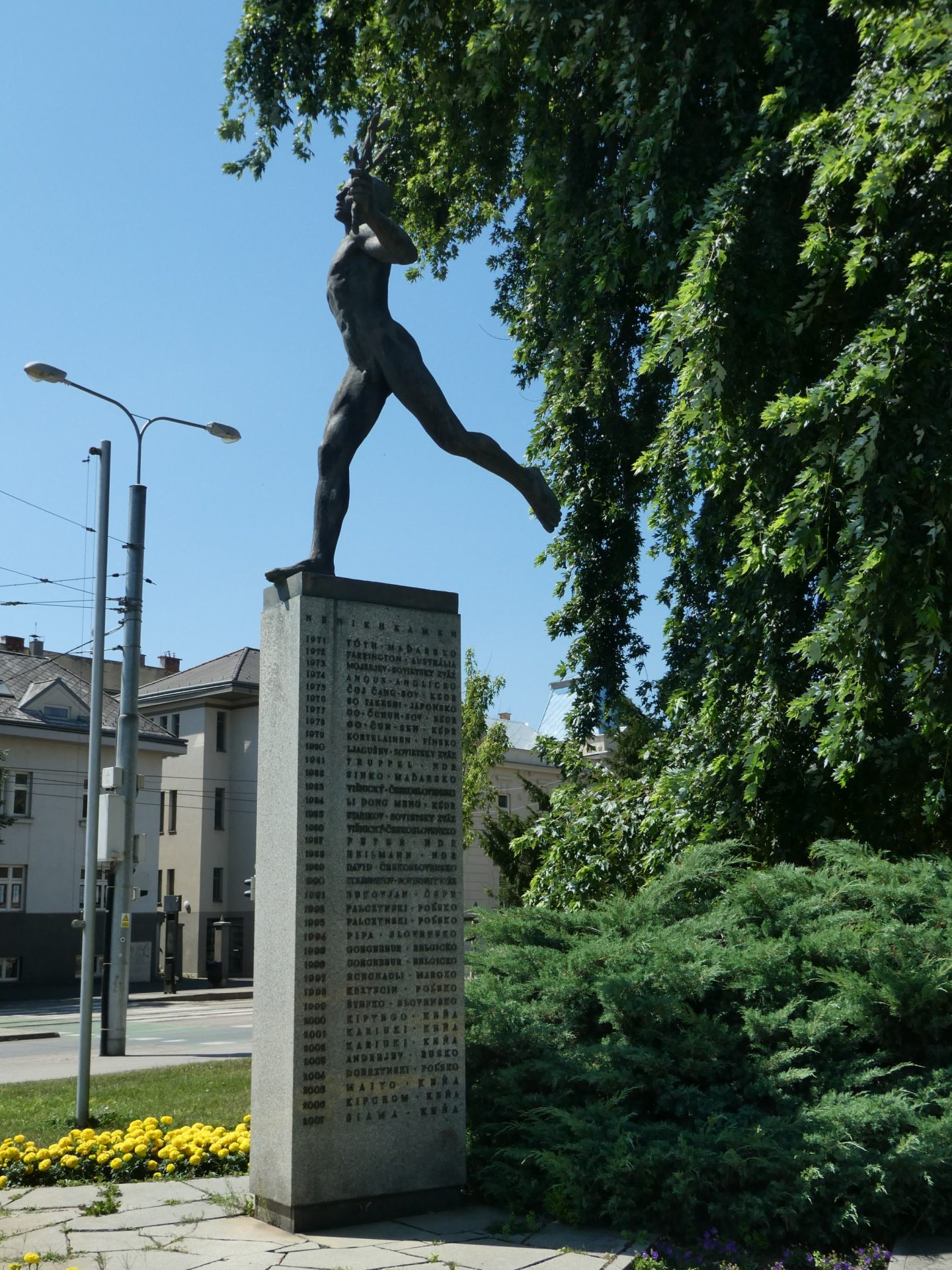
Outside the museum, the plinth beneath this naked runner and a wall behind, record the names of the winners of the Košice Peace Marathon. Held annually since 1924, it celebrates its 100th year this October. It’s the oldest marathon in Europe.
Worldwide, only three marathons are older – Boston and Yonkers in the US and the Comrades Marathon in South Africa – but none of them have been held continuously. That makes Kosice the oldest continuously run marathon in the world. Won by an Australian in 1972, we noted.
Since its unveiling in 1986, the Singing Fountain in the centre of Kosice’s Old Town has been a hit with locals and visitors alike. Originally the jets were synchronised by microcomputer to respond to notes from a nearby carillon, a tower of 22 bells representing Kosice’s 22 city districts.

Revamped in 1997 and again in 2023, it’s now more high tech. The fountain performs to more than 400 musical pieces, everything from classical music by Vivaldi and Mozart to contemporary tunes by the Beatles and Elton John.

It’s enormously popular. At night, it’s also matched to lighting. It sounds hokey. It is hokey. But actually it was remarkably entertaining.

Novelist Sandor Marai was born in Kosice in 1900 and lived there until his family decamped when he was 18. Many of his novels were set in and around the city. A nationalist, communist and opponent of the Nazi regime, he was one of the most read authors in Europe in the 1940s and 50s although we’d not heard of him. We’re guessing most of our readers haven’t either, as his work was not translated into English until the 1990s. His childhood home is now a museum and he’s honoured with this interesting statue.
 Before WWII, Kosice was home to one of the largest Jewish communities in Slovakia. In a mere three weeks, between 16 May and 5 June 1944, every single one of the city’s 12,000 Jews, together with another 2,000 living in the nearby countryside, were deported to concentration camps and killed. Today the Jewish community numbers just 250 people.
A memorial plaque at the pre-war synagogue honours them, but the synagogue has never been adequately restored and is not open to the public.
It’s not the only part of recent Slovak history that remains sensitive.
The Musuem to the Victims of Communism is a first of its kind in the Slovak Republic. The multi-media museum presents a no-holds-barred description of life during the communist years from 1945 until 1991 when democracy was achieved. Through personal video testimonies, it deals with the effects of farm collectivisation, the repression of intellectual freedoms, forced labour camps, persecution of the churches and other organisations seen as a potential challenge to the authority of the State, and the ludicrously excessive prison sentences given for anything viewed as an act of dissent.
It’s largely designed as an education resource for students because this history isn’t taught in schools. Too soon, too sensitive, apparently.
All the signage is in Slovak but you can download an app which delivers even more comprehensive information in English. The museum is privately owned and gets no government funding. We’ve read they’ve had to avoid putting names to the acts of repression discussed. Some of those involved, or their family members, are still influential in government and the museum steps carefully for fear of being closed down.
Most shocking was a scrolling list of names of people imprisoned or killed for alleged anti-state activities during the communist period. To see them all, you’d have to stand there for seven hours.

Kosice has a thriving coffee culture. The cobbled streets of the semi-pedestrianised Old Town are lined with them.
There’s lots of lanes leading to hidden squares and covered alleys of shops.

Wandering the Old Town, Kosice feels timeless, but step outside its boundaries and there’s a large, modern city of 230,000 people. The majority live in relatively dense apartment style housing which ranges from pre-democracy ‘dull but adequate’ to quite modern and attractive.
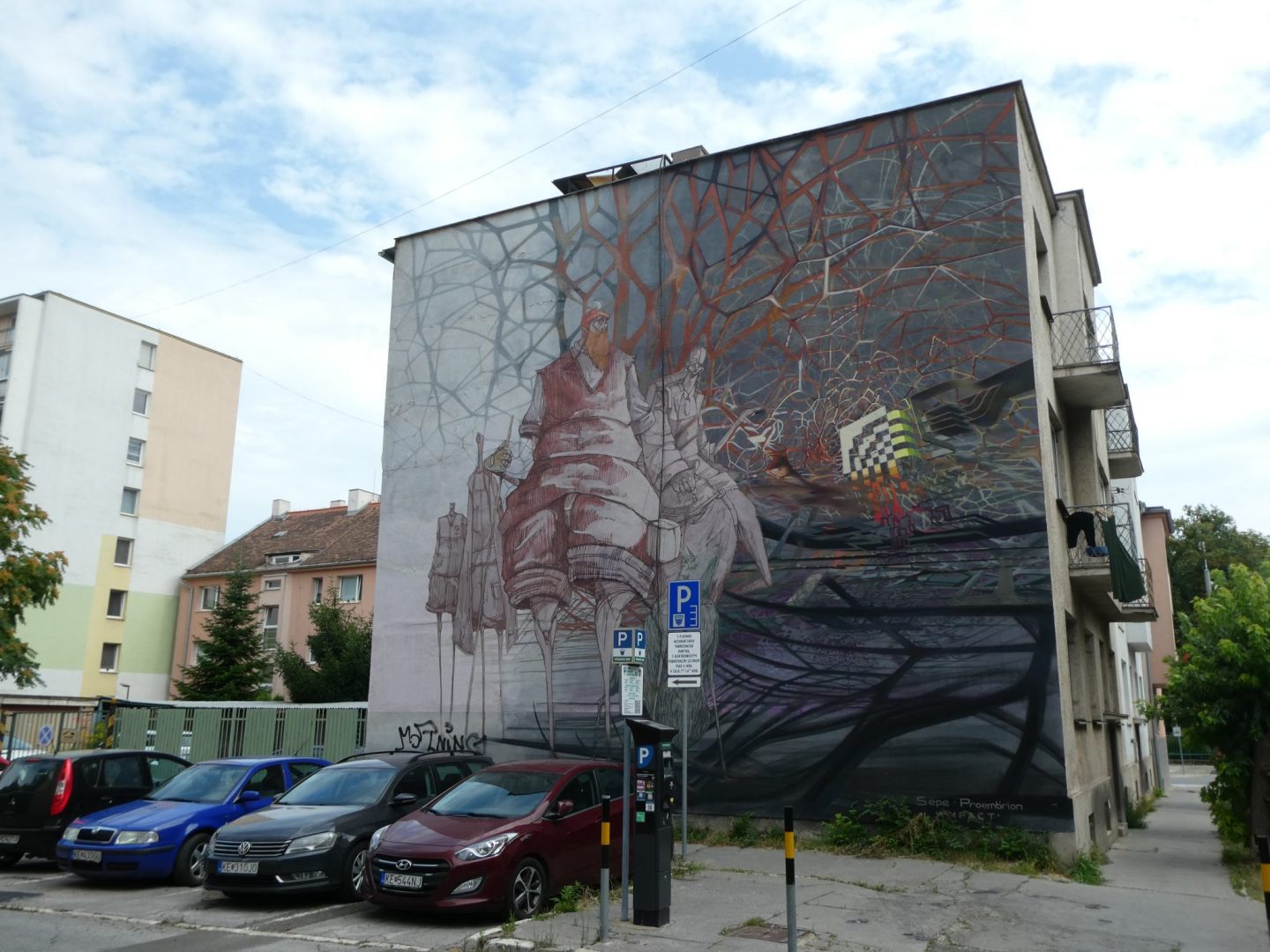
Since 2008, a local organisation called Street Art Collective has been arranging for murals to be installed in older urbanised areas to brighten up the neighbourhoods. The murals are widely scattered so we couldn’t see many, but here’s a few we did catch.



And there’s some funky street installations.


John got quizzed by a couple of Czech guys while Julie was checking us in to our hotel. “Why are you here? Did you get a cheap flight or something?” “Why not Prague?”
They seemed bemused, almost sceptical, of the idea of a couple of Australians coming all the way to Kosice. A touch of old-style Czech-Slovak rivalry perhaps?
Their attitude surprised us a lot. We really enjoyed Kosice. Sure, it doesn’t have the monumental splendour of Prague’s Old Town. But it doesn’t have its tourist masses either. Nor does it have one of those infuriating little tourist trains, spruikers flogging day tours, city tours or cheap beer deals, or shops full of tourist tatt.
And while it doesn’t have Prague’s fabulous, historic beer halls, if you hunt around you can find a mighty fine pork knuckle. Just like Prague.


Pork knuckle in Kosice – yummy – a very interesting read – the buildings and architecture is amazing just wish I got to the bucket of gold coins first x
Author
We thought of you guys as we tucked into the pork knuckle. Have fun in Canada.
Love the street art, especially the rats, and both those installations are fabulous. I definitely see the attraction in a “ city less visited “.