Leaving the Skeleton Coast we drove east, over the mountains where the coastal lions hid out in the 1990s.

On the other side is Damaraland, a region of red rocks and granite domes towering over a desert landscape.
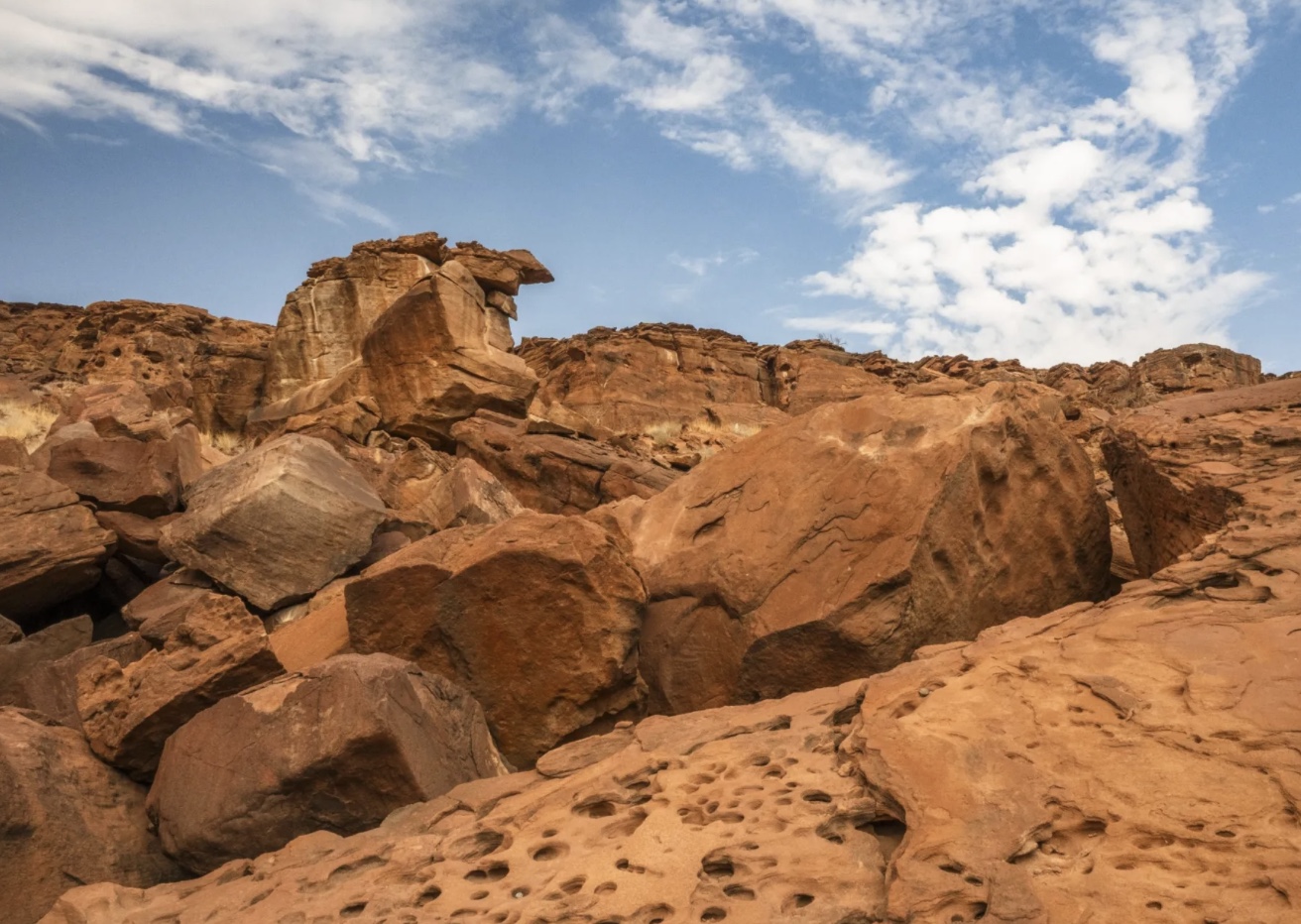

In 1947, a topographer named David Levin came to the area to investigate the feasibility of farming. He found a spring but was so wracked with doubt about its capacity to sustain his herd that an Afrikaaner friend started calling him David Twyfelfontein, ‘David Doubts-the-Spring’. When he finally bought the land, he called his farm Twyfelfontein.
Despite his concerns, the spring continued to deliver enough to support a very marginal farm. But in the 1960s he was required to sell his land back to the government to be incorporated into a homeland for the indigenous Damara people. Near the site of the original homestead, Twyfelfontein Country Lodge is one of the cleverest designed lodges we’ve stayed in. From the approach, it’s completely hidden behind towering rock faces.

The walkway snakes through rocks which were once the site of shamanistic rituals practised by the original inhabitants. For 6,000 years before the arrival of Europeans, this area was used by hunter-gatherers, and later by herders, who left behind one of the largest concentrations of rock petroglyphs in Africa.


On these and other rock outcrops scattered over several kilometres are at least 2,500 rock carvings and a few paintings dating back thousands of years. In 2007, Twyfelfontein was the first place in Namibia to be declared a UNESCO World Heritage site.


Damaraland is also home to some very special animals.
Desert adapted elephants once roamed many areas of Africa but sadly they are now found only in two places, Mali in north Africa and the Northern Namibian Desert.
In the early 20th century there were about 3,000 desert elephants in northern Namibia. But hunting, poaching and human-elephant conflict have reduced them to five small sub-populations clustered along this region’s ephemeral rivers. Ephemeral rivers are those that flow only after rain and otherwise are dry beds with some subsurface moisture supporting limited plant life.

At the last official count in 2013, there were just 600 desert elephants left. It is feared that number has dropped further to around 150. The survival of the desert adapted elephants of Namibia hangs in the balance.
We went with a guide to seek them out. There’s no standing water. They travel daily up and down the dry river beds and surrounding area seeking food and nosing out sub-surface water. Here they come!

The elephants are not a distinct species. They are African bush elephants that over many generations have developed adaptations to better suit desert living. Some of the adaptations are physical and some are behavioural.
Compared to their cousins in the savannah grasslands, desert elephants have broader, essentially flat feet, providing more surface area for walking on soft sand.

They have longer legs and trunks, enabling them to reach higher into trees to pick leaves. That’s important when trees are few and bear less succulent leaves.

Desert elephants often go more than a day without a drink, and have adapted to survive for up to four days without water, whereas their savanna counterparts drink daily or even twice a day.
Savannah elephants typically roam between 8 and 24km from their primary water source to forage for food. Given the meagre desert environment, desert elephants cover 20 to 40km, often moving between several different food sources in the course of a day. In desperate times they may travel up to 70km and historical records during severe drought have clocked them walking up to 100km from their base in search of water and food. That’s another reason for their longer legs.
We saw them grazing along the side of the dry river bed, continually plucking small amounts off low bushes as they moved.


And snuffling around under the acacia trees for fallen seeds.

And this is the thing we found most astonishing – desert elephants cause less destruction than savanna grassland ones. They will eat only the shoots from a tree or selectively pull off branches instead of stripping the tree bare, or stand on their hind legs to reach higher branches instead of toppling the whole tree. It’s as if they know that if they leave the tree intact, it will continue to produce food for them.

They keep their herds smaller and have fewer offspring than their grassland relatives. In times of severe drought, they don’t reproduce at all, seeming to recognise there won’t be enough to sustain little ones. That’s caused grave concerns for the viability of the groups here. There have been few births in recent years.


But after 14 years of drought, there were decent rains a year ago, bringing new plant growth. One of the females had a baby which the locals called Hope, crossing their fingers she would survive, and she has.

She’s a symbol of optimism that despite the challenges they face, the desert adapted elephants of Namibia have a future.

What a fabulous trip you folks are having. I am so enjoying my pre-breakfast read a few times a week.
Author
Thanks, Richard. It has been amazing.
The desert elephants story is a beautiful one. I hope there are more Hopes in the near future.