From the east coast of Africa to the west. We left Pemba and flew to Windhoek, Namibia via a complicated set of connections. Transport is rarely easy in Africa.
Our first destination was the Kalahari, the semi-arid sandy savannah spanning more than 900,000 sq km across Namibia, Botswana and South Africa. Its dunes comprise the largest continuous expanse of sand on earth.
It receives too much rain to meet the technical definition of a desert. But its 5 to 10 inches per annum drain rapidly into the sand, leaving very little surface water. Early European settlers called it a ‘thirstland’ and it’s commonly called the Kalahari Desert.
It’s hardly surprising that the fauna here is distinctly different to that of east Africa. What is surprising is what can survive in this harsh environment.
We stayed on a private game reserve where we got a crash course in southern African antelopes.
Namibia’s national animal is the gemsbok, or South African oryx. They are hunted for their impressive horns and for their meat. After admiring them on our game drives, we also found them on our dinner plate. Oryx steak was very tasty.


These oryx were missing the black board shorts and tails of the regular gemsbok and were mostly white. Not quite albino but an unusual variation.


These tsessebe felt comfortable enough around people to come foraging around the lodge buildings in the late afternoon. Perhaps they know they are unlikely to end up in a casserole because they are one of the world’s fastest antelopes, capable of speeds of up to 90kph.


The blesbok is endemic to Namibia, South Africa and Eswatini. They were once hunted nearly to extinction for their skin, meat and by trophy hunters. But they’ve been protected since the late 1800s and numbers have rebounded nicely.
 The kudu is easy to identify because of its characteristic corkscrew horns which measure up to 1.8 metres and are also coveted by trophy hunters. Kudus are responsible for more motor accidents in Namibia than any other animal. At night, if they see their own shadow created by the headlights of an approaching vehicle, they think it is a predator. Fleeing the ‘enemy’, they run toward the light, become blinded and fail to avoid the car. Literally, they are scared of their own shadow.
 We saw plenty of springboks. South Africa’s national animal and the emblem of its rugby team is an elegant antelope. And very tasty.

 They are especially entertaining when they are pronking. No, it’s not what it sounds like. It’s that springing thing they do. It comes from an Afrikaans word ‘pronk’, which means to ‘show off’.
If a springbok senses danger, it repeatedly leaps up to two metres in the air with an arched back and stiff legs. Others notice and the whole group takes off. We saw it a lot but it’s so fast, we didn’t manage to catch it on film. Here’s a photo from National Geographic.
 The dainty little steenbok has a fur pattern in its ears similar to the oribi found in the east, but doesn’t have a black tail. Identifying antelopes is very confusing.
 It became even more confusing when we discovered that as a private game reserve not a national park, the owners can put in species that are not native to the Namibian Kalahari at all.
The sable antelope is a beauty, but it’s only found naturally in the north of the country.

Having the flexibility to tinker with the stock has its advantages for visitors. The latest addition is four white rhinos.

The reserve is maintained as a wild place, with the animals free to roam throughout its 10,000 hectares. But new arrivals are kept in a zone fenced off from the rest until they are acclimatised to their new home. On an afternoon game drive, we pulled up next to the separation fence and two of the rhinos came right up to us, not at all perturbed by human presence.


How big is a rhinos’s foot?
 And how beautiful is their eye!
 When we saw the wild rhinos at Ziwa in Uganda, we were struck by their power, and almost majestic presence.
The ones we saw here were purchased from a reserve which habituates its animals. They were gentle giants, so accustomed to people you could actually stroke their horn, scratch them behind the ears and run your hand down their cheek. We have mixed feelings about habituating wild animals to this degree. They should have the right to stay wild. But we have to admit, it was an awesome experience.
 The reserve has large populations of giraffes and zebras. You couldn’t pose this.

Young male giraffes assert dominance over one another by taking turns swinging their neck, trying to strike the other one with their head. It’s called ‘necking’ and it’s violent.
But here we saw a different kind of necking. A Kalahari romance was unfolding.
“I really like you”.
 “Well, I like you, too”.
 “Do you think anyone’s looking? Public displays of affection are so embarrassing”.
 “No one’s looking”.
“Good”.


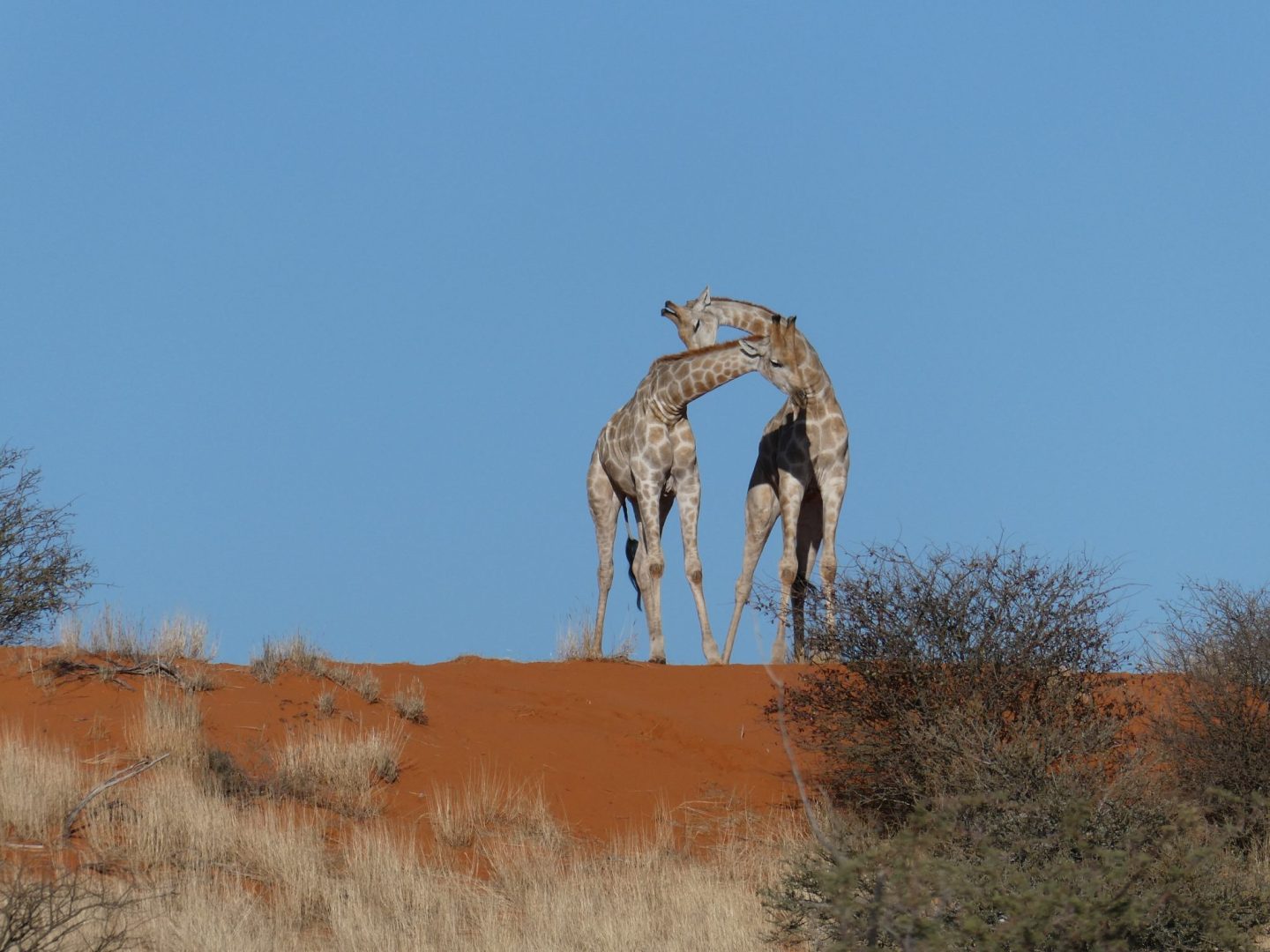
“Will you be my girlfriend?”

“Yes”.

“I really love you”.

“That’s great. But we need to play it cool”.
”Of course”.
Both in unison, “Nothing to see here”.
 The original inhabitants of the Kalahari are the San people, often referred to as the Bushmen, nomadic hunter-gatherers who survived here for at least 30,000 years before the arrival of Europeans.
Early Boer settlers considered them sub-human and attempted to ‘exterminate’ them. Those that weren’t killed were increasingly unable to sustain their traditional way of life as the colonialists engaged in whole scale killing of the wild animals they hunted and introduced cattle which consumed the indigenous edible plants with which they supplemented their diet.
Today there are no San living an exclusively nomadic life according to the old ways. Small numbers live in village communities on the fringes of the Kalahari. They attend schools in their traditional language and some maintain their culture, but increasingly they migrate to cities and towns for work.
We usually loathe ‘traditional performances’ but the lodge stay included a demonstration by four San men who explained hunting techniques, nomadic life and the uses for various desert plants. They spoke only in their traditional language but mimed everything in a way that was very easy to follow. It was very interesting and we learnt a lot.
To survive in this environment without modern technology requires incredible ingenuity and respect for meagre resources. Here’s an example. The aardvark uses its long tongue to scoop termites from their mound in huge quantities, then goes back to a safe place to sleep. It has swallowed the termites live, and it takes up to three days for them to die in the aardvark’s stomach. The San would wait at the termite mound while the aardvark feasted, follow it back to its resting place and then kill it when it was groggy with sleep. They would then take the aardvark back to the termite mound and remove the still living termites from its stomach, returning them to the mound before cooking the aardvark for themselves. The termite mound survived, ready for another aardvark, and in turn another meal for the hunters in the future. Amazing.
 There are two species of wildebeest. The ones we saw in the east were the white bearded gnu, also known as the blue gnu because in certain light its coat looks blue-black. In the west is the black gnu. They have a matt black coat and a coarse black bristle on the nose instead of a white fringe under the chin. But here was something different again. The golden gun is a rare variant of the black one. Check out these eyelashes!
 He kept getting in the way of the San demonstration and clearly wanted to be the centre of attention. That was pretty amusing.
 The San call the Kalahari, ‘the soul of the world’. A beautiful name for a place of exceptional beauty.

 The sunsets on the red sand were phenomenal. And so, for those readers who complain we never post photos of ourselves – looking at you, Ange – here’s a sundowner spot to die for.


This trip looks to have been even beyond your best expectations!
This amount of wildlife you have experienced at first hand is phenomenal.
Thank you for the blogs as ever . We have loved experiencing your trip with you .
When the rain is falling in England what better thing to do than look at your great pictorial record of the African bush .
Lasting memories for sure
David & Noreen
Loved the exchanges between the loved-up giraffes as well as the fascinating facts about kudus being scared of their own shadows and how aardvarks get terminated! Great stuff.. That photo of the giraffes interspersed with the zebras belongs in National Geographic.
Author
Thanks!
Great that you got to see some of the Bushmen culture. We had a cultural tour at Deception Valley Lodge where one of our trackers and his friend, both San, showed us how they make their poison tipped arrows, hunt, make their huts etc. They started a fire by rubbing two sticks together in under 10mins.
Throughout the whole 3 hours they spoke in Bushman language with all its clicks and our guide translated it into English.
Giraffe behaviour is so fascinating. I prefer your sort of necking to the male contest one. It was aweful to behold.
Author
The clicking language is amazing and surely unique. We had an interpreter but didn’t really need it, their mime and demonstrations were so good.