From the Kalahari, we drove over the bare mountains to a completely different landscape.


The savanna grasslands were replaced by stony desert.
 The San once roamed this arid land, leaving their mark in the form of art painted under rocky overhangs about 6,ooo to 7,000 years ago.


Strange desert plants survive here.
The hoodia, nicknamed the desert cucumber, literally drips water if cut. It looks like a cactus but isn’t. The San used it as an appetite suppressant when hunting. It’s so effective, researchers are today trying to figure out how it works. If it turns out to be the next Ozempic, remember you read about it here first.

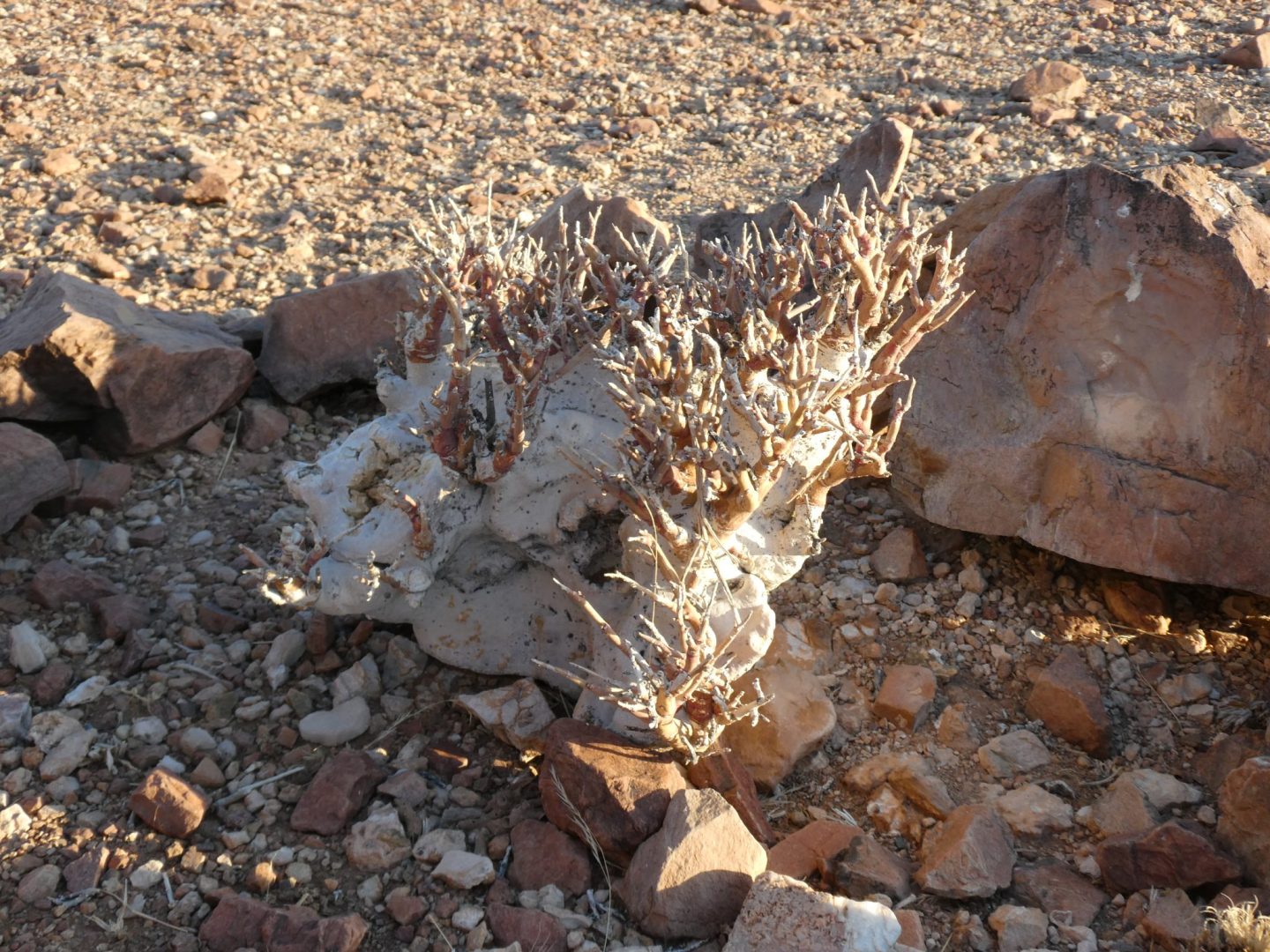
To us this one looks like a stone or some kind of coral. Locals call it Elephant’s Foot. It’s rare and endemic to Namibia. It’s illegal to harvest it, but fetches such a high value in China, criminal syndicates are actively soliciting local people to locate it. Plant poaching.
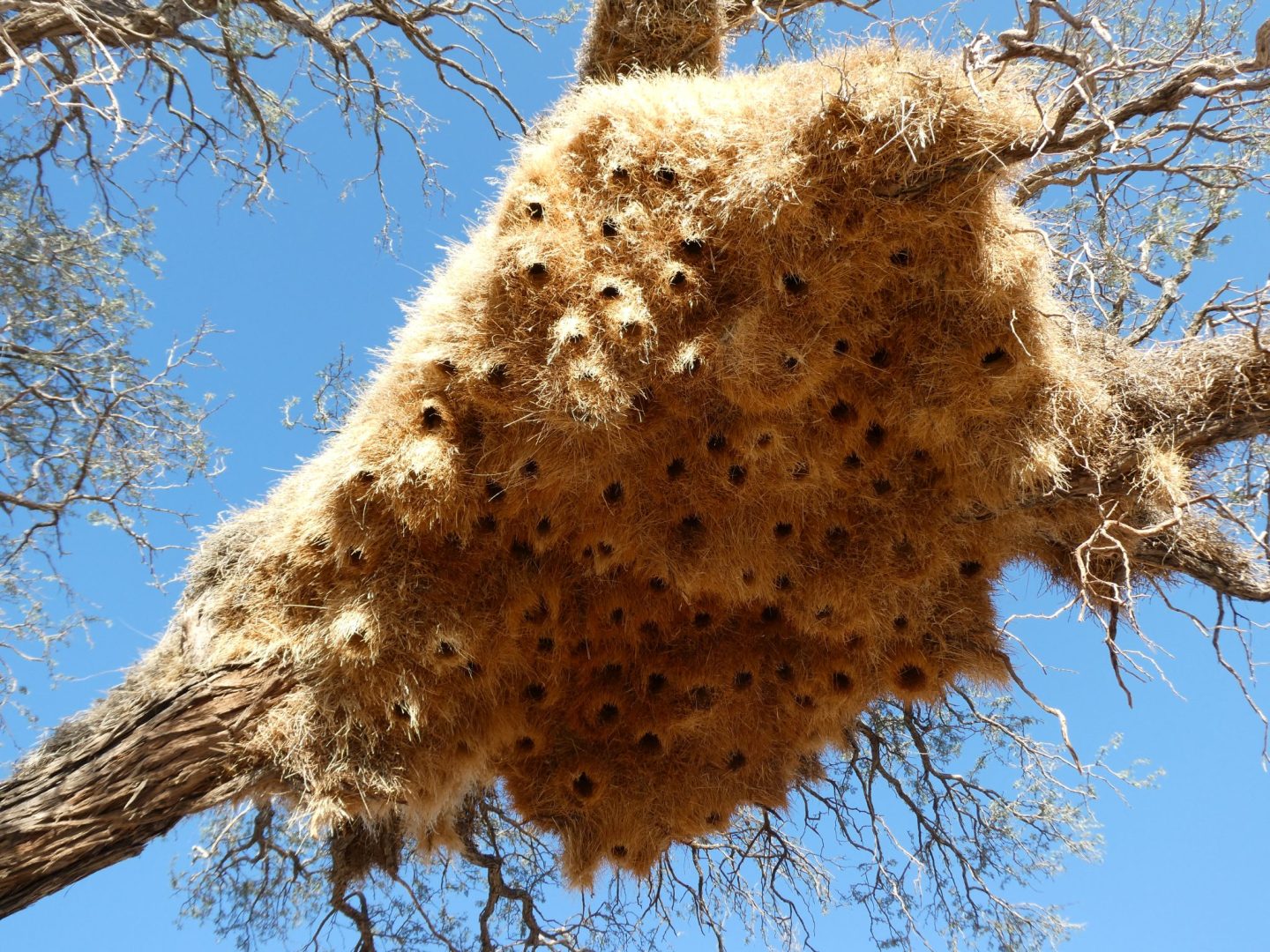
Sociable weaver birds build community nests, a rare thing in the avian world. Described by experts as “perhaps the most spectacular structure built by any bird”, the nests can weigh up to one tonne. Here’s one we saw in the Kalahari.
 We saw more huge examples here.
The birds themselves are tiny, weighing only about 25-30gm each.

But they communally build a nest that will house up to 100 breeding pairs and their chicks. They can last many generations, with some nests being estimated to be more than 200 years old. Their only restriction seems to be that if they become too heavy, the branch on which they rest will break. If that happens, the birds can rebuilt the nest elsewhere with the same materials in an astonishing five days.

The sunsets were like an active volcano.

We reached the Namib Sand Sea, which blankets 3.4 million hectares of Namibia and is one of the world’s largest continuous dune fields.
It’s often claimed that the Namib contains the highest sand dunes in world. It doesn’t. There are higher dunes in Argentina, Chile, Mongolia and Iran. But several are in the world top ten, are accessible, can be climbed by persons of average fitness, and are incredibly beautiful.
So it isn’t surprising that Sossusvlei is Namibia’s biggest tourist draw and one of the most photographed places in sub-Saharan Africa. Technically speaking, Sossusvlei is a salt and clay pan more or less in the centre of the sand sea, but the name is commonly used to refer to both the pan and the dunes which surround it.
The tallest dune in the Sossusvlei area is Big Daddy, with a height of around 325 metres. Conventional wisdom is to climb close to sunrise, to watch the dune colours developing with the light. Good theory, but surprisingly often for a desert, the sunrise is masked by fog.
And so it was on the day we went.

The walk up the ridge line is narrow and loose underfoot, but once you get going it’s neither as treacherous as it looks nor as hard work.

Even if sunrise is a fizzer, it pays to start early. Once the fog burns off, the temperature rises quickly. It can be baking hot by late morning.
It’s hard to convey the size of the dune, but check out the tiny people along the top in this photo we took after we came down.

From the top we had a still-foggy 360 degree view over the surrounding dunes.

You don’t need a guide here. Provided you stick to climbing the dunes that are signposted as visitor-accessible, and follow the fairly obvious trajectory up and down, you won’t get lost. But we overheard someone saying that three people have died here in the last five years because they went into unauthorised areas, probably without adequate water, lost their way and perished. If it’s windy, your footsteps are gone as soon as you take your next step.
The few guides we saw waited at the base of the dune rather than walking up with their guests. This one was taking no chances on her people not being able to find their way back to her. She would have been visible from space!

Coming down, we were sinking shoe-deep in the soft sand. At the bottom, it was time to empty the boots.
 We had cut down the side of Big Daddy to Deadvlei. Many hundreds of years ago, seasonal waterflow from the nearby Tsauchab River created temporary pools which sustained camelthorn trees. Healthy specimens look like this one near the lodge outside Sossusvlei where we were staying.

But the climate changed sometime between 600 and 900 years ago. The sand dunes encroached, blocking the river from the area. Without seasonal water, over time the ground became a rock hard, salt encrusted clay pan. The name Deadvlei means ‘dead marsh’.
The camelthorn trees perished but the air is so dry, they have never decomposed. Scorched black by the sun’s intense heat, these skeletons of trees are believed to be almost 1,000 years old.


The contrast of the black trees, white clay and red dunes with walkers inching up the crest like a trail of ants was stunning.
 Another popular one for climbing is Dune 45, so named because it is 45km from the Sossusvlei main gate. At a mere 145 metres, it’s a dwarf compared to Big Daddy, but is one of the most photographed for its clean lines against a blue sky.

One of the most interesting aspects of the dunes is the way their colour changes with the light. A dull red when the sun is obscured by fog and cloud, they become almost multi-coloured as the sky clears and deep red in the full sun.


The same river that once sustained the camelthorn trees at Deadvlei carved out Sesreim Canyon over millions of years. It’s one of the few places in the area with permanent water, although there’s precious little of it. The canyon is so deep, Afrikaner explorers had to tie six leather straps together to create a rope long enough to draw buckets of water out. The name comes from Afrikaans words ‘ses’ meaning six and ‘reim’ being the name of the leather straps.
The canyon is narrow and cool where the sun is blocked. Baboons live here but must have been holed up in the caves which line the walls, escaping the heat.


And in case you wondered just how dry it is, at the aptly named flyspeck petrol stop of Solitaire, 100km from Sossusvlei, these vintage car wrecks have been artistically displayed with no prospect of rusting. Like the camelthorn tree skeletons at Deadvlei, they’ll still be here in a thousand years.


Weaver bird nests, devil marsh & climbs over Big Daddy – an adventure not to be missed x
Another fascinating post. My goodness – plant poachers! I thought the Chinese fascination with the magical qualities of Rhino horns was bad enough. Amazing that those trees are still there after a thousand years.
You really do feel like a tiny ant climbing up the ridge of Big Daddy but such a stunning view. I remember looking down and seeing, surrounded by red sand and very few trees, one magnificent gemsbok. Sossusvlei is where we had a bbq smorgasbord of more than a dozen different game meats. Unsurprisingly, impala was the most tender and the warthog just a little on the tough side.
Author
Oryx and kudu have been our favourites on the bbq so far. Oryx in particular was surprisingly tender. We really didn’t go for the smoked zebra on the breakfast buffet in the Kalahari – very salty, but that might reflect the way it was prepared more than the animal itself.